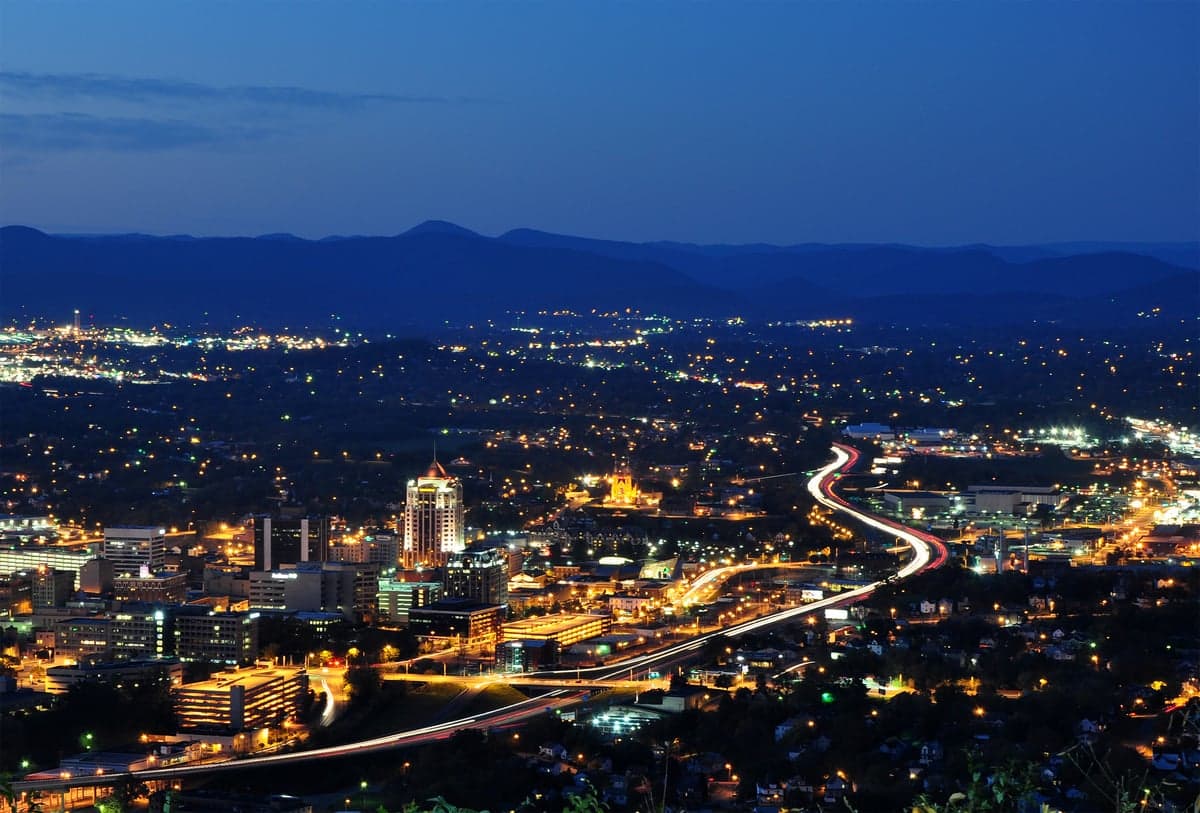
Photo: Wikipedia
Political ClimatePolitical Climate in Roanoke, VA
District shown is the primary district for this city’s centroid. Cities may span multiple districts.
Inherited from parent state — no local data available.
Local Political AnalysisPolitical Analysis of Roanoke, VA
Roanoke’s political climate has long been a quiet, conservative stronghold, but like many mid-sized Southern cities, it’s starting to feel the tug-of-war between traditional values and the progressive push coming out of Richmond and D.C. The city itself has a Cook PVI of R+12, which means it’s reliably Republican by a solid margin, but don’t let that number fool you into thinking it’s a monolith. The real story is how the city’s core is slowly shifting leftward, while the surrounding counties—especially Botetourt, Franklin, and Bedford—remain deeply red, creating a cultural and political divide that’s become more pronounced over the last decade.
How it compares
If you’re looking for a true contrast, just drive 45 minutes north to Blacksburg or Christiansburg, where the Virginia Tech influence pulls the area noticeably to the left. Roanoke, by comparison, still feels like the old Virginia—practical, hardworking, and skeptical of big government solutions. The city council has seen a few progressive wins in recent years, like zoning changes and diversity initiatives, but those moves have been met with pushback from long-time residents who remember when Roanoke was a manufacturing hub and didn’t have to worry about “equity audits.” The surrounding towns like Vinton and Salem are even more conservative, often voting 65-70% Republican in local races, which keeps the region’s overall character grounded in fiscal responsibility and Second Amendment rights.
What this means for residents
For folks who value personal freedoms and limited government, Roanoke is still a decent place to live, but you have to keep an eye on the city council meetings. The biggest red flag is the creeping influence of state-level policies from Richmond—things like gun control measures and energy mandates that don’t fit the local way of life. Property taxes have crept up as the city tries to fund new public art projects and bike lanes, while the real infrastructure needs (roads, schools, public safety) get pushed aside. That said, the county governments are still run by folks who understand that your paycheck and your privacy matter more than a climate action plan. If you’re moving here, stick to the county lines for a more predictable, less bureaucratic experience.
One thing that hasn’t changed is the cultural conservatism that runs deep here. Churches are still central to community life, and the local gun culture is strong—you’ll see “Come and Take It” stickers on trucks as often as you’ll see a farmer’s market. The biggest policy distinction is that Roanoke has resisted the kind of sanctuary city status you see in places like Charlottesville or Richmond, and the police department still works closely with ICE. That’s a big deal for folks who want law and order to mean something. Looking ahead, the concern is that as more remote workers from Northern Virginia and D.C. move in for the lower cost of living, they’ll bring their voting habits with them. For now, though, Roanoke remains a place where you can still have a conversation about freedom without being called a bigot—and that’s getting harder to find.

State Political ClimatePolitical Climate in Virginia
State Political AnalysisPolitical Environment in the State
Virginia is a purple state that has shifted from reliably red to a Democratic-leaning battleground over the past two decades, driven largely by explosive growth in the Washington, D.C. suburbs. The state voted for Joe Biden by 10 points in 2020, but in 2024 it tightened to a 5-point margin for Kamala Harris, signaling a potential rightward correction. The dominant coalition is a mix of progressive urban centers and moderate suburbanites, but the rural and exurban regions remain deeply conservative, creating a stark internal divide that defines every election cycle.
Urban vs. rural divide
The political map of Virginia is a tale of two states. The northern Virginia suburbs—Arlington, Alexandria, Fairfax, and Loudoun counties—are the engine of Democratic power, producing massive vote margins that offset the rest of the state. These areas are home to federal employees, tech workers, and a highly educated, diverse population that leans heavily progressive. The Richmond metro area, particularly Henrico County and the city of Richmond itself, adds another deep-blue anchor. On the flip side, the rural south and southwest—places like Roanoke, Lynchburg, and the Shenandoah Valley—vote overwhelmingly Republican. The Hampton Roads region around Norfolk and Virginia Beach is a true swing area, with military families and defense contractors creating a more mixed political environment. The key battlegrounds are the exurban counties like Prince William and Stafford, which have been trending blue but saw a slight red shift in 2024 as cost-of-living and school concerns drove some voters back to the GOP.
Policy environment
Virginia’s policy environment is a mixed bag that reflects its purple status. The state income tax is a flat 5.75%, which is moderate by national standards, but property taxes vary wildly—Loudoun County has some of the highest in the state, while Pittsylvania County in the south is much lower. The regulatory posture is generally business-friendly, but the past few years have seen a push toward progressive priorities. Under Governor Glenn Youngkin (R), the state enacted a 2023 budget that cut taxes by $1 billion, including a standard deduction increase and a partial repeal of the grocery tax. However, the Democratic-controlled Senate blocked his push for a full repeal of the car tax and a 12% income tax cut. On education, Youngkin’s “Parents Matter” agenda has been a flashpoint, with his administration pushing for more transparency in school curricula and stronger parental rights—a direct response to the progressive policies that took hold in Fairfax County Public Schools during the pandemic. Election laws are relatively stable: Virginia has no-excuse absentee voting and same-day registration, but voter ID is required. The state also has a Democratic trifecta in the legislature as of 2024, which has blocked Youngkin’s more conservative initiatives on abortion and gun rights.
Trajectory & freedom
Virginia’s trajectory on personal freedom is concerning for conservatives. The state has seen a clear erosion of Second Amendment rights: in 2020, the Democratic legislature passed a package of gun control laws including universal background checks, a “one handgun a month” limit, and a red flag law that allows temporary confiscation of firearms without a criminal conviction. Youngkin has been unable to roll these back due to the Democratic Senate. On medical freedom, the state’s response to COVID-19 was heavy-handed—Richmond and Arlington had some of the longest mask mandates and vaccine passport requirements in the country. Youngkin ended the state of emergency on his first day in office, but the underlying regulatory power remains. Parental rights have seen a mixed trajectory: Youngkin’s executive orders on transparency in school curricula have been implemented, but the Democratic legislature has blocked his efforts to ban critical race theory and restrict transgender policies in schools. Property rights are generally strong, but zoning battles in Loudoun County over data center expansion and affordable housing mandates have created friction. The bottom line: Virginia is becoming less free on gun rights and medical autonomy, but has seen a modest recovery on education and tax policy under Youngkin.
Civil unrest & political movements
Virginia has been a flashpoint for political movements on both sides. The 2017 “Unite the Right” rally in Charlottesville remains a defining moment, leading to a statewide backlash against Confederate monuments and a surge in progressive activism. That event galvanized the left and led to the Democratic sweep of the legislature in 2019. On the right, the “Parents Matter” movement has been particularly strong in Loudoun County, where school board meetings became battlegrounds over transgender policies and critical race theory. The 2021 gubernatorial election was largely a referendum on these issues, with Youngkin winning by tapping into suburban parent frustration. Immigration politics are less intense than in border states, but Prince William County has seen debates over sanctuary policies, with the board voting in 2023 to limit cooperation with ICE. Election integrity has been a persistent concern: Virginia uses Dominion voting machines, and the 2020 election saw no major irregularities, but the 2021 gubernatorial race was closely watched. The state has not seen the kind of widespread unrest seen in Portland or Seattle, but the political temperature is high, and new residents should expect a polarized environment, especially in the D.C. suburbs.
Projection
Over the next 5-10 years, Virginia is likely to remain purple but with a slight rightward tilt. The key demographic trend is the continued growth of the D.C. suburbs, which will keep the state competitive for Democrats. However, the 2024 results showed that even Loudoun County shifted right by 3 points, suggesting that the progressive wave may have peaked. In-migration from blue states like California and New York is slowing, and many new arrivals are fleeing high taxes and crime, which could benefit Republicans. The wild card is the 2025 gubernatorial election: if a Democrat wins, expect a push for a state-level version of the Green New Deal and expanded gun control. If a Republican wins, the focus will be on tax cuts, school choice, and parental rights. The state’s economic growth is strong, driven by defense spending, tech, and data centers, which will continue to attract a mix of conservative and liberal professionals. For a conservative moving in now, the realistic expectation is that Virginia will remain a battleground where your vote matters, but where you’ll need to be engaged at the local level to protect your freedoms.
For a new resident, the bottom line is that Virginia offers a high quality of life with strong job markets and good schools, but it requires constant vigilance on policy. If you’re moving to Roanoke or Lynchburg, you’ll find a conservative community with lower taxes and fewer regulations. If you’re heading to Fairfax or Arlington, be prepared for high property taxes, progressive school boards, and a political culture that may clash with your values. The state is not a lost cause, but it’s not a redoubt either—it’s a place where your voice and your vote truly matter, and where the fight for freedom is ongoing.
* Values derived from national, state, county, city and local statistics and may differ in a specific area. Last updated: 2026-05-02T05:03:55.000Z
Narrative content on this page is AI-generated and may contain mistakes. Verify any details that matter before acting on them.
ReloMaps may earn a commission from affiliate links at no extra cost to you.

