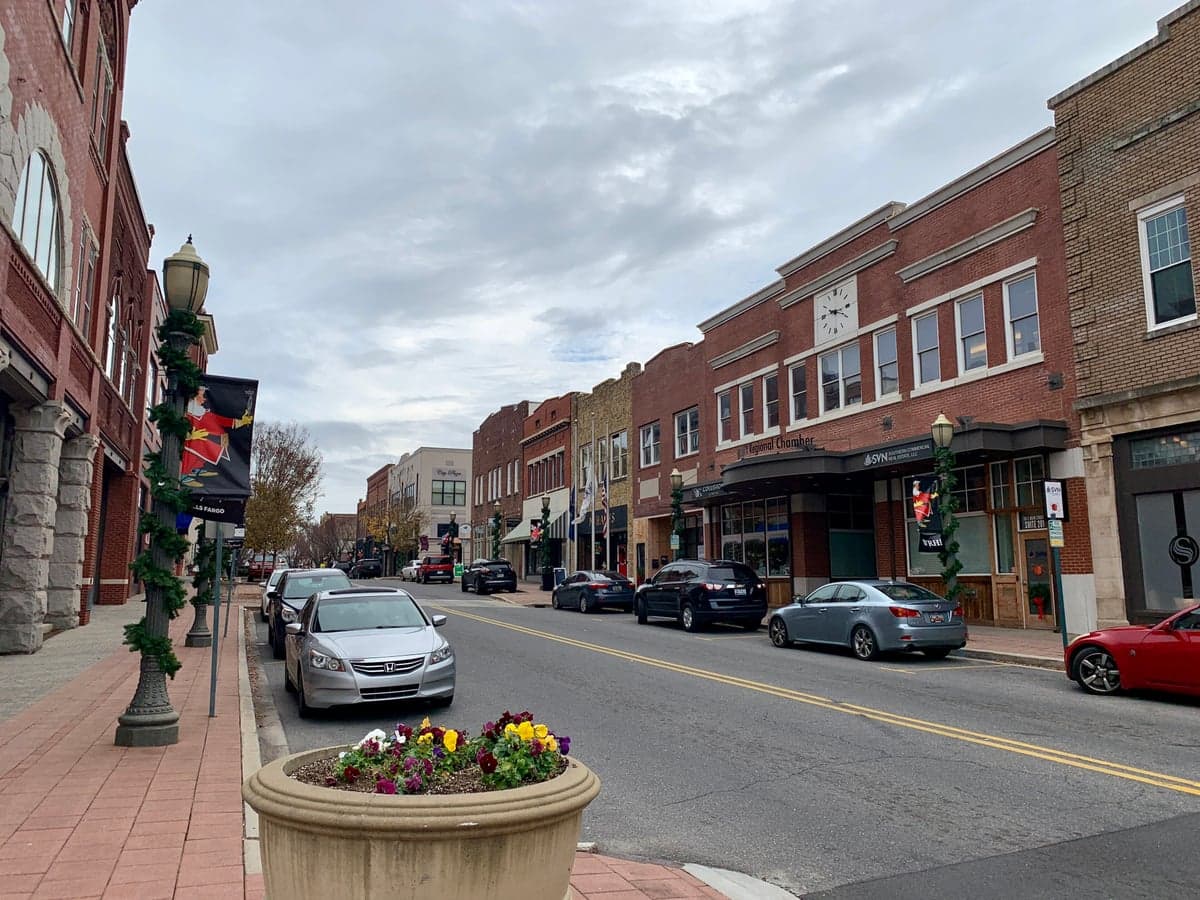
Photo: Wikipedia
Demographics of Rock Hill, SC
Affluence Level in Rock Hill, SC
A middle-class area roughly in line with national averages across income, home values, education, and employment.
People of Rock Hill, SC
The people of Rock Hill, South Carolina, today form a community of roughly 74,769 residents defined by a near-even racial split between White (49.5%) and Black (39.5%) populations, a small but growing Hispanic presence (5.7%), and a notably low foreign-born share of just 3.4%. The city carries a distinctive identity as a former textile mill town that has reinvented itself as a regional education and healthcare hub, with 34.5% of adults holding a college degree. Rock Hill’s population is denser and more diverse than surrounding York County, yet remains less ethnically varied than Charlotte, its larger neighbor 25 miles north. The city’s human history is a story of successive waves — Catawba land cession, Scots-Irish settlement, African American migration during Reconstruction, mill-town industrialization, and recent suburban in-migration from Charlotte — each leaving its mark on specific neighborhoods that still reflect those origins.
How the city was settled and grew
Rock Hill’s population history begins with the Catawba Nation, whose ancestral lands covered the area until treaties in the 1760s opened the region to European settlement. The first permanent non-Native settlers were Scots-Irish and English farmers who arrived in the late 1700s, drawn by fertile Piedmont soil and the promise of land grants. The community remained a small crossroads hamlet until the Charlotte and South Carolina Railroad arrived in 1852, transforming Rock Hill into a cotton-shipping depot. The real population surge came after the Civil War, when the city became a center for cotton textile manufacturing. Between 1880 and 1920, mills such as the Rock Hill Printing and Finishing Company drew thousands of rural White families from the surrounding countryside into mill villages — company-owned neighborhoods like Ebenezer and Fewell Park, where workers lived in rows of identical houses within walking distance of the mill gates. These neighborhoods remain predominantly White and working-class today. Simultaneously, African Americans who had been enslaved on area plantations moved into the city after emancipation, establishing distinct communities such as Friendship and Herald — historically Black neighborhoods centered around churches, schools, and small businesses. By 1900, Rock Hill’s population had reached roughly 5,000, with a Black share near 40% that has persisted remarkably consistently for over a century.
Modern era (post-1965)
The 1965 Immigration and Nationality Act had minimal direct impact on Rock Hill — the city’s foreign-born share remains just 3.4%, far below the national average of 13.7%. Instead, the post-1965 story is one of domestic migration and suburbanization. The decline of the textile industry in the 1970s and 1980s devastated the mill-village economy, leading to population stagnation and out-migration of younger workers. The turnaround began in the 1990s, as Charlotte’s explosive growth spilled south across the state line. Rock Hill positioned itself as a more affordable alternative, attracting White and Black middle-class families from Mecklenburg County. New subdivisions such as Waterford and Baxter Village — a traditional neighborhood development built from 2000 onward — drew college-educated professionals, many commuting to Charlotte. The Hispanic population, though small at 5.7%, grew from near zero in 1990, concentrated in rental apartments and older neighborhoods like Cherry Park, where immigrant-owned restaurants and tiendas have appeared. East/Southeast Asian residents (1.6%) and Indian-subcontinent residents (0.4%) are a recent, thin presence, mostly professionals employed by the city’s three hospitals or at York Technical College. The Black population, at 39.5%, remains heavily concentrated in the historic neighborhoods of Friendship and Herald, though middle-class Black families have also moved into newer subdivisions like Waterford. The city’s overall racial geography shows moderate integration in newer developments but persistent segregation in older neighborhoods — a pattern common across Southern mill towns.
The future
Rock Hill’s population is heading toward modest diversification, but the pace is slow. The foreign-born share, at 3.4%, is unlikely to rise dramatically given the city’s lack of a large immigrant-employing industry and its distance from traditional gateway cities. The Hispanic share (5.7%) is growing steadily through natural increase and some migration from Charlotte, but remains below the South Carolina average of 6.9%. The Black share (39.5%) has been stable for decades and is likely to remain so, as the city attracts both Black and White in-migrants from Charlotte at similar rates. The White share (49.5%) is declining slowly, not from out-migration but from the growing Hispanic and multiracial populations. The most significant demographic trend is educational sorting: the 34.5% college-educated share is concentrated in Baxter Village and newer subdivisions, while older mill villages like Ebenezer and Fewell Park have lower educational attainment and higher poverty rates. This is creating a de facto class divide that may deepen as Rock Hill continues to attract Charlotte commuters while its native-born working class ages in place. The city is not tribalizing into ethnic enclaves — no single group dominates any neighborhood above 80% — but it is stratifying by education and income.
For someone moving to Rock Hill now, the city offers a stable, moderately diverse community with a clear Black-White demographic core and a small but growing Hispanic presence. The low foreign-born share means English is the near-universal language, and the city’s political culture reflects its Southern Baptist and mill-town roots — conservative on social issues, pragmatic on economic development. The population is not homogenizing; instead, it is slowly becoming more educated and more suburban, with the historic mill neighborhoods and the new commuter subdivisions growing apart in lifestyle and outlook. Rock Hill is becoming a place where the old textile-working class and the new professional class coexist but do not necessarily mix — a reality any prospective resident should understand before choosing a neighborhood.

* Values derived from national, state, county, city and local statistics and may differ in a specific area. Last updated: 2026-04-30T07:57:45.000Z
Narrative content on this page is AI-generated and may contain mistakes. Verify any details that matter before acting on them.
ReloMaps may earn a commission from affiliate links at no extra cost to you.

