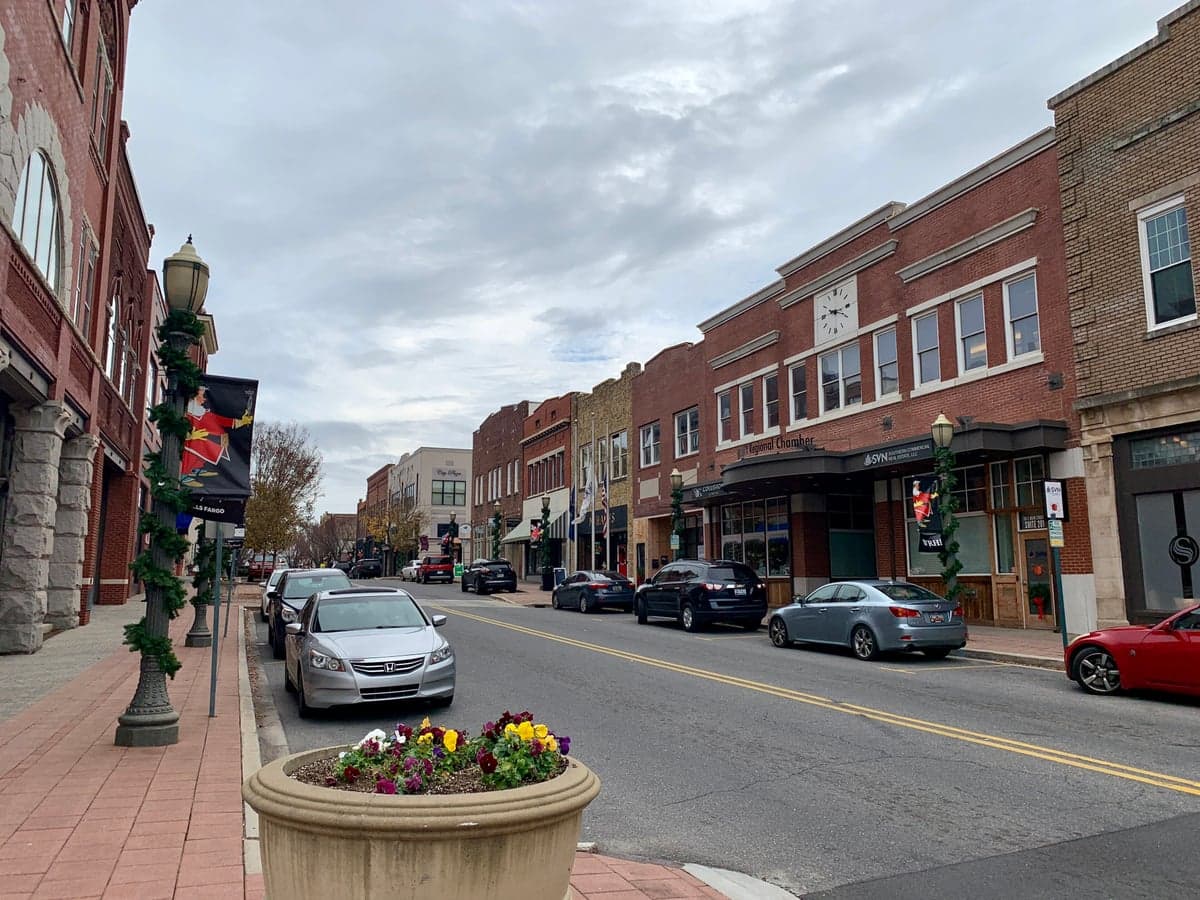
Photo: Wikipedia
Personal Sovereignty in Rock Hill, SC
Viable for self-reliance. Generally workable, though some barriers may limit total independence.
What does Personal Sovereignty tell us?
Personal Sovereignty measures your capacity for self-reliance and independence with minimal government friction. Higher scores mean fewer barriers between you and the way you want to live... but it assumes you have the space you need and good neighbors.
What does this tell us?
Personal Sovereignty measures your capacity for self-reliance and independence with minimal government friction. Higher scores mean fewer barriers between you and the way you want to live... but it assumes you have the space you need and good neighbors.
State Policy
Energy independence: Importer (25% of energy produced in-state)
Personal Liberty
Homesteading

Personal Liberty Analysis
Rock Hill, South Carolina, offers a notably high degree of personal sovereignty compared to much of the Eastern Seaboard, largely due to South Carolina’s status as a Dillon’s Rule state with a strong tradition of local control and a state government that has consistently pushed back against federal overreach. For the strategic relocator—whether a single individual or a parent—this translates into a legal and cultural environment where the default assumption leans toward individual liberty rather than government permission. The city’s proximity to Charlotte (just 25 miles north) provides economic opportunity without the regulatory and tax burdens of North Carolina’s Mecklenburg County, making Rock Hill a practical base for those who want to opt out of the denser, more restrictive governance models found in many urban centers. This analysis examines the specific pillars of autonomy that matter most to those prioritizing self-reliance and minimal state interference.
Tax burden and regulatory posture: How South Carolina’s fiscal policies protect your income and property
South Carolina’s tax structure is a clear advantage for anyone seeking to keep more of what they earn. The state levies a flat income tax rate of 6.2% (as of 2025, with scheduled reductions toward a flat 3.99% by 2026), and there is no state-level tax on Social Security benefits. Property taxes in York County, where Rock Hill sits, are among the lowest in the region, with an effective rate around 0.55% of assessed value—roughly half of what you’d pay in Charlotte’s Mecklenburg County. The regulatory posture is equally favorable: South Carolina is a right-to-work state, meaning you cannot be forced to join a union as a condition of employment, and occupational licensing requirements are less burdensome than in many Northeastern states. For a prepper or survivalist, this means fewer layers of bureaucracy when starting a home-based business, operating a small farm, or engaging in trades like welding or firearms repair. The state’s business climate is consistently ranked in the top 10 nationally by the Tax Foundation, and local zoning in Rock Hill’s outlying areas (especially west of I-77) remains relatively permissive for light industrial and agricultural uses.
Self-defense and gun law specifics: Stand Your Ground, constitutional carry, and what it means for daily life
South Carolina is a constitutional carry state as of 2024, meaning no permit is required to openly or concealed carry a firearm for any law-abiding adult 18 or older. This is a foundational liberty for those who view self-defense as a non-negotiable right. The state also has a strong Stand Your Ground statute (codified in S.C. Code § 16-11-440), which removes any duty to retreat before using deadly force if you are lawfully present and reasonably believe force is necessary to prevent death, great bodily harm, or a violent felony. Castle Doctrine protections extend to your vehicle and place of business, not just your home. Rock Hill itself is in York County, which has a generally pro-2A sheriff’s office and no local ordinances that preempt state law—meaning no extra waiting periods, no magazine capacity bans, and no “assault weapon” restrictions. For parents, this also means you can legally teach your children firearm safety and marksmanship on your own property without special permits. The only notable restriction is a 24-hour waiting period for handgun purchases from a licensed dealer (but not private sales), and the state does not require registration of any firearm. For those concerned about government overreach, South Carolina’s Second Amendment Preservation Act (passed in 2021) explicitly prohibits state resources from being used to enforce any future federal gun bans or confiscation orders.
Self-reliance and homesteading viability: Lot sizes, zoning, and off-grid feasibility in Rock Hill’s periphery
Rock Hill’s zoning code offers a realistic path to self-sufficiency, especially if you look beyond the suburban subdivisions near the city core. In the county’s unincorporated areas (which are just a 10-15 minute drive from downtown), minimum lot sizes for single-family homes are typically 1 to 3 acres in the Rural Residential (RR) district, and agricultural zoning allows parcels as small as 5 acres for active farming. The city itself has a “Urban Agriculture” ordinance that permits backyard chickens, beekeeping, and small-scale vegetable production on lots as small as 0.25 acres, though livestock like goats or pigs require a minimum of 2 acres and a permit. Off-grid feasibility is moderate: South Carolina has no state-level ban on rainwater collection, and York County does not require a building permit for solar panels on existing structures (though grid-tied systems require utility approval). However, the county does enforce the International Residential Code for new construction, which means composting toilets and greywater systems must meet specific health department standards—not impossible, but requiring some paperwork. The real advantage is water: the Catawba River basin provides abundant groundwater, and well drilling is permitted on parcels of 1 acre or more with a simple permit from DHEC. For a prepper, the combination of affordable land (still under $15,000 per acre in many rural tracts), permissive animal ordinances, and access to surface water makes Rock Hill’s fringe areas a viable base for a self-reliant lifestyle.
Personal liberties: Parental rights, medical autonomy, free speech, and property rights in practice
South Carolina has been a battleground for parental rights, and the current legal landscape strongly favors family autonomy. The state’s Parental Bill of Rights (enacted in 2023) explicitly affirms that parents have the fundamental right to direct the upbringing, education, and healthcare of their children, including the right to opt out of any school curriculum or activity without penalty. This means no mandatory “social-emotional learning” programs or gender ideology instruction without parental consent—a critical factor for conservative parents. Medical autonomy is more mixed: South Carolina does not have a state-level vaccine mandate for adults, but certain healthcare workers and schoolchildren are still subject to standard immunization requirements (with religious and medical exemptions available). The state passed a law in 2023 banning gender transition procedures for minors, which aligns with the values of many in this audience. Free speech protections are robust, with no state-level “hate speech” laws that could criminalize political or religious expression. Property rights are similarly strong: South Carolina is a “property rights” state under the Private Property Protection Act, meaning any regulation that reduces a property’s value by more than 20% triggers a right to compensation. This makes it harder for local governments to impose restrictive zoning or environmental regulations without paying landowners. For the survivalist, this legal framework means you can build a bunker, store supplies, and homeschool your children without fear of state intervention—provided you stay within basic building codes and health regulations.
Overall, Rock Hill offers a level of personal sovereignty that is rare in the Southeast’s growing metro areas. While you won’t find the extreme libertarian legal environment of, say, rural Idaho or Alaska, the combination of constitutional carry, low taxes, permissive zoning on the city’s fringe, and strong parental rights creates a practical middle ground for those who want urban access without urban governance. The key trade-off is proximity to Charlotte: the closer you are to I-77, the more you’ll encounter suburban HOA restrictions and higher land prices. But if you’re willing to drive 15 minutes west of downtown, you can find 2-acre lots with no HOA, a well, and a clear view of the stars—all while being 30 minutes from a major airport. For the strategic relocator who values autonomy over convenience, Rock Hill’s legal and cultural posture is a solid B+ in a country where most metro areas are trending toward a C-.

* Values derived from national, state, county, city and local statistics and may differ in a specific area. Last updated: 2026-04-30T07:57:45.000Z
Narrative content on this page is AI-generated and may contain mistakes. Verify any details that matter before acting on them.
ReloMaps may earn a commission from affiliate links at no extra cost to you.

