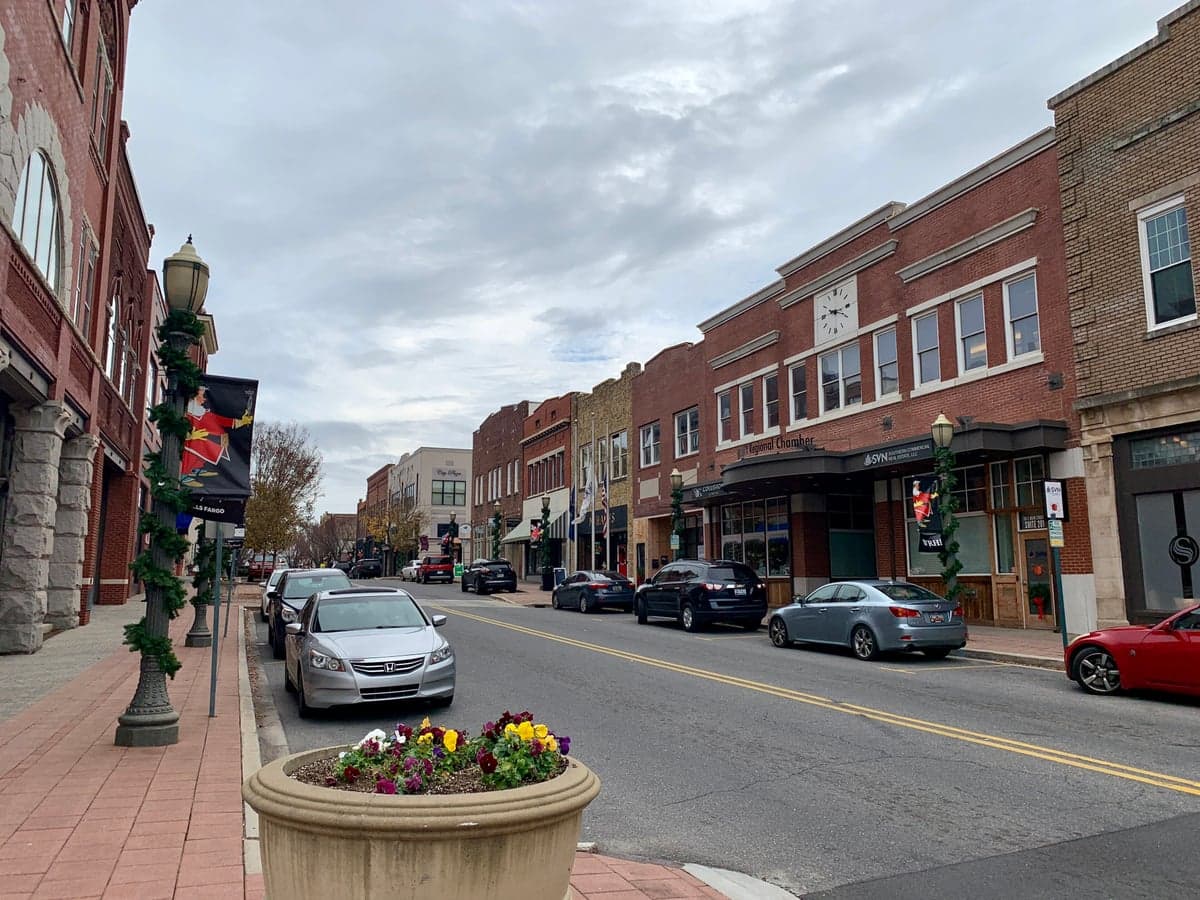
Photo: Wikipedia
Strategic Assessment of Rock Hill, SC
Multiple tactical vulnerabilities. Population density, target proximity, or disaster risk are likely compounding. A retreat property and exit planning is required.
What does the Strategic Assessment tell us?
Our Strategic Assessment grades tactical survivability of an area. Major population centers, military targets, fallout zones, natural disasters, and border exposure all drive risk — lower exposure means a more defensible position in a crisis.
This is heavily inspired by Joel Skousen's Strategic Relocation book. Highly recommended you checkout the book ($)What does this tell us?
Our Strategic Assessment grades tactical survivability of an area. Major population centers, military targets, fallout zones, natural disasters, and border exposure all drive risk — lower exposure means a more defensible position in a crisis.
This is heavily inspired by Joel Skousen's Strategic Relocation book. Highly recommended you checkout the book ($)Strategic Pillars

Key Distances
Regional Safe Places
Below is our recommended "safe zones" in South Carolina and the surrounding area based on our strategic heuristics. For most people, it's unrealistic to live in a “safe zone” full-time due to work, family or other personal reasons. They tend to be more rural. However, many of these areas are perfect for second homes and retreat properties that double as a vacation home or even a short-term rental.
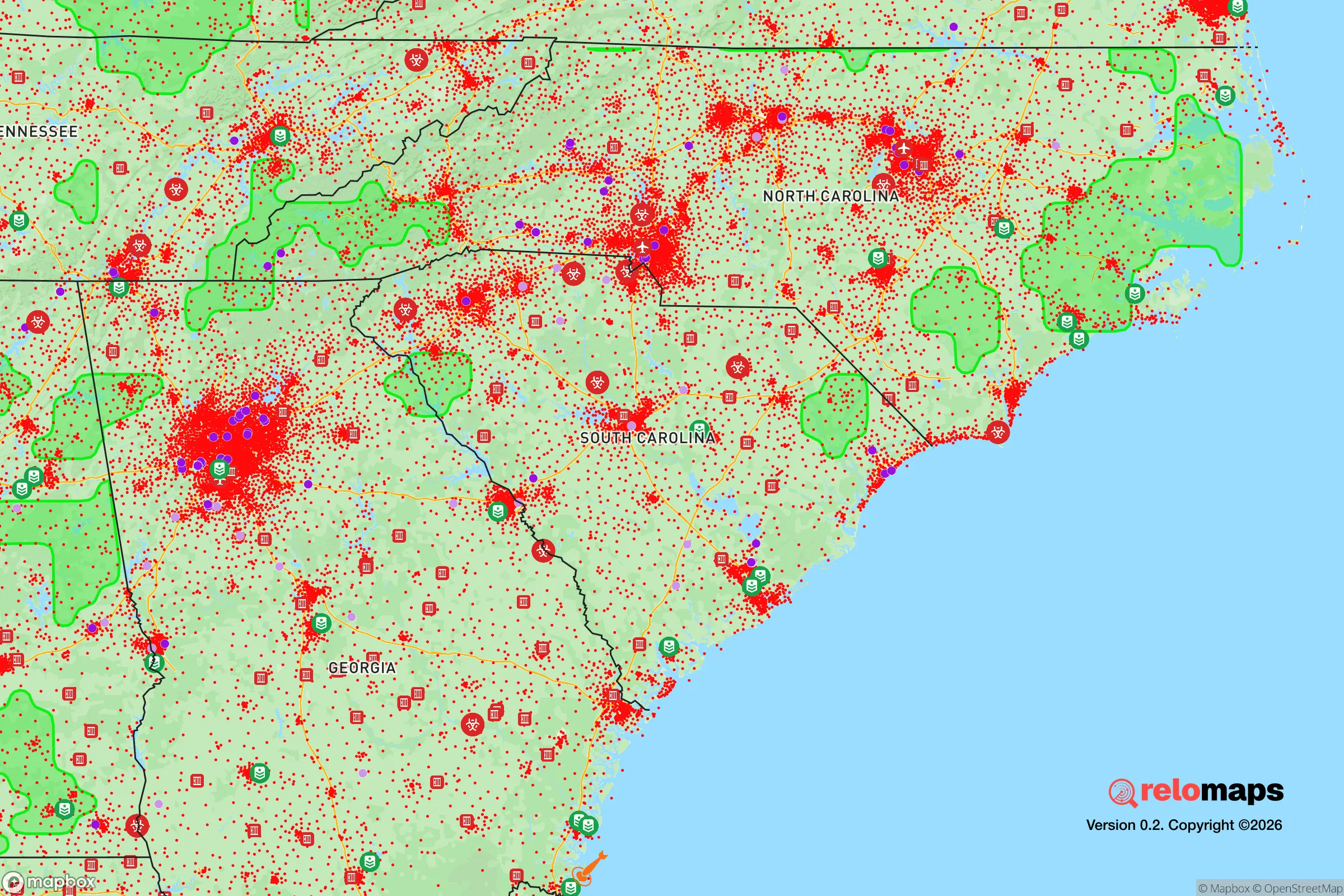
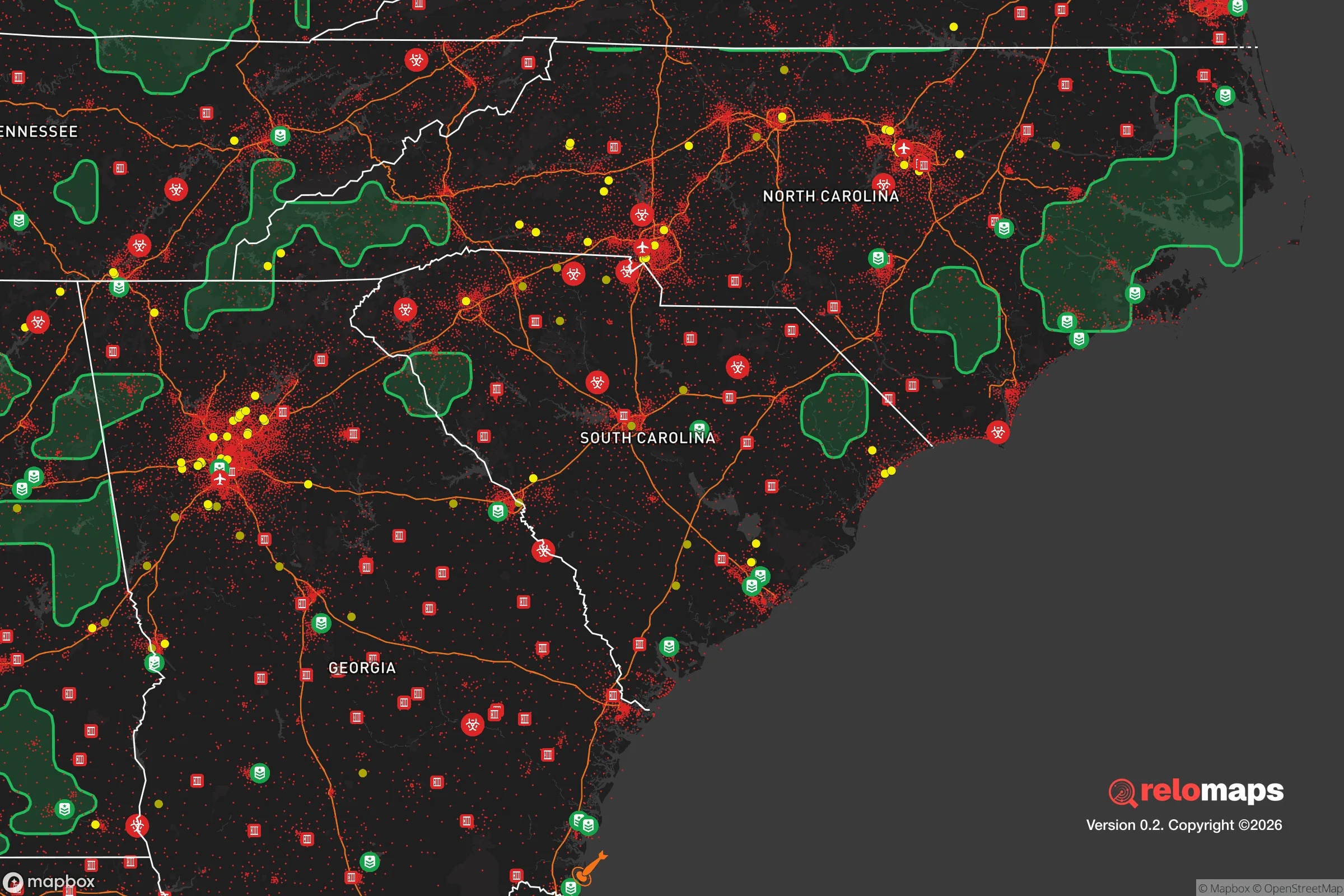


Important Note: For informational purposes only. This does not mean nothing bad ever happens in the green zones. Please use common sense. This is based on public data and modeled with AI. We tried to take a conservative approach but mistakes happen. We update this regularly as new information becomes available.
Solar Generator Recommendations
Backup power matters more here than in safer locations. We've picked three solar generators across budgets and capacity tiers — start with the budget unit if you only need a few essentials, or step up if you want to run a fridge and HVAC for days at a time.

Jackery Portable Power Station Explorer 300
Budget OptionPower on the Go: Weighing only 11 lbs, it's convenient to set up and store with book-sized foldable solar panels

BLUETTI Portable Power Station AC180
Designed for both indoor and outdoor scenarios, AC180 is highly capable as it has a robost capacity and continuous output power.

EF ECOFLOW DELTA Pro Ultra Power Station
Upgraded PickEcoFlow DELTA Pro Ultra is a whole-home energy system designed to grow with your family. Integrated with the Smart Home Panel 2, it scales to meet your evolving energy needs — keeping your home powered, intelligent, and secure through every stage of life.
We earn a commission, at no additional cost to you.
Strategic Assessment Analysis
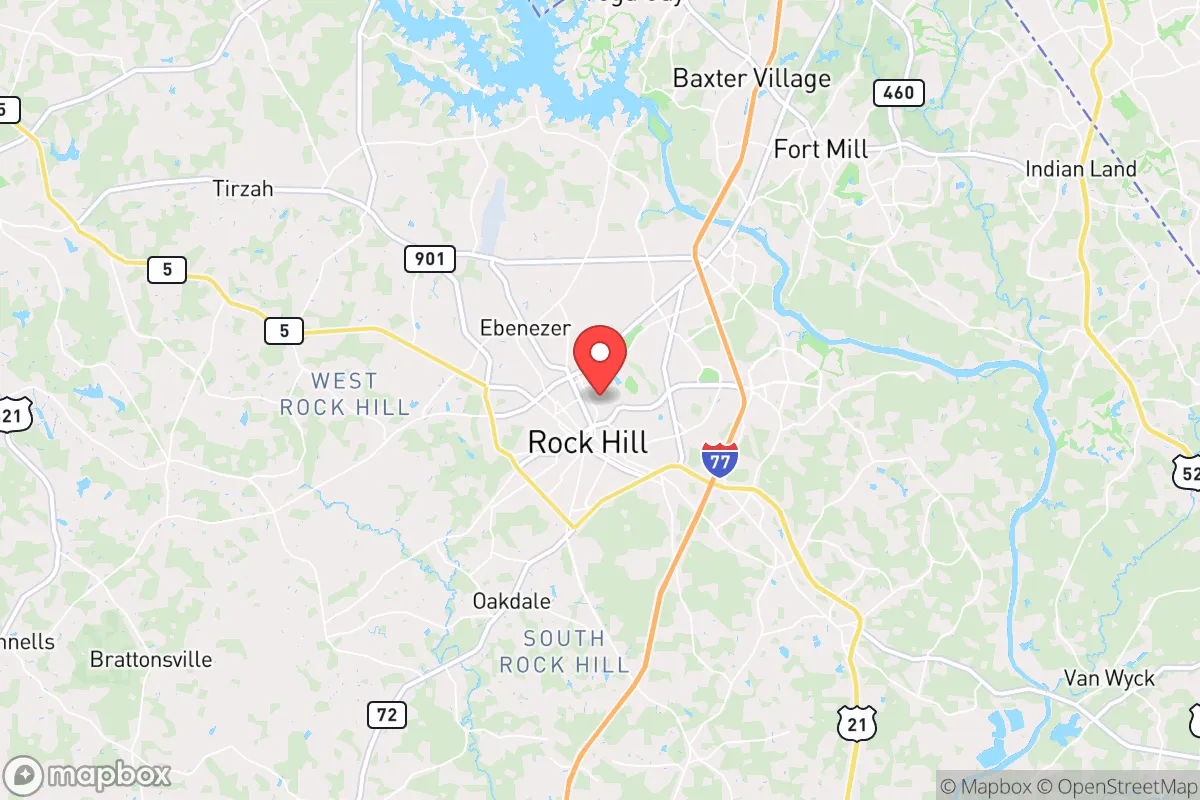
Rock Hill, South Carolina, occupies a strategic position that balances proximity to major economic corridors with a degree of geographic insulation that appeals to those prioritizing resilience. Located roughly 25 miles south of Charlotte, North Carolina, and 70 miles north of Columbia, the city sits in a zone that benefits from regional infrastructure without being directly exposed to the worst-case scenarios of a major metropolitan collapse. The area's topography—rolling Piedmont hills, clay soils, and a network of creeks and rivers—offers natural advantages for water sourcing and defensible terrain, while its position along the I-77 corridor provides a viable evacuation route toward the less-dense coastal plains or the Appalachian foothills. For a relocator thinking in terms of long-term stability, Rock Hill presents a credible middle-ground option: close enough to urban resources to be practical, far enough to avoid the immediate blast radius of a major event.
Geographic position and natural advantages for long-term stability
Rock Hill's location in the Piedmont region places it on a geological foundation of ancient, hard rock that is less prone to seismic activity than areas further west, and its elevation—around 650 feet above sea level—keeps it above the flood-prone zones of the coastal plain. The Catawba River, which flows along the city's western edge, is a reliable surface water source, and the area's average annual rainfall of 45 inches supports both groundwater recharge and small-scale agriculture. The surrounding landscape is a mix of forested hills and open farmland, offering natural cover and multiple potential retreat points within a 30-minute drive. Unlike the flat, exposed terrain of the Lowcountry, the Piedmont's rolling hills create natural chokepoints and observation positions, which could be tactically advantageous in a prolonged disruption scenario. The climate is temperate, with mild winters and hot summers, reducing the risk of extreme weather events that plague other regions—hurricanes rarely reach this far inland with full force, and tornado activity is below the national average.
Risks, exposures, and proximity to fallout-relevant landmarks
The most significant vulnerability for Rock Hill is its proximity to Charlotte, a major financial hub and transportation nexus that includes Charlotte Douglas International Airport, a regional FedEx hub, and multiple rail lines. In a scenario involving civil unrest, a mass casualty event, or a coordinated attack, Charlotte would be a high-probability target, and the resulting chaos could spill south along I-77 within hours. Rock Hill is also within 100 miles of the Savannah River Site, a nuclear weapons facility and waste storage complex near Aiken, SC, which represents a low-probability but high-consequence hazard in the event of a security breach or accident. The city itself has no major military installations, but the nearby Charlotte Air National Guard Base and Fort Jackson (Columbia) could become staging areas for federal responses, potentially drawing unwanted attention. On the positive side, Rock Hill's industrial base—including a large 3M plant and a Continental Tire facility—is not a primary target for most threat scenarios, and the city's lack of a major port or refinery reduces its strategic value to adversaries. The local power grid is served by Duke Energy, which has a mixed reliability record, but the area's tree canopy and aging infrastructure mean that ice storms and summer thunderstorms can cause localized outages lasting 24–48 hours.
Practical resilience for a relocator: food, water, energy, and defensibility
For a relocator focused on self-sufficiency, Rock Hill offers a workable baseline but requires deliberate preparation. The Catawba River is the primary surface water source, but access points are limited by private property and park regulations; a well-permitting process exists through York County, and groundwater depths typically range from 50 to 150 feet, with yields adequate for a household. The local soil is clay-heavy, which means drainage is poor for conventional gardening, but raised beds and contour farming can mitigate this—many residents in the surrounding rural areas maintain small vegetable plots and chicken coops. The city's zoning code allows for backyard livestock in most residential zones with lot size restrictions, and the county's agricultural extension office offers resources for small-scale food production. For energy, solar panel installations are permitted without excessive bureaucracy, and the area receives an average of 218 sunny days per year, making photovoltaic systems viable with battery backup. Natural gas is available in most subdivisions, but a propane tank setup is a more resilient alternative for cooking and heating. Defensibility is moderate: the city's layout is a mix of suburban sprawl and older neighborhoods with narrow streets, which can be barricaded or monitored, but the lack of natural barriers like mountains or large water bodies means that a determined group could approach from multiple directions. The local law enforcement presence is adequate for routine matters, but the Rock Hill Police Department has roughly 1.5 officers per 1,000 residents—below the national average—so in a prolonged crisis, residents would need to rely on mutual aid networks and personal preparedness. The gun culture in South Carolina is robust, with constitutional carry in effect since 2021, and there are multiple local ranges and training facilities within a 20-minute drive.
The overall strategic picture for Rock Hill is one of calculated trade-offs. It is not a remote bunker location, nor is it a high-risk urban core—it sits in a gray zone that rewards preparation and community building. The city's growth rate of roughly 2% annually since 2020 has brought new infrastructure and amenities, but also increased traffic and housing costs, which could strain resources in a crisis. For a conservative-leaning individual or family who values proximity to work and education but wants a buffer from the worst-case scenarios of a major city, Rock Hill offers a viable middle path. The key is to treat it as a base of operations rather than a final redoubt: establish a well-stocked home, build relationships with like-minded neighbors, and maintain a secondary retreat option further into the rural Piedmont or the mountains. The area's strengths—water access, moderate climate, and a politically aligned local culture—outweigh its vulnerabilities, provided the relocator does not become complacent about the risks that come with living near a major metropolitan area. In a world where the state of the country and the world feels increasingly fragile, Rock Hill is a place where you can live a normal life while keeping one eye on the horizon.

* Values derived from national, state, county, city and local statistics and may differ in a specific area. Last updated: 2026-04-30T07:57:45.000Z
Narrative content on this page is AI-generated and may contain mistakes. Verify any details that matter before acting on them.
ReloMaps may earn a commission from affiliate links at no extra cost to you.

