Photo: Wikipedia
Demographics of Rockland, ME
Affluence Level in Rockland, ME
A middle-class area roughly in line with national averages across income, home values, education, and employment.
People of Rockland, ME
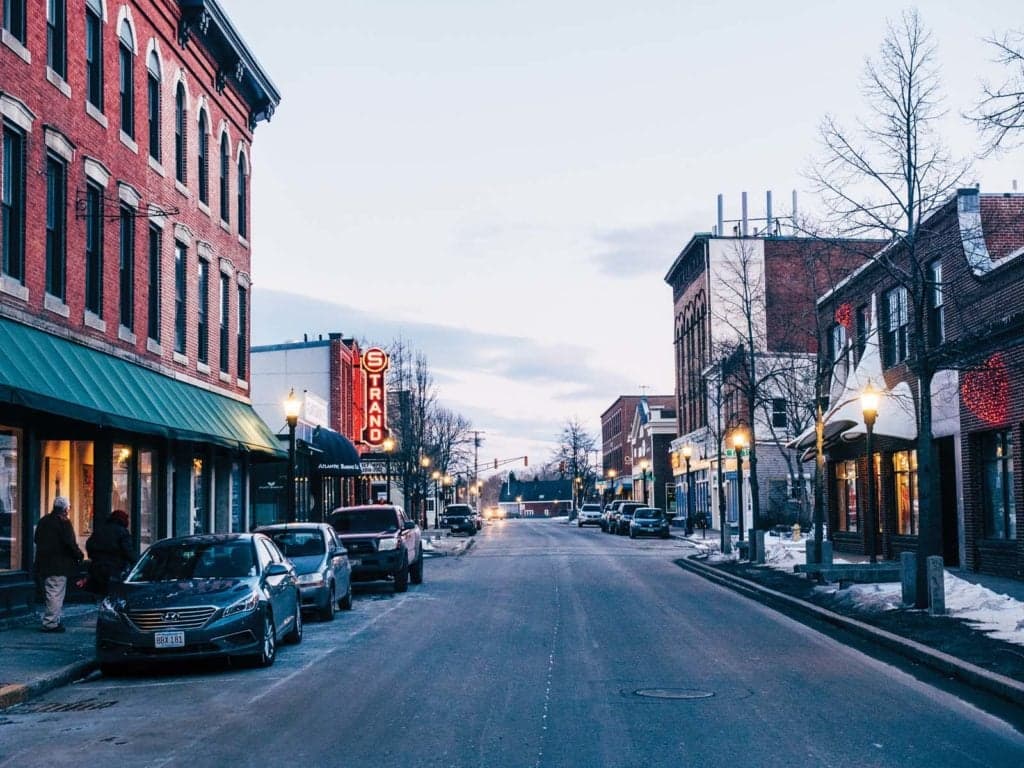
The people of Rockland, Maine, today number 6,991, forming a tight-knit, predominantly white community with a distinctive working waterfront character. With 96.5% of residents identifying as white and only 0.8% foreign-born, Rockland remains one of the most ethnically homogeneous small cities in New England, a direct legacy of its 19th-century industrial origins. The city’s identity is shaped by a blend of old fishing families, retired professionals, and a growing creative class drawn by the Farnsworth Art Museum and the Maine Lobster Festival, giving it a slightly more educated profile than surrounding towns—35.6% of adults hold a college degree.
How the city was settled and grew
Rockland’s population story begins with the Wabanaki people, who used the sheltered harbor for seasonal fishing and clamming long before European contact. Permanent European settlement began in the 1760s, when English and Scottish families from Massachusetts and New Hampshire received land grants in what was then part of Thomaston. The city’s explosive growth came after 1850, driven by the lime industry—the region’s limestone deposits created a booming quarry and kiln economy that drew waves of Irish immigrants, followed by smaller numbers of French Canadians and Germans. These workers settled in distinct neighborhoods: the South End became the Irish quarter, with dense tenements and boarding houses near the harbor, while Lime Kiln Hill (the area around today’s Main Street and Park Street) housed the quarry laborers and their families. By 1900, Rockland’s population had swelled to over 8,000, making it the largest city in Knox County. The decline of the lime industry after World War I, combined with the rise of sardine canning and shipbuilding, shifted the population toward the North End and Broadway corridor, where newer housing stock attracted second- and third-generation families moving up from the crowded South End.
Modern era (post-1965)
The 1965 Hart-Cellar Act had virtually no effect on Rockland’s demographics—the city’s foreign-born population has never exceeded 2% in any census since 1970. Instead, the major population shift after 1965 was domestic: the collapse of the sardine industry in the 1980s and 1990s triggered an out-migration of working-age families, reducing the population from 9,900 in 1970 to 7,300 by 2000. Those who remained were disproportionately older, with the median age rising from 32 in 1970 to 44 by 2020. The East Side (east of Main Street, toward the breakwater) saw an influx of out-of-state retirees and second-home buyers from Massachusetts and New York, drawn by waterfront property and the arts scene. Meanwhile, the South End continued its long decline, with many of its historic Irish-American families moving to the West Side (west of Rankin Street) or out of the city entirely. The city’s Black population, never more than 0.3% since 1965, remains concentrated in scattered single-family homes rather than any identifiable neighborhood. The Hispanic population, at 0.8%, is almost entirely Mexican-origin workers employed in the lobster processing plants along the waterfront, living primarily in rental units near the Harbor District.
The future
Rockland’s population is projected to remain stable or decline slightly over the next decade, with the Maine State Planning Office forecasting a 1-2% drop by 2035. The city is not homogenizing—it is already maximally homogeneous—but it is tribalizing along age and income lines. The East Side and Broadway corridor are becoming enclaves of affluent retirees and remote workers, while the South End and West Side retain a mix of working-class families and younger locals priced out of the waterfront. The immigrant communities are not growing: the foreign-born share has been flat at 0.8% for two decades, and no new refugee or asylum-seeker resettlement programs are active in Knox County. The most significant demographic trend is the aging of the native-born population—nearly 30% of residents are over 65—which will likely accelerate as younger adults continue to leave for Portland or Boston for employment. The East/Southeast Asian population remains at 0.0%, and the Indian-subcontinent population at 0.0%, with no signs of change.
For someone moving to Rockland now, the city offers a stable, culturally cohesive community with a strong sense of place, but it is not a place of demographic dynamism or diversity. The population is aging, the economy is heavily seasonal, and the housing market is increasingly tilted toward wealthier newcomers. New residents will find a city that values its maritime heritage and small-town character, but should expect limited ethnic diversity and a population that skews older and whiter than the national average.

* Values derived from national, state, county, city and local statistics and may differ in a specific area. Last updated: 2026-05-01T16:57:17.000Z
Narrative content on this page is AI-generated and may contain mistakes. Verify any details that matter before acting on them.
ReloMaps may earn a commission from affiliate links at no extra cost to you.

