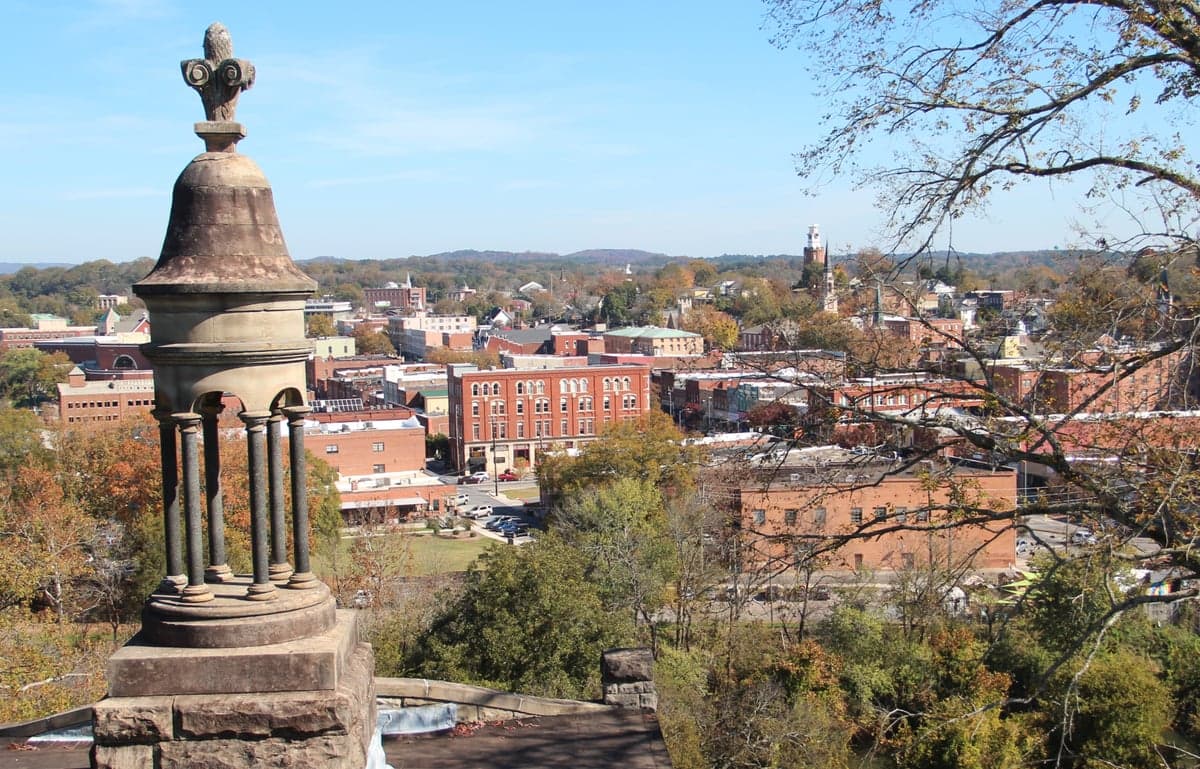
Photo: Wikipedia
Demographics of Rome, GA
Affluence Level in Rome, GA
A middle-class area roughly in line with national averages across income, home values, education, and employment.
People of Rome, GA
The people of Rome, Georgia today form a tri-ethnic plurality city of 37,754, where no single racial or ethnic group holds a majority. White residents make up 48.9% of the population, Black residents 24.4%, and Hispanic residents 20.3%, creating a demographic profile that is distinctly Southern yet increasingly diverse. The city is also home to a small but growing East/Southeast Asian community (1.3%) and an Indian-subcontinent population (0.5%), with 7.4% of residents foreign-born. This is a working-to-middle-class city with a 28.5% college-educated rate, where historic neighborhoods still reflect the settlement patterns of the 19th and 20th centuries.
How the city was settled and grew
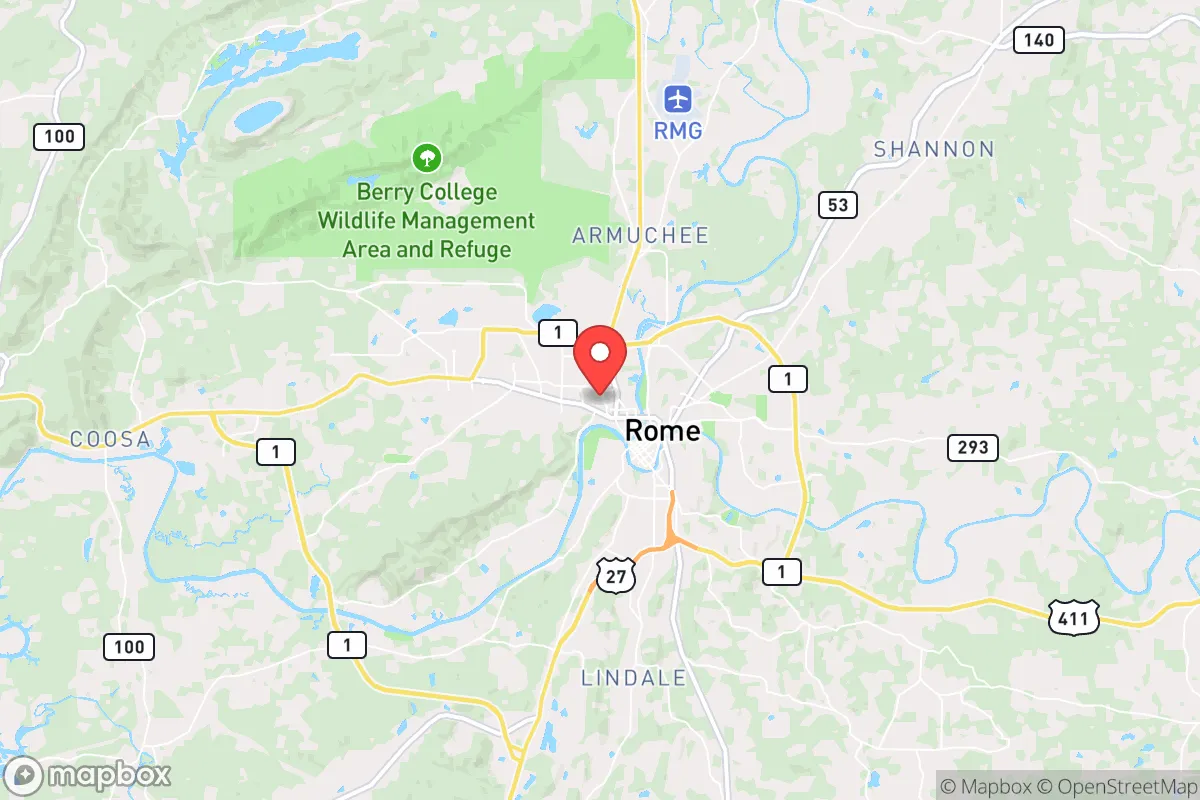
Rome was founded in 1834 at the confluence of the Etowah and Oostanaula rivers, a location chosen for its navigable waterways and fertile valley. The original white settlers were primarily yeoman farmers and merchants from the Upper South—Virginia, North Carolina, and Tennessee—who arrived via the Federal Road and later the railroad. By the 1840s, Rome had become a regional cotton market, and enslaved Black laborers formed the backbone of the plantation economy. After the Civil War, freedmen established the East Rome neighborhood, a historically Black district that remains a cultural anchor today, with institutions like the historic Chubb Chapel United Methodist Church. The post-Reconstruction era brought a wave of Italian and Irish immigrants who worked on the railroads and in the textile mills, settling in the South Rome and North Rome mill villages. The early 20th century saw the rise of the textile industry, with companies like the Rome Hosiery Mills drawing rural white families from North Georgia and Appalachia into neighborhoods such as Lindale (now part of Rome’s city limits) and Garden Lakes, a planned mill village built in the 1920s. By 1950, Rome was a majority-white, heavily Protestant city of roughly 30,000, with a significant Black minority concentrated in East Rome and the South Rome corridor.
Modern era (post-1965)
The 1965 Hart-Cellar Act had a modest direct effect on Rome, as the city did not become a major immigrant gateway. However, the broader shift in U.S. immigration policy, combined with the decline of the textile industry in the 1970s and 1980s, reshaped the population. White flight to unincorporated Floyd County and the Mount Berry area (home to Berry College) accelerated after school desegregation, leaving the city core more diverse. The most significant post-1965 change has been the growth of the Hispanic population, which rose from negligible in 1980 to over 20% today. This wave began in the 1990s, driven by construction, poultry processing, and landscaping jobs. Mexican and Central American immigrants settled primarily in East Rome and the South Rome neighborhoods near the old mill housing, where affordable rents and existing minority communities provided a foothold. The Black population, which was roughly 30% in 1970, has declined slightly to 24.4% as some middle-class families moved to newer subdivisions in West Rome and the Coosa Valley area. The East/Southeast Asian community (1.3%) is small but visible, concentrated among professionals at Floyd Medical Center and Georgia Highlands College, with no single ethnic enclave. The Indian-subcontinent population (0.5%) is even smaller, largely tied to the medical and academic sectors.
The future
Rome’s population is trending toward a tri-ethnic equilibrium, with the Hispanic share continuing to grow slowly through both immigration and natural increase. The white share is declining gradually, while the Black share is stabilizing. The city is not homogenizing into a single melting pot; rather, distinct residential patterns persist. East Rome remains the most diverse and affordable area, while West Rome and the Mount Berry corridor are whiter and more affluent. The foreign-born share (7.4%) is likely to rise modestly as the city attracts more healthcare and manufacturing workers, but Rome is not on track to become a major immigrant hub. The college-educated rate (28.5%) is below the national average but is rising as Berry College and Georgia Highlands College draw younger, more educated residents. Over the next 10-20 years, Rome will likely become slightly more Hispanic, slightly less white, and remain a predominantly native-born, working-class city with a stable Black community and small but growing Asian and Indian populations.
For someone moving to Rome now, the city offers a genuinely diverse Southern environment where no single group dominates, but where historic neighborhood boundaries still shape daily life. The population is stable, not booming, and the cultural character is rooted in the textile-mill and agricultural past, overlaid with a growing Hispanic presence. This is a place where community identity is local and neighborhood-based, not a homogenized suburb.

* Values derived from national, state, county, city and local statistics and may differ in a specific area. Last updated: 2026-04-30T01:13:12.000Z
Narrative content on this page is AI-generated and may contain mistakes. Verify any details that matter before acting on them.
ReloMaps may earn a commission from affiliate links at no extra cost to you.

