
Photo: Wikipedia
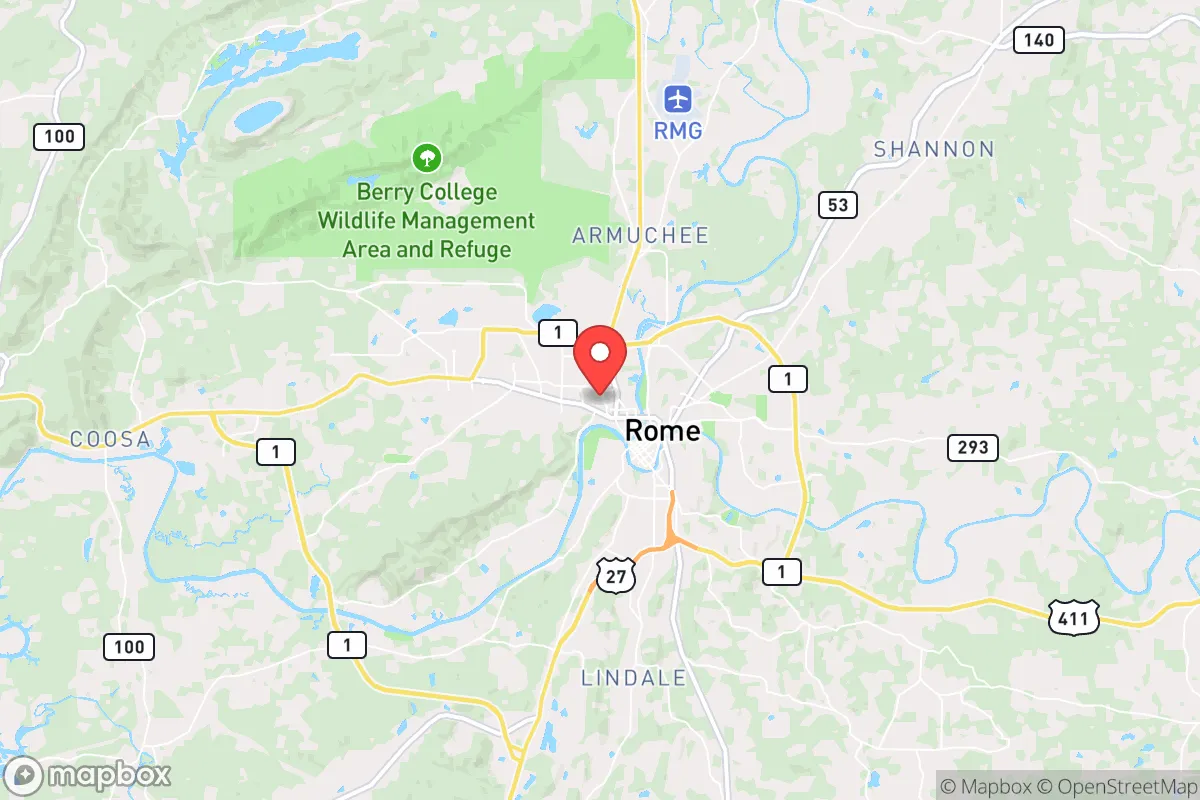
Personal Sovereignty in Rome, GA
Viable for self-reliance. Generally workable, though some barriers may limit total independence.
What does Personal Sovereignty tell us?
Personal Sovereignty measures your capacity for self-reliance and independence with minimal government friction. Higher scores mean fewer barriers between you and the way you want to live... but it assumes you have the space you need and good neighbors.
What does this tell us?
Personal Sovereignty measures your capacity for self-reliance and independence with minimal government friction. Higher scores mean fewer barriers between you and the way you want to live... but it assumes you have the space you need and good neighbors.
State Policy
Energy independence: Importer (12% of energy produced in-state)
Personal Liberty
Homesteading

Personal Liberty Analysis
Rome, Georgia, offers a notably high degree of personal sovereignty compared to many other parts of the country, particularly for those who prioritize minimal government interference in daily life. The city sits in Floyd County, a region where the prevailing culture and local governance lean heavily toward individual liberty, self-reliance, and a skepticism of overreach from higher levels of government. For the strategic relocator—whether a single prepper or a family looking to build a resilient life—Rome provides a legal and regulatory environment that largely respects the autonomy of its residents, though it is not without its own local nuances that require careful consideration.
Tax burden and regulatory posture in Floyd County
Georgia is a right-to-work state with a flat income tax rate of 5.49% as of 2026, and Floyd County keeps property taxes reasonable. The combined county and city millage rate in Rome hovers around 30 mills, which translates to roughly $1,200 annually on a $200,000 home—well below the national average. There is no state-level estate or inheritance tax, and the state sales tax of 4% plus local options brings the total to about 8% in Rome, which is standard for the region. The regulatory climate is business-friendly, with no county-level occupational licensing for most trades and a zoning code that is less restrictive than in metro Atlanta. However, Rome does enforce standard building codes and requires permits for major construction, so you cannot simply throw up a shed or a bunker without paperwork. The overall posture is one of low friction: the government expects you to pay your taxes and follow basic safety codes, but it does not actively seek to micromanage how you live on your property.
Self-defense and gun law specifics in Rome
Georgia is a constitutional carry state, meaning no permit is required to carry a concealed or open firearm for anyone legally allowed to possess one. Rome and Floyd County fully respect this right, with local law enforcement generally supportive of armed citizens. There are no county-level restrictions on magazine capacity, firearm types, or ammunition purchases beyond state law. The state preempts local governments from enacting their own gun ordinances, so Rome cannot ban carry in parks or other public spaces—though private businesses can post signage to prohibit firearms. Stand Your Ground and Castle Doctrine laws are firmly in place, with no duty to retreat in any place you are lawfully present. For the prepper mindset, this is a strong environment: you can keep a rifle in your truck, carry a sidearm daily, and defend your home without legal ambiguity. The only notable limitation is that Georgia does not allow the open carry of long guns in vehicles without a permit, but that is a minor technicality.
Self-reliance and homesteading viability in Rome
Rome’s zoning code is a mixed bag for serious homesteaders. Inside the city limits, residential lots are typically a quarter-acre to half-acre, and the city restricts keeping livestock—chickens are allowed only with a permit and no roosters, and larger animals like goats or pigs are prohibited. However, unincorporated Floyd County is far more permissive. Outside the city, you can find properties with 1 to 10 acres zoned agricultural, where you can raise chickens, goats, cattle, and even pigs without special permits. The county does not enforce strict setback requirements for outbuildings like barns or workshops, and there are no restrictions on rainwater collection or composting toilets for off-grid living. Solar panels are allowed without HOA interference in most rural areas, though the city has some aesthetic guidelines. For off-grid feasibility, the biggest hurdle is well and septic permitting: Floyd County requires a permit for new wells and septic systems, but the process is straightforward and costs under $500. The climate supports year-round gardening, with a growing season from March to November, and the local soil is decent for vegetables. If you want true self-reliance, aim for land outside the Rome city limits, preferably in the rural stretches toward Cave Spring or Coosa.
Personal liberties in Rome: parental rights, medical autonomy, speech, and property
Parental rights are strongly protected in Georgia. The state has a Parents’ Bill of Rights law that affirms parents have the primary authority over their children’s education, healthcare, and upbringing. Rome City Schools and Floyd County Schools both allow parents to opt out of any curriculum materials they find objectionable, and there is no mandatory vaccine requirement for school attendance—only a list of recommended vaccines that parents can decline with a simple waiver. Medical autonomy is similarly robust: Georgia does not have a state-level vaccine mandate for adults, and there are no restrictions on purchasing over-the-counter supplements or herbal remedies. The state also has a broad health freedom law that protects the right to refuse medical treatment. Free speech is protected under the Georgia Constitution, which explicitly guarantees the right to assemble and petition the government. Rome has not enacted any local ordinances restricting political speech or public assembly, and the city’s public forums—like the Forum River Center and local parks—are open for gatherings without excessive permitting. Property rights are strong: Georgia is a “measure of damages” state for eminent domain, meaning the government must pay fair market value plus relocation costs, and there is no statewide rent control or landlord-tenant laws that heavily favor tenants over owners. For the property owner, you have wide latitude to use your land as you see fit, as long as you do not create a public nuisance.
In the broader context of the Southeast, Rome stands out as a place where personal sovereignty is not just tolerated but expected. Compared to areas like metro Atlanta or the coastal cities, Floyd County has far less regulatory creep, lower taxes, and a culture that values individual responsibility over collective mandates. The city itself is a small urban center with amenities, but the real draw for the survivalist or prepper is the surrounding county, where you can own land, carry a firearm, raise your own food, and raise your children without constant government interference. The trade-off is that you are still in a state with a functioning government that collects taxes and enforces basic codes—this is not a free-for-all. But for someone looking to escape the overreach of blue-state governance while staying within driving distance of resources and healthcare, Rome, Georgia, offers a solid foundation for a self-determined life.

* Values derived from national, state, county, city and local statistics and may differ in a specific area. Last updated: 2026-04-30T01:13:12.000Z
Narrative content on this page is AI-generated and may contain mistakes. Verify any details that matter before acting on them.
ReloMaps may earn a commission from affiliate links at no extra cost to you.

