
Photo: Wikipedia
Political ClimatePolitical Climate in Rome, GA
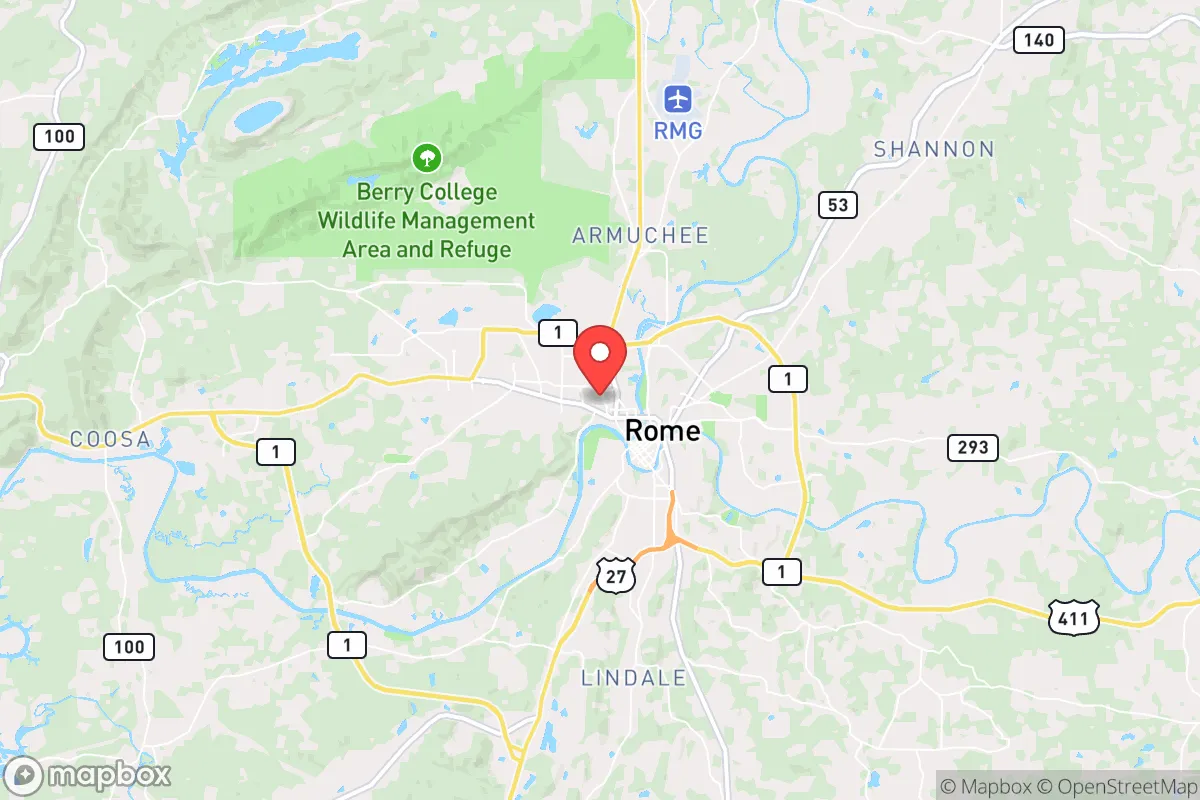
District shown is the primary district for this city’s centroid. Cities may span multiple districts.
Local Political AnalysisPolitical Analysis of Rome, GA
Rome, Georgia, sits deep in reliably conservative territory, with a Cook PVI of R+19 that reflects generations of traditional values and limited government sentiment. For as long as anyone around here can remember, Floyd County has voted solidly Republican in presidential races, and local offices are held by folks who generally believe in keeping government out of your business, your wallet, and your family life. That said, there’s been a quiet but noticeable shift in the last few years—some of the younger crowd moving in from Atlanta or Chattanooga bring more progressive ideas, and you can feel the tension at city council meetings over things like zoning, school policies, and public spending. The overall lean is still deeply red, but the trajectory is worth watching if you care about preserving personal freedoms.
How it compares
Compared to its neighbors, Rome is actually a bit of a moderate outlier in an otherwise deeply conservative region. Drive 30 minutes south to Cedartown or 45 minutes west to Centre, Alabama, and you’ll find even stronger Republican majorities and less appetite for any kind of government expansion. Head east toward Cartersville, and you’re in Bartow County, which is reliably red but has seen more development pressure and the associated uptick in regulations. The real contrast is with Atlanta, about 70 miles southeast—Rome feels like a different world politically, with far less tolerance for the kind of progressive overreach you see in the capital. Locals here still remember when Rome was a Democratic stronghold back in the 1960s and 70s, but those days are long gone; the shift to the right has been steady and, for most residents, welcome.
What this means for residents
For the average person living here, the conservative climate means fewer headaches from government bureaucracy. Property taxes are reasonable compared to metro Atlanta, there’s no city income tax, and the local school board has resisted the kind of curriculum changes that have stirred up trouble in other parts of the state. You won’t find the same level of overreach with mask mandates, business closures, or vaccine requirements that plagued other cities during the pandemic—Rome’s leaders generally trusted people to make their own decisions. The downside is that if you’re hoping for more progressive policies on things like housing density or public transit, you’ll be disappointed; the county commission moves slowly and prefers to keep things as they are. For those who value personal responsibility and limited interference, that’s a feature, not a bug.
One cultural distinction worth noting is Rome’s strong sense of local identity and resistance to outside influence. There’s a palpable wariness of Atlanta-style politics creeping in, and you’ll hear it in conversations at the coffee shop or the hardware store. The city has a historic downtown that’s been preserved without the heavy-handed redevelopment mandates you see elsewhere, and the local paper still runs editorials that defend Second Amendment rights and school choice. If the progressive wave that’s washing over other parts of Georgia keeps pushing, Rome will likely be one of the last holdouts—and that’s exactly how most folks here want it.

State Political ClimatePolitical Climate in Georgia
State Political AnalysisPolitical Environment in the State
Georgia has shifted from a reliably Republican stronghold to a true battleground state over the past two decades, with the Atlanta metro area’s explosive growth driving a rapid leftward turn. In 2020, Joe Biden became the first Democrat to carry the state since 1992, winning by just 11,779 votes, and the 2022 Senate runoff cemented Georgia’s purple status. However, outside the Atlanta core, the state remains deeply conservative, and the overall partisan lean is now a razor-thin margin—roughly 49-48 in favor of Republicans in recent statewide races—making it one of the most politically volatile states in the country for a relocating family or individual.
Urban vs. rural divide
The political map of Georgia is a tale of two worlds. The Atlanta metro area—specifically Fulton, DeKalb, Cobb, Gwinnett, and Clayton counties—now accounts for nearly 60% of the state’s vote, and these counties have swung hard to the left. Fulton County alone gave Biden over 400,000 votes in 2020, more than the entire rural southern half of the state combined. Meanwhile, the rest of Georgia is overwhelmingly Republican. Counties like Forsyth (north of Atlanta) and Cherokee have become conservative strongholds, with Forsyth voting +30 points for Trump in 2024. The rural “Black Belt” counties in central and southwest Georgia, such as Dougherty (Albany) and Macon-Bibb, lean Democratic due to high African American populations, but their turnout is lower than the booming Atlanta suburbs. The coastal city of Savannah (Chatham County) is a blue island in a red region, while Augusta (Richmond County) is reliably Democratic. The real story is the Atlanta exurbs—places like Hall County (Gainesville) and Paulding County—which are growing fast and trending red, but not fast enough to offset the blue wave in the core metro.
Policy environment
Georgia’s policy environment is a mixed bag for conservatives. On the positive side, the state has a flat income tax rate of 5.49% (down from 6% in 2022), with a scheduled phase-down to 4.99% by 2029. There is no state inheritance tax, and property taxes are relatively low, with a median effective rate of 0.87% of home value. The state is a “right-to-work” state, and its regulatory climate is business-friendly, ranking in the top 10 nationally for economic freedom. However, the education landscape is concerning: Georgia’s public schools rank 38th nationally in spending per pupil, and the state’s school choice options are limited compared to Florida or Arizona. The Georgia Promise Scholarship Act, passed in 2024, offers $6,500 vouchers for students in low-performing schools, but it’s capped at 10,000 students. Healthcare policy is a flashpoint: Georgia did not expand Medicaid under the Affordable Care Act, but the state’s “Pathways to Coverage” program, launched in 2023, requires 80 hours of work or community engagement per month for eligibility—a conservative work requirement that has enrolled only about 4,000 people, far below projections. Election laws tightened after 2020 with SB 202, which added voter ID requirements for absentee ballots, limited drop boxes, and banned mobile voting centers. This law has been a national lightning rod, but it remains in effect and has withstood legal challenges.
Trajectory & freedom
Georgia is becoming less free in several key areas, particularly regarding personal liberty and government overreach. The most alarming trend is the erosion of Second Amendment rights: in 2024, Governor Brian Kemp signed a “red flag” law (HB 451) that allows courts to temporarily seize firearms from individuals deemed a threat, without a criminal conviction or due process hearing. This was a major departure from Georgia’s long-standing constitutional carry law (passed in 2022), which allowed permitless carry. On parental rights, the state passed the “Parents’ Bill of Rights” (SB 449) in 2023, which requires schools to notify parents of any changes to a child’s mental, emotional, or physical health—a win for conservatives. However, the state’s medical autonomy is under threat: Georgia’s six-week abortion ban (HB 481) is among the strictest in the nation, but it has created a chaotic legal environment, with clinics closing and women traveling out of state. Property rights are generally strong, with no statewide rent control and relatively low eminent domain abuse, but local zoning battles in Atlanta suburbs are increasingly contentious. The biggest freedom concern is taxation: while the income tax is dropping, local sales taxes can exceed 8% in some counties, and the state’s gas tax is 29.1 cents per gallon. Overall, Georgia’s trajectory is one of incremental government expansion in the name of public safety and health, which should worry anyone who values limited government.
Civil unrest & political movements
Georgia has been a hotbed of political activism since 2020. The “Stop the Steal” movement was particularly active in Georgia, with Trump’s phone call to Secretary of State Brad Raffensperger in January 2021 becoming a national scandal. The Fulton County election interference case against Trump and 18 co-defendants has kept the state in the headlines, with ongoing trials and a polarized public. On the left, the “Cop City” protests in Atlanta’s South River Forest—against a proposed police training facility—turned violent in 2023, with one activist killed by state troopers. These protests have galvanized both anarchist and anti-police movements in the city. Immigration politics are tense: Georgia has a strict E-Verify law (SB 160, 2023) that requires all employers to check immigration status, but the influx of migrants through the southern border has strained resources in Dalton and Gainesville, where the carpet and poultry industries rely heavily on immigrant labor. There is no sanctuary city policy in Georgia—state law (HB 87, 2011) prohibits it—but Atlanta’s city council has passed symbolic resolutions opposing immigration enforcement. Election integrity remains a flashpoint: the 2024 election saw record turnout, but ongoing lawsuits over absentee ballot deadlines and drop box access keep the issue alive. A new resident would notice the constant political tension, especially in Atlanta, where yard signs and bumper stickers are a daily reminder of the divide.
Projection
Over the next 5-10 years, Georgia will likely become more competitive and more progressive at the state level, driven by demographic shifts. The Atlanta metro area is adding about 100,000 new residents annually, many from blue states like California and New York, and these newcomers tend to vote Democratic. The 2020 census gave Georgia an additional congressional seat, and the 2024 redistricting created two new majority-minority districts, further boosting Democratic representation. Rural counties will continue to shrink and age, losing political clout. By 2030, Georgia could easily be a lean-Democratic state in presidential elections, with Republicans holding on only through gerrymandered state legislative maps. The state’s cultural and policy trajectory will follow: expect more gun control, more spending on public transit (the Atlanta BeltLine expansion), and a push for Medicaid expansion. However, the state’s business-friendly tax structure and right-to-work laws will likely remain intact, as even Democratic governors (like Stacey Abrams, if she wins) have signaled support for economic development. For a conservative moving in now, the realistic expectation is that Georgia will feel like a blue state in the cities and a red state in the country, with the balance tipping toward blue over the next decade.
For a new resident, the bottom line is this: Georgia offers low taxes and a business-friendly climate, but you must be prepared for a rapidly changing political landscape. If you’re moving to the Atlanta suburbs, expect your local school board and county commission to shift left over time. If you’re moving to a rural area like Valdosta or Rome, you’ll find a stable conservative environment, but with fewer economic opportunities. The state’s freedom index is declining, particularly on gun rights and medical autonomy, and the constant election drama can be exhausting. Choose your county carefully—Forsyth, Cherokee, and Oconee remain conservative strongholds—and get involved in local politics if you want to preserve the Georgia you’re moving to.
* Values derived from national, state, county, city and local statistics and may differ in a specific area. Last updated: 2026-04-30T01:13:12.000Z
Narrative content on this page is AI-generated and may contain mistakes. Verify any details that matter before acting on them.
ReloMaps may earn a commission from affiliate links at no extra cost to you.

