 Popular
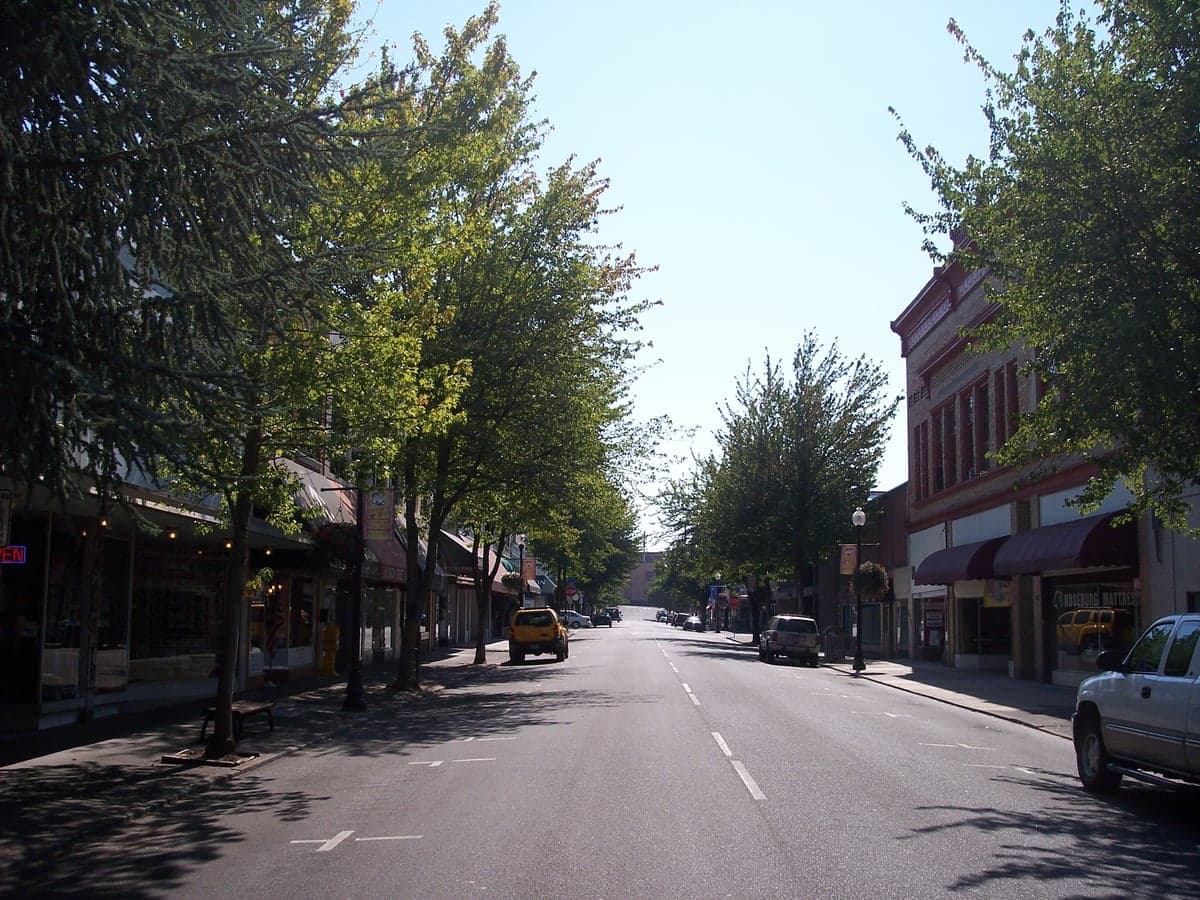
Photo: Wikipedia
Demographics of Roseburg, OR
Affluence Level in Roseburg, OR
A below-average socioeconomic profile. Incomes, home values, and educational attainment trail the U.S., with higher poverty and unemployment.
People of Roseburg, OR
Roseburg, Oregon, is a predominantly white, family-oriented city of 23,773 residents, where the population is older and less diverse than the national average. The city’s character is shaped by a deep-rooted timber and agricultural heritage, with a strong sense of local identity and a slower pace of life. With a foreign-born population of just 1.4% and a college attainment rate of 21.3%, Roseburg remains a culturally homogeneous community, distinct from Oregon’s more diverse urban centers like Portland or Salem.
How the city was settled and grew
Roseburg’s population history begins with the Umpqua Indians, who lived along the South Umpqua River before European settlement. The first major wave of white settlers arrived in the 1850s, drawn by the Donation Land Claim Act, which offered 320 acres to married couples. These early pioneers, primarily of English, Scottish, and Irish descent, established farms and small businesses in what is now the Historic Downtown Roseburg district. The arrival of the Oregon and California Railroad in 1872 transformed the town into a regional timber and agricultural hub, attracting a second wave of settlers from the Midwest and the East Coast. These newcomers built homes in the Eastwood and Westwood neighborhoods, which still feature Craftsman and Victorian-era houses. By the early 20th century, Roseburg’s population was almost entirely white, with a small number of Chinese laborers who had worked on the railroad but largely left by the 1900s. The timber boom of the 1940s and 1950s brought a third wave of domestic migrants from rural Oregon and northern California, who settled in the Melrose and Green District areas, establishing the working-class character that persists today.
Modern era (post-1965)
Following the 1965 Hart-Cellar Act, Roseburg saw negligible immigration from outside the United States. The city’s foreign-born population remains at 1.4%, far below the national average of 13.7%. The post-1965 period was instead defined by domestic in-migration from other parts of Oregon and the Pacific Northwest, as people sought affordable housing and a rural lifestyle. The Winston area, just south of Roseburg, absorbed many of these new residents, who built ranch-style homes on larger lots. The Hispanic population, now 7.4%, began to grow in the 1990s, driven by agricultural and construction jobs. These families concentrated in the Garden Valley corridor and parts of the Green District, where they established small businesses and churches. The Black population remains at 0.2%, and East/Southeast Asian communities at 1.1%, with no significant Indian subcontinent population (0.0%). The city’s racial homogeneity has been reinforced by a lack of major employers attracting diverse talent; the largest employers are the local hospital, school district, and timber-related firms.
The future
Roseburg’s population is slowly aging, with a median age of 42.5, and the city is projected to grow modestly, primarily through domestic in-migration from California and the Portland metro area. These new arrivals are often retirees or remote workers seeking lower costs and a quieter environment, and they tend to settle in newer subdivisions in the Winston and Melrose areas. The Hispanic population is expected to continue its gradual increase, potentially reaching 10-12% by 2040, but will likely remain concentrated in the Garden Valley corridor. The city shows no signs of significant diversification beyond this; the white population will remain dominant, and the foreign-born share is unlikely to rise above 2-3%. Roseburg is not tribalizing into distinct ethnic enclaves but is instead experiencing a slow, steady homogenization, with new residents largely mirroring the existing demographic profile.
For someone moving in now, Roseburg offers a stable, culturally conservative community where the population is predictable and change is gradual. The city is becoming a destination for those seeking an affordable, low-diversity environment with strong ties to the timber and agricultural economy. Newcomers should expect a place where neighborly familiarity and traditional values prevail, but where the population is aging and the economy remains narrowly focused on natural resources and healthcare.

* Values derived from national, state, county, city and local statistics and may differ in a specific area. Last updated: 2026-04-24T14:55:59.000Z
Narrative content on this page is AI-generated and may contain mistakes. Verify any details that matter before acting on them.
ReloMaps may earn a commission from affiliate links at no extra cost to you.

