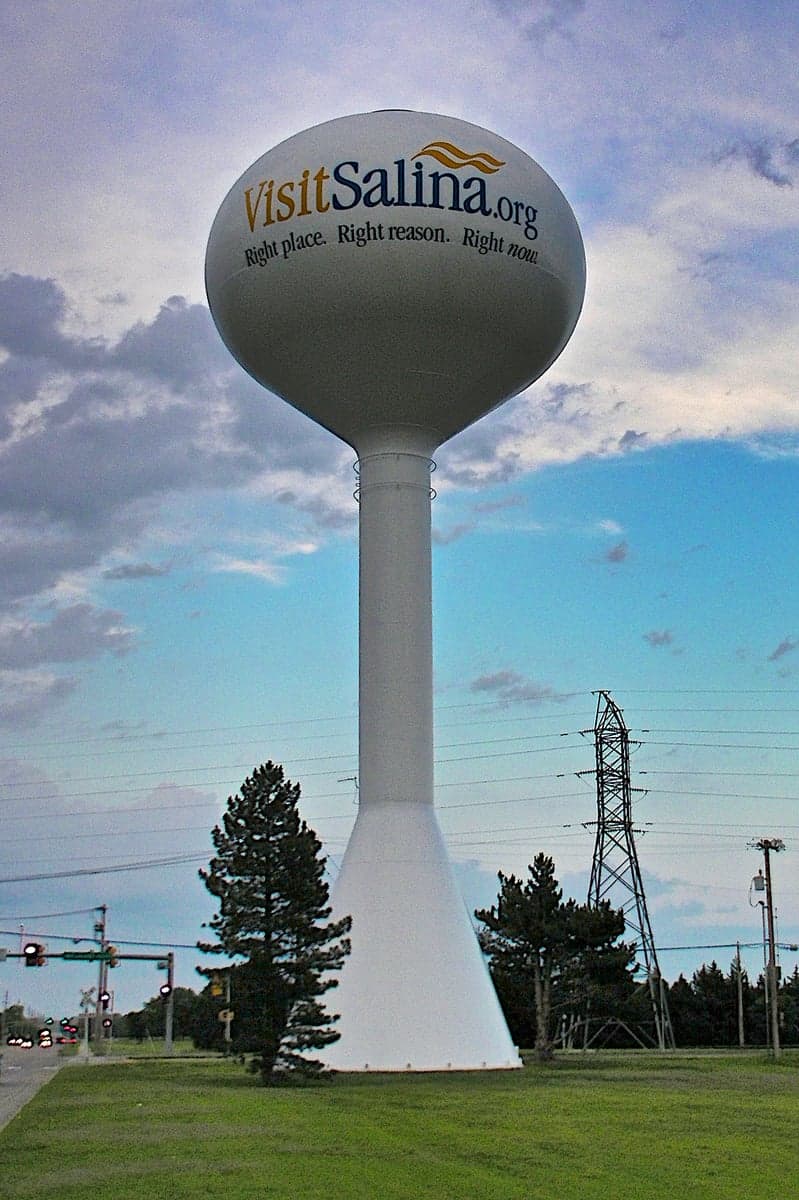
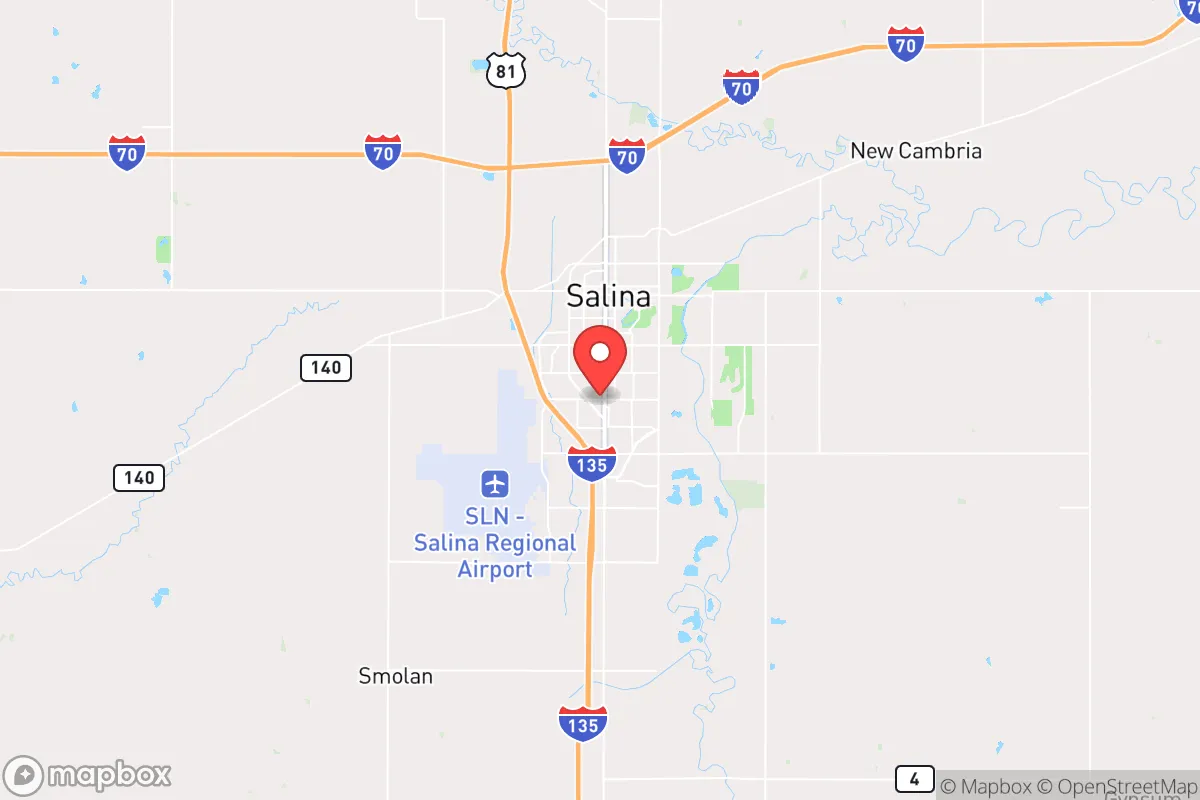
Photo: Wikipedia
Demographics of Salina, KS
Affluence Level in Salina, KS
A middle-class area roughly in line with national averages across income, home values, education, and employment.
People of Salina, KS
The people of Salina, Kansas today number 46,432, forming a community that is predominantly white (77.0%) with a significant Hispanic minority (13.5%) and smaller Black (3.9%) and East/Southeast Asian (2.2%) populations. The city’s foreign-born share is low at 2.7%, and just 28.7% of adults hold a college degree, reflecting a historically working-class, agricultural, and railroad-rooted character. Salina’s identity is that of a stable, family-oriented Great Plains hub—less transient than a college town, less diverse than a major metro, and more rooted in multi-generational Kansas families than in recent immigration.
How the city was settled and grew
Salina was founded in 1858 by a group of settlers led by William A. Phillips, who saw the potential of the Saline River valley as a trading post along the Smoky Hill Trail to Denver. The city’s early population was overwhelmingly of Anglo-American stock—farmers, merchants, and land speculators from the Ohio River Valley and the Upper Midwest. The arrival of the Kansas Pacific Railroad in 1867 transformed Salina into a regional shipping center for wheat and cattle, drawing waves of German and Irish immigrants who settled in the Iron Avenue corridor and the working-class blocks south of the railroad tracks, an area still known informally as South Salina. By 1900, the city had grown to roughly 6,000 residents, with a small but established Black community concentrated around North Street and Ash Street, near the Santa Fe rail yards where many found work as porters and laborers. The 1920s and 1930s brought a second wave of German-Russian Mennonites from the Volga region, who settled in the East Crawford neighborhood and established the area’s first large-scale wheat farms. Salina’s population doubled between 1940 and 1960, driven by the expansion of Schilling Air Force Base (opened 1942) and the growth of the regional livestock market. The base brought in military families from across the country, many of whom settled in the Sunset Park and Westwood subdivisions, giving those neighborhoods a more transient, middle-class character distinct from the older ethnic enclaves.
Modern era (post-1965)
The post-1965 period saw Salina’s demographic profile shift modestly. The closure of Schilling Air Force Base in 1965 removed a major source of in-migration and slowed population growth for two decades. The Hispanic population began to grow noticeably in the 1980s and 1990s, driven by Mexican and Central American immigrants recruited by the meatpacking and food-processing industries—particularly at the Exide Technologies plant and the Schwan’s distribution center. These new arrivals concentrated in the Marshall Street corridor and the North Central neighborhood, areas that today have the highest Hispanic density in the city. The East/Southeast Asian community (2.2%) is small but visible, anchored by Vietnamese and Filipino families who arrived in the 1970s and 1980s as refugees and medical professionals; they are scattered across the city but have a modest cluster near South 9th Street. The Indian-subcontinent population is negligible at 0.1%, consisting of a handful of professionals at the local hospital and Kansas State University’s Salina campus. The Black population (3.9%) has remained stable since the 1970s, with most families living in the historic North Street area and the Oakdale Park neighborhood. White flight to the suburbs was minimal in Salina—the city’s boundaries have expanded to absorb new subdivisions like Indian Rock and Falcon Ridge, which are overwhelmingly white and middle-class, while the older core neighborhoods have become more ethnically mixed.
The future
Salina’s population is projected to grow slowly, reaching roughly 48,000 by 2035, driven by natural increase and modest domestic in-migration from rural Kansas and the Denver exurbs. The Hispanic share is expected to rise to 18–20% by 2040, as younger Hispanic families have higher birth rates and continued recruitment by food-processing employers. This growth is likely to concentrate in the Marshall Street and North Central areas, creating a more distinct ethnic enclave rather than widespread integration. The white population will continue to age and decline slightly, while the Black and East/Southeast Asian shares are expected to remain flat. The city is not tribalizing into sharply divided enclaves—neighborhoods remain relatively mixed by Great Plains standards—but the Hispanic concentration in the north-central corridor is becoming more pronounced. The foreign-born share may rise to 4–5% by 2040, still low by national standards. For a newcomer, Salina is becoming a slightly more diverse, still predominantly white, family-oriented city where the main demographic story is the gradual growth of a Hispanic working class alongside a stable white middle class.
For someone moving to Salina now, the city offers a low-diversity, low-cost, family-focused environment where the population is slowly becoming more Hispanic but remains overwhelmingly white and native-born. The historic neighborhoods—South Salina, North Street, East Crawford, Sunset Park, Marshall Street, and Falcon Ridge—each retain distinct characters, from working-class ethnic enclaves to newer subdivisions. The city’s demographic trajectory is one of gradual change, not rapid transformation, making it a stable choice for those seeking a traditional Great Plains community.

* Values derived from national, state, county, city and local statistics and may differ in a specific area. Last updated: 2026-04-29T17:52:38.000Z
Narrative content on this page is AI-generated and may contain mistakes. Verify any details that matter before acting on them.
ReloMaps may earn a commission from affiliate links at no extra cost to you.

