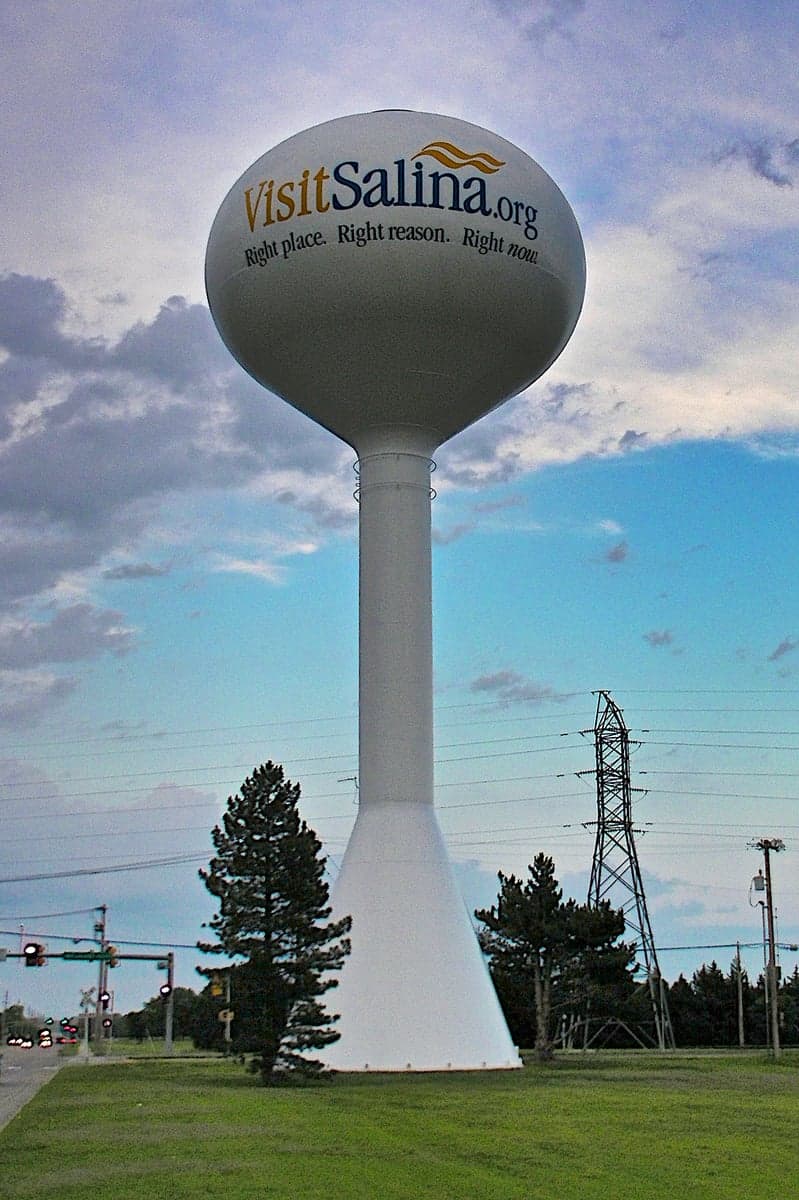
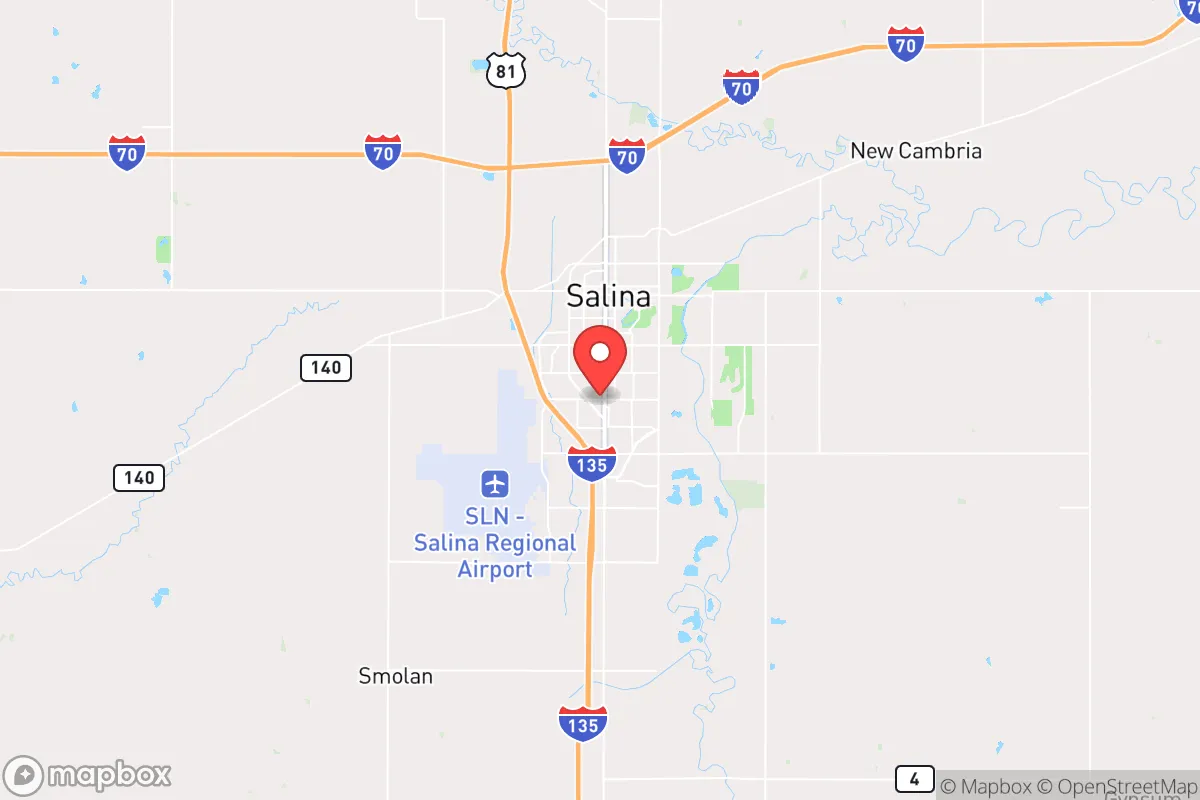
Photo: Wikipedia
Political ClimatePolitical Climate in Salina, KS
District shown is the primary district for this city’s centroid. Cities may span multiple districts.
Local Political AnalysisPolitical Analysis of Salina, KS
Salina, Kansas, sits in a solidly conservative corner of the state, with a Cook PVI of R+16 that reflects decades of consistent Republican voting in federal elections. The city itself leans red, but it’s not the deep crimson you’ll find in the rural farm towns to the west or south—places like Abilene or McPherson, where the GOP vote share regularly tops 75%. Salina has historically been a bit more moderate, a kind of pragmatic conservative town where folks value hard work, self-reliance, and keeping government out of their lives. But over the last ten years, you’ve seen a slow drift leftward in local elections, especially in the city council and school board races, which has a lot of longtime residents keeping a wary eye on things.
How it compares
Drive 30 minutes north to Concordia or 45 minutes east to Junction City, and you’ll find communities that vote even more reliably Republican—often R+20 or stronger on the Cook scale. Those towns haven’t seen the same influx of new residents or the subtle cultural shifts that Salina has experienced, partly because of the growth at Kansas State University in Manhattan (about an hour east) and the trickle-down effect of more progressive ideas from there. Meanwhile, head south to Hutchinson, and you’re in a similar boat: conservative at the core, but with a noticeable progressive push in city hall and the local media. Salina’s political climate is still overwhelmingly conservative by national standards—the county voted +16 points for Trump in 2024—but the trend lines are what worry folks. The city council has passed a few zoning and housing ordinances that feel like overreach, and there’s chatter about a “Welcoming City” resolution that could open the door to sanctuary policies. That’s not the Salina I grew up in, where the attitude was “live your life, but don’t ask the government to solve your problems.”
What this means for residents
For the average Salina resident, the political climate means you’re still free to run your business, keep your guns, and send your kids to a school that doesn’t push a political agenda—for now. Property taxes remain low compared to Johnson County or Lawrence, and there’s no city income tax, which is a big deal for families trying to stretch a paycheck. But the warning signs are there: the school board has debated “equity” policies that sound like code for race-based quotas, and the city’s planning department has floated density mandates that would tell homeowners what they can build on their own land. That kind of government creep is what pushes people out of places like California and Colorado, and it’s starting to show up here. The long-term concern is that if Salina keeps electing moderate Republicans or even a few Democrats to local office, you’ll see more regulations, higher fees, and a loss of the independent spirit that made this town a great place to raise a family. The state legislature in Topeka is still solidly conservative, so there’s a buffer, but local elections matter more than ever.
One cultural distinction that sets Salina apart is its strong sense of community self-reliance—there’s a long tradition of church-based charities and neighbor-helping-neighbor that makes big government feel unnecessary. You don’t see the same push for expanded social services here that you do in Wichita or Topeka, because people still believe in solving problems locally. The city’s annual Smoky Hill River Festival is a good example: it’s run by volunteers, funded by local businesses, and celebrates the area’s heritage without any political grandstanding. That’s the Salina worth fighting for. The near-term outlook is cautiously optimistic—the R+16 lean isn’t going anywhere fast—but the long-term trajectory depends on whether residents stay engaged and push back against the progressive drift that’s creeping in from the coasts and the college towns. If you’re thinking of moving here, know that you’ll find a place that still values freedom and common sense, but you’ll also need to keep an eye on the ballot box to make sure it stays that way.

State Political ClimatePolitical Climate in Kansas
State Political AnalysisPolitical Environment in the State
Kansas has long been a reliably red state in presidential elections, having not voted for a Democrat since Lyndon Johnson in 1964, but the real story is a slow, grinding shift leftward in its suburbs and college towns that has made the state more competitive than its national reputation suggests. The dominant coalition remains conservative, anchored by rural and exurban voters, but the margin of victory has shrunk from double digits to single digits in recent cycles—Trump won the state by 15 points in 2016, by 10 points in 2020, and by roughly 12 points in 2024. The 10-20 year trajectory shows a state where the traditional Republican stronghold is being chipped away by in-migration to the Kansas City suburbs and a growing progressive presence in places like Lawrence and Manhattan, while the rural heartland holds firm but loses population.
Urban vs. rural divide
The political map of Kansas is a textbook case of the urban-rural split. The eastern third of the state, anchored by the Kansas City metro area, is the battleground. Johnson County, the wealthiest and most populous county, was once a Republican fortress but has been trending purple for a decade—it went for Trump by only 2 points in 2020 and flipped to Biden in 2024 by a narrow margin, driven by well-educated suburbanites in Overland Park and Leawood who are increasingly uncomfortable with the national GOP brand. Meanwhile, Wyandotte County (Kansas City, KS) is a deep blue stronghold, reliably delivering 70%+ margins for Democrats. On the flip side, western Kansas is as red as it gets—counties like Grant, Haskell, and Wallace routinely give Republicans 80-90% of the vote. The real tension is in the medium-sized cities: Wichita, the largest city, is a classic swing area where the urban core leans left but the surrounding Sedgwick County suburbs (like Derby and Goddard) are solidly conservative. Manhattan, home to Kansas State University, is a blue dot in a red sea, while Lawrence (home to the University of Kansas) is the most reliably liberal city in the state outside of Kansas City proper. The rural-urban divide isn't just about votes—it's about culture, with rural Kansans feeling increasingly alienated from the priorities of the growing suburban and urban populations.
Policy environment
Kansas's policy environment is a mixed bag for conservatives. On the positive side, the state has a flat income tax rate of 5.7% (down from a top rate of 6.45% a decade ago), no estate tax, and a relatively low property tax burden compared to neighboring Missouri. The state legislature, controlled by a conservative supermajority, has passed a series of pro-business reforms, including right-to-work laws and tort reform that caps non-economic damages in medical malpractice cases at $250,000. However, the ghost of the Brownback tax experiment (2012-2017) still lingers—those massive income tax cuts led to budget crises that forced the legislature to reverse course, and the memory of that fiscal instability makes some conservatives wary of further tax-cutting zeal. On education, Kansas has a mixed record: the state funds schools through a complex formula that has been repeatedly litigated, and the legislature has resisted expanding school choice, though a modest tax-credit scholarship program for private school tuition exists. Healthcare policy is a sore spot—Kansas has not expanded Medicaid under the Affordable Care Act, which conservatives see as a win for fiscal restraint, but it also means rural hospitals are under constant financial pressure. Election integrity is a bright spot: Kansas requires a photo ID to vote, has a secure voter registration system, and has resisted the push for widespread mail-in voting that other states adopted post-2020. The state also has a constitutional amendment (approved by voters in 2022) that explicitly states there is no right to abortion in the Kansas Constitution, though the state Supreme Court had previously found a right to abortion under the state's Bill of Rights—a tension that remains unresolved.
Trajectory & freedom
On the freedom front, Kansas is a state that has been moving in the right direction on several key fronts, but with some worrying exceptions. The biggest win for personal liberty in recent years was the passage of the Second Amendment Protection Act in 2023, which prohibits state and local law enforcement from enforcing any federal gun control measures that infringe on the right to keep and bear arms—a direct challenge to federal overreach. The state also has permitless carry for handguns (passed in 2015) and a strong castle doctrine. On parental rights, Kansas passed a Parents' Bill of Rights in 2022 that requires school districts to notify parents of any changes to a student's mental, emotional, or physical health, and gives parents the right to review instructional materials. This was a direct response to the growing influence of critical race theory and gender ideology in schools, particularly in Johnson County districts like Shawnee Mission and Blue Valley. On medical freedom, Kansas has been a mixed bag: the state banned COVID-19 vaccine mandates for state employees and contractors in 2021, but it also has some of the strictest vaccine requirements for schoolchildren in the region (though religious exemptions are available). The most concerning trend for conservatives is the growing influence of the state Supreme Court, which has been increasingly activist on issues like school funding and abortion—the court's 2019 ruling that the state constitution protects a right to abortion was a major blow to legislative efforts to restrict the practice. Property rights are generally strong, with no statewide rent control and relatively few zoning restrictions outside of the major cities, though Johnson County has seen a push for more "smart growth" regulations that some conservatives view as a backdoor to limiting development.
Civil unrest & political movements
Kansas has not seen the kind of large-scale civil unrest that has plagued coastal states, but there have been notable flashpoints. The most significant was the 2022 abortion referendum, where voters in a special election rejected a proposed constitutional amendment that would have explicitly stated there is no right to abortion—this was a stunning defeat for the pro-life movement, driven by a massive turnout in Johnson County and the Kansas City suburbs. The result was a wake-up call for conservatives, showing that the suburban shift is real and that single-issue voters can swing elections. On the left, activist groups like the Kansas People's Action and the Mainstream Coalition have been increasingly vocal, pushing for Medicaid expansion, higher minimum wages, and more progressive school board candidates. On the right, the Kansas Republican Party has been riven by internal divisions between the establishment wing (represented by Senator Jerry Moran) and the more populist, Trump-aligned wing (represented by Senator Roger Marshall and former Attorney General Derek Schmidt). Immigration politics have been relatively quiet compared to border states, but there have been flashpoints over sanctuary city policies—in 2024, the legislature passed a law banning any city or county from adopting sanctuary policies, a direct response to efforts in Lawrence and Kansas City, KS to limit cooperation with federal immigration enforcement. Election integrity remains a hot-button issue, with conservative activists continuing to push for hand-counting of ballots and stricter voter ID laws, though the state's current system is already among the most secure in the nation.
Projection
Looking ahead 5-10 years, Kansas is likely to become more politically competitive, but not necessarily more liberal. The key demographic trend is the continued growth of Johnson County, which is attracting young professionals and families from the coasts who are culturally moderate but fiscally conservative—these are the voters who flipped the county in 2024. At the same time, rural Kansas is losing population, which means the political weight of the state is shifting eastward. This will likely lead to more moderate Republican governance at the state level, with a focus on education funding and infrastructure rather than culture war issues. However, the conservative supermajority in the legislature is unlikely to be broken anytime soon, thanks to gerrymandered districts that favor rural areas. The biggest wild card is the state Supreme Court—if the court continues to strike down conservative legislation on abortion and school choice, there will be growing pressure for a constitutional amendment to restructure the court or limit its jurisdiction. A new resident moving to Kansas now should expect a state that is still fundamentally conservative, but where the suburbs are becoming more purple and where the culture war battles will increasingly be fought at the local school board and city council level rather than in Topeka.
For a conservative family or individual considering a move to Kansas, the bottom line is this: you will find a state that respects your gun rights, protects parental authority in education, and keeps taxes relatively low, but you need to be strategic about where you settle. If you want a deep-red environment, look to the rural counties or the Wichita suburbs. If you want a more moderate, suburban lifestyle with good schools and job opportunities, Johnson County is the place—but be prepared for a political environment that is increasingly contested. The state is not California or Illinois by any stretch, but it is also not Texas or Florida. It is a state in transition, where the old conservative consensus is being challenged by new arrivals and shifting demographics. The key is to get involved locally—school boards, city councils, and county commissions are where the real battles are being fought, and your vote matters more here than in almost any other state.
* Values derived from national, state, county, city and local statistics and may differ in a specific area. Last updated: 2026-04-29T17:52:38.000Z
Narrative content on this page is AI-generated and may contain mistakes. Verify any details that matter before acting on them.
ReloMaps may earn a commission from affiliate links at no extra cost to you.

