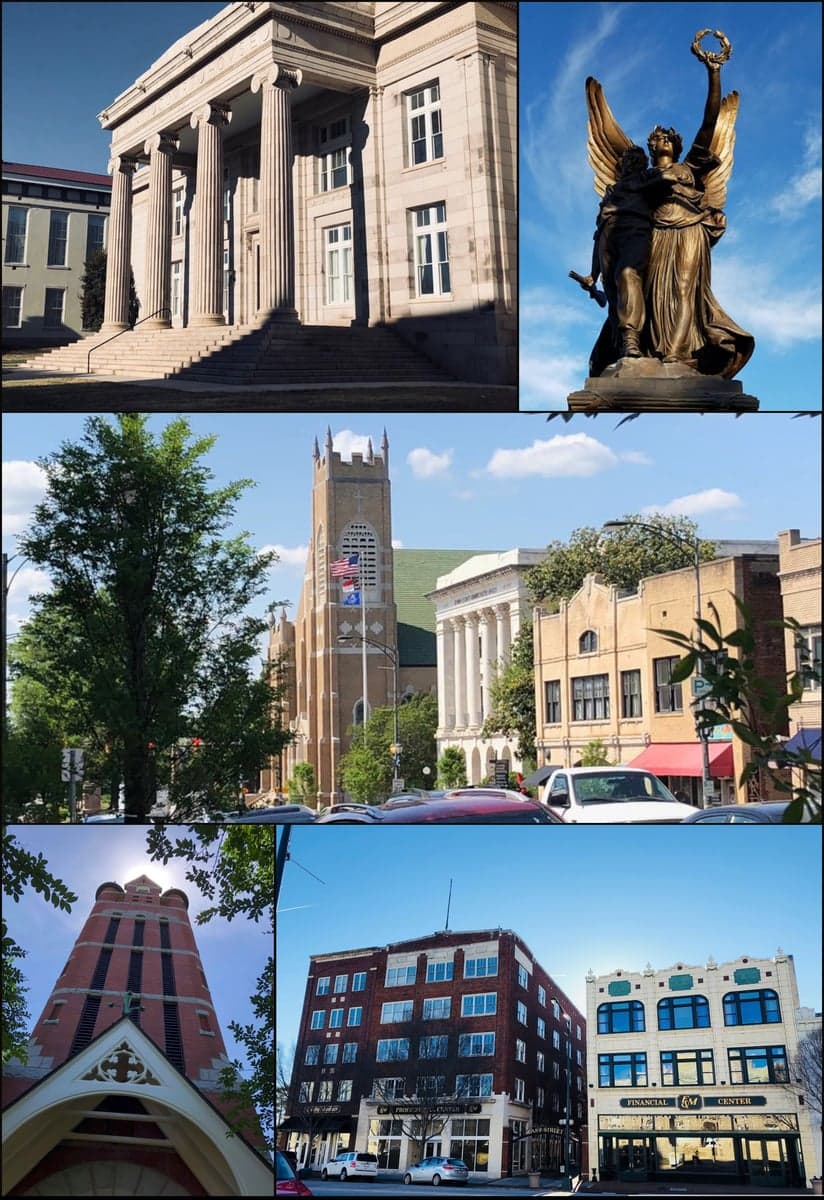
Photo: Wikipedia
Demographics of Salisbury, NC
Affluence Level in Salisbury, NC
A below-average socioeconomic profile. Incomes, home values, and educational attainment trail the U.S., with higher poverty and unemployment.
People of Salisbury, NC
The people of Salisbury, North Carolina today form a racially and economically diverse community of 35,730, characterized by a near-even split between White (47.5%) and Black (35.2%) residents, with a growing Hispanic population (12.1%) and small East/Southeast Asian (1.1%) and Indian (0.3%) communities. The city’s identity is shaped by its historic role as a railroad and textile hub, a legacy that still anchors neighborhoods like the Historic West End and the South Side. With a foreign-born share of just 4.9% and a college attainment rate of 26.9%, Salisbury remains a predominantly native-born, working-to-middle-class Southern city where distinct residential areas reflect the settlement patterns of different eras.
How the city was settled and grew
Salisbury was founded in 1753 as the seat of Rowan County, drawing its first wave of settlers—primarily Scots-Irish and German farmers—via the Great Wagon Road from Pennsylvania. These early arrivals established the downtown core around the courthouse square, building the city as a market and legal center for the surrounding agricultural region. The arrival of the North Carolina Railroad in 1855 transformed Salisbury into a transportation and manufacturing hub, attracting a second wave of laborers. During Reconstruction and into the early 20th century, freedmen and their descendants settled in the South Side (south of Liberty Street) and the West End, building churches, schools, and businesses that became the backbone of the Black community. The textile boom of the late 1800s and early 1900s drew rural White families into mill villages such as the Spencer Mill Village (now part of Spencer, just north of Salisbury) and the China Grove area, creating a patchwork of working-class enclaves defined by mill employment. By 1950, Salisbury’s population was roughly 60% White and 40% Black, a ratio that held steady through the mid-century.
Modern era (post-1965)
The post-1965 era brought gradual demographic shifts. The Immigration and Nationality Act of 1965 had a muted effect on Salisbury compared to larger cities; the foreign-born share remains low at 4.9%. The most significant change has been the growth of the Hispanic population, which rose from near zero in 1990 to 12.1% today, driven by labor demand in construction, poultry processing, and agriculture. Hispanic families have concentrated in the South Side and along the East Innes Street corridor, where older housing stock and rental properties offered affordable entry points. The Black population share has declined slightly from its mid-century peak, from roughly 40% to 35.2%, as some middle-class Black families moved to newer subdivisions in the West End and the Kelsey Scott area. The White population share has fallen from 60% to 47.5%, partly due to out-migration to suburban Rowan County communities like Granite Quarry and Rockwell. The East/Southeast Asian community (1.1%) is small and dispersed, with no single ethnic enclave, while the Indian subcontinent population (0.3%) is negligible. The college-educated share of 26.9% reflects the presence of Catawba College and Livingstone College, but remains below the national average, indicating a workforce still rooted in manufacturing, healthcare, and logistics.
The future
Salisbury’s population is likely to continue a slow diversification, with the Hispanic share projected to rise toward 15-18% by 2040, driven by natural increase and continued labor migration. The Black and White shares will likely converge further, each settling around 40-45%, as the city becomes more tri-ethnic. The foreign-born share may edge up to 7-8%, but Salisbury is unlikely to become a major immigrant destination. Neighborhoods are showing signs of modest integration: the Historic West End has seen White and Hispanic in-movers renovating older homes alongside long-standing Black families, while the South Side remains predominantly Black and Hispanic. The city is not tribalizing into starkly separate enclaves, but economic sorting is more pronounced than ethnic sorting—newer subdivisions on the western edge attract middle-class families of all races, while older core neighborhoods concentrate lower-income households. The East/Southeast Asian and Indian communities are expected to remain small and assimilated, with no enclave formation.
For someone moving to Salisbury now, the city offers a genuinely diverse, mid-sized Southern community where racial groups share public spaces, schools, and workplaces more than in many larger metros. The population is stable in size but slowly shifting in composition, creating a place where newcomers—whether White, Black, or Hispanic—can find established communities of their own background while living in a city that is neither homogenizing nor fragmenting along sharp ethnic lines. The key dynamic to watch is economic: as manufacturing continues to decline and healthcare and logistics grow, the college-educated share may rise, potentially widening the gap between Salisbury’s older working-class neighborhoods and its newer professional subdivisions.

* Values derived from national, state, county, city and local statistics and may differ in a specific area. Last updated: 2026-05-03T20:27:02.000Z
Narrative content on this page is AI-generated and may contain mistakes. Verify any details that matter before acting on them.
ReloMaps may earn a commission from affiliate links at no extra cost to you.

