
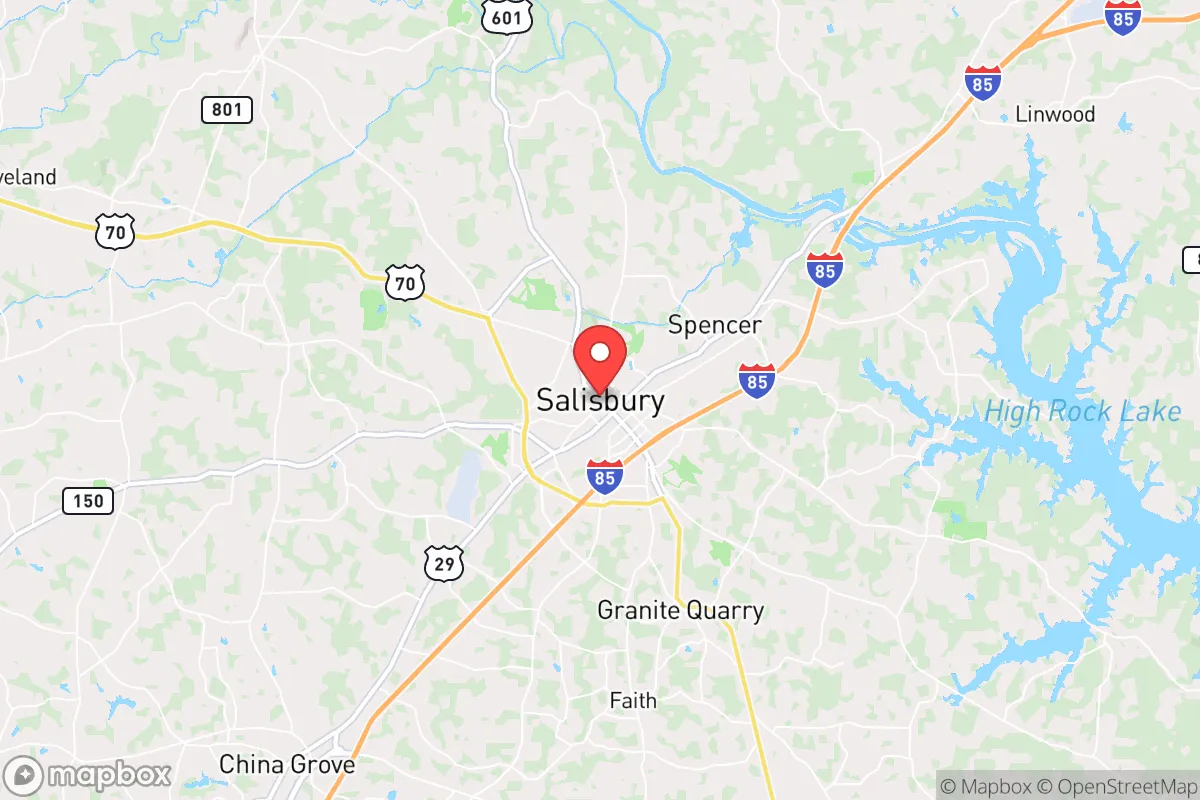
Photo: Wikipedia
Personal Sovereignty in Salisbury, NC
Viable for self-reliance. Generally workable, though some barriers may limit total independence.
What does Personal Sovereignty tell us?
Personal Sovereignty measures your capacity for self-reliance and independence with minimal government friction. Higher scores mean fewer barriers between you and the way you want to live... but it assumes you have the space you need and good neighbors.
What does this tell us?
Personal Sovereignty measures your capacity for self-reliance and independence with minimal government friction. Higher scores mean fewer barriers between you and the way you want to live... but it assumes you have the space you need and good neighbors.
State Policy
Energy independence: Importer (15% of energy produced in-state)
Personal Liberty
Homesteading

Personal Liberty Analysis
Salisbury, North Carolina, offers a notably high degree of personal sovereignty compared to many urban and coastal jurisdictions, functioning as a pocket of relative autonomy within a state that has historically resisted heavy-handed government overreach. For the individual or family operating from a survivalist or prepper mindset, the city’s environment is defined less by what the local government does and more by what it refrains from doing. The prevailing political culture in Rowan County leans heavily toward limited interference in daily life, property use, and personal defense, making it a viable base for those seeking to minimize entanglements with state authority while maintaining access to regional infrastructure. This analysis examines the specific pillars of that sovereignty—tax burden, self-defense law, homesteading feasibility, and personal liberties—to determine whether Salisbury delivers on its promise of freedom or merely offers a quieter version of the same constraints found elsewhere.
Tax burden and regulatory posture: how much the state takes and how much it interferes
North Carolina’s tax structure is a mixed bag for the sovereignty-minded, but Salisbury sits in a relatively favorable position within that framework. The state’s flat income tax rate of 4.5% (as of 2026, with a scheduled decline to 3.99% by 2027) is moderate, but the real burden falls on property owners. Rowan County’s property tax rate is approximately $0.6275 per $100 of assessed value, which is below the state average and significantly lower than Mecklenburg County’s $0.89 rate just 40 miles south. For a $250,000 home, that translates to roughly $1,569 annually—a manageable figure that leaves more capital for self-reliant investments like land improvements, water storage, or solar arrays. Sales tax in Salisbury sits at 7%, with 2% going to the county and local governments, but essential preparedness items like bulk food, tools, and building materials are exempt from sales tax in many cases. The regulatory posture is where Salisbury truly shines: the city has no overly burdensome business licensing requirements for home-based enterprises, and zoning codes are generally permissive for small-scale agriculture, workshops, and storage. There is no city-level income tax, and the county’s approach to code enforcement is reactive rather than proactive—meaning you won’t get a knock on the door for a slightly overgrown lot unless a neighbor complains. For those who view every dollar taxed and every regulation imposed as a loss of personal agency, Salisbury’s fiscal and regulatory environment is a net positive, though not as aggressively libertarian as rural counties further west.
Self-defense and gun law specifics: what you can carry, where, and how the law backs you
North Carolina is a shall-issue state for concealed carry permits, and Salisbury’s local law enforcement does not add extra hurdles beyond the state’s requirements. The permit process involves a background check, fingerprints, and an 8-hour training course, but there is no discretionary denial—if you meet the criteria, the sheriff must issue the permit. Rowan County’s sheriff’s office has a reputation for being pro-Second Amendment, and permit processing times typically run 45 to 90 days, which is reasonable compared to the six-month delays seen in more restrictive states. Open carry is legal without a permit for anyone who can legally possess a firearm, though carrying a concealed handgun without a permit is a misdemeanor. Stand-your-ground laws are fully in effect: there is no duty to retreat in any place you have a lawful right to be, and the Castle Doctrine applies to your home, vehicle, and workplace. This is critical for the prepper mindset—if a situation escalates on your property or in your vehicle, the law is on your side as long as you are not the initial aggressor. Magazine capacity is not restricted, and there is no state-level assault weapons ban. The only notable limitation is that concealed carry is prohibited in places that serve alcohol (unless you are not drinking), on school grounds (with a permit exception for pickup/drop-off), and in government buildings with security screening. For the survivalist, Salisbury offers a legal environment where your defensive capabilities are largely your own business, and the local authorities are not looking to create additional restrictions beyond what the state mandates.
Self-reliance and homesteading viability: lot sizes, zoning, and off-grid feasibility
Within Salisbury’s city limits, homesteading is possible but constrained by typical suburban zoning. Minimum lot sizes in residential zones range from 6,000 to 12,000 square feet, which limits the scale of food production and water independence. However, the city’s zoning code explicitly allows for “community gardens” and “urban agriculture” as accessory uses, and keeping chickens is permitted on lots of 10,000 square feet or more (with a limit of six hens, no roosters). Goats and other livestock are generally not allowed within city limits, but the real opportunity lies just outside the municipal boundary. In unincorporated Rowan County, zoning is far more permissive: lots as small as one acre can support a small homestead, and there are no county-level restrictions on rainwater collection, composting toilets, or solar panel installation. The county does not require building permits for structures under 200 square feet, which means a storage shed, workshop, or small greenhouse can be erected without government approval. Off-grid feasibility is high in the surrounding rural areas: the water table is accessible with a shallow well (typically 50 to 150 feet), and the region receives an average of 45 inches of rainfall annually, making rainwater catchment a viable primary water source. Solar potential is good, with roughly 4.5 peak sun hours per day, and net metering is available through Duke Energy, though the utility’s interconnection process can be bureaucratic. For the prepper looking to establish a self-sufficient property, the sweet spot is a 2- to 5-acre parcel in the county’s extraterritorial jurisdiction (ETJ), where you can drill a well, install solar, raise chickens and goats, and store supplies without constant oversight from code enforcement. Salisbury itself is a good base for supplies and employment, but the true sovereignty lies in the surrounding rural buffer.
Personal liberties: parental rights, medical autonomy, speech, and property
North Carolina has a mixed record on parental rights, but Salisbury’s local school board and county government lean toward deference to parents. The state does not have a universal school choice program, but charter schools and homeschooling are well-established: homeschool parents must file a notice of intent with the state and maintain annual standardized testing, but there is no curriculum approval or home visit requirement. Rowan-Salisbury Schools have a relatively conservative board that has resisted controversial curriculum mandates, and the district allows parents to opt their children out of specific instructional materials without a formal hearing process. Medical autonomy is a weaker point: North Carolina has not expanded Medicaid under the Affordable Care Act, but it also has not imposed vaccine mandates beyond the standard school-entry requirements, and there is no state-level religious or philosophical exemption for childhood vaccines—though exemptions are available for medical and religious reasons, and enforcement is lax in practice. Free speech protections are robust, as North Carolina is not a state that has enacted broad “hate speech” laws or social media content moderation mandates that would chill private expression. Property rights are strongly protected: the state has a right-to-farm law that shields agricultural operations from nuisance lawsuits, and eminent domain is limited to public use projects with just compensation. For the individual concerned with government overreach, the key takeaway is that Salisbury’s local governance is characterized by a “live and let live” attitude, with the most significant threats to personal sovereignty coming from the state level (e.g., potential future vaccine mandates or school curriculum changes) rather than from city or county officials. The local political climate is such that you can generally speak your mind, raise your children according to your values, and use your property as you see fit, as long as you are not creating a public nuisance.
In the broader context of the Southeast, Salisbury ranks as a solid mid-tier location for personal sovereignty—not as free as the truly rural counties of western North Carolina or the libertarian-leaning areas of New Hampshire, but significantly more autonomous than the heavily regulated cities of the Northeast, West Coast, or even the Research Triangle. The city offers a practical balance: you can live a self-reliant lifestyle with minimal government interference, access regional supply chains and medical facilities, and still be within a two-hour drive of the Appalachian Mountains for deeper retreat options. The primary vulnerabilities are the state-level political shifts that could tighten gun laws or expand vaccine mandates, and the creeping suburbanization that may eventually bring more restrictive zoning to the county’s ETJ. For the strategic relocation decision, Salisbury works best as a forward operating base—a place to establish a legal residence, build a homestead on the outskirts, and maintain a low profile while keeping an eye on the horizon for further erosion of freedoms elsewhere. It is not a fortress of liberty, but it is a defensible position in a country where such positions are becoming harder to find.

* Values derived from national, state, county, city and local statistics and may differ in a specific area. Last updated: 2026-05-03T20:27:02.000Z
Narrative content on this page is AI-generated and may contain mistakes. Verify any details that matter before acting on them.
ReloMaps may earn a commission from affiliate links at no extra cost to you.

