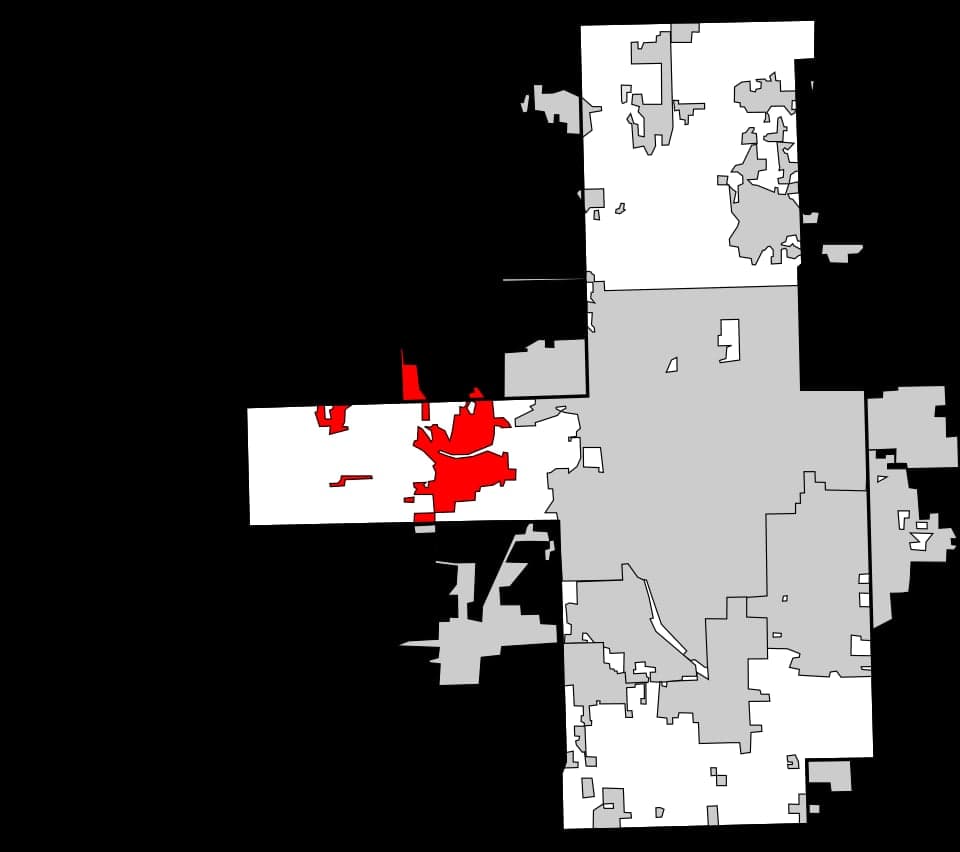
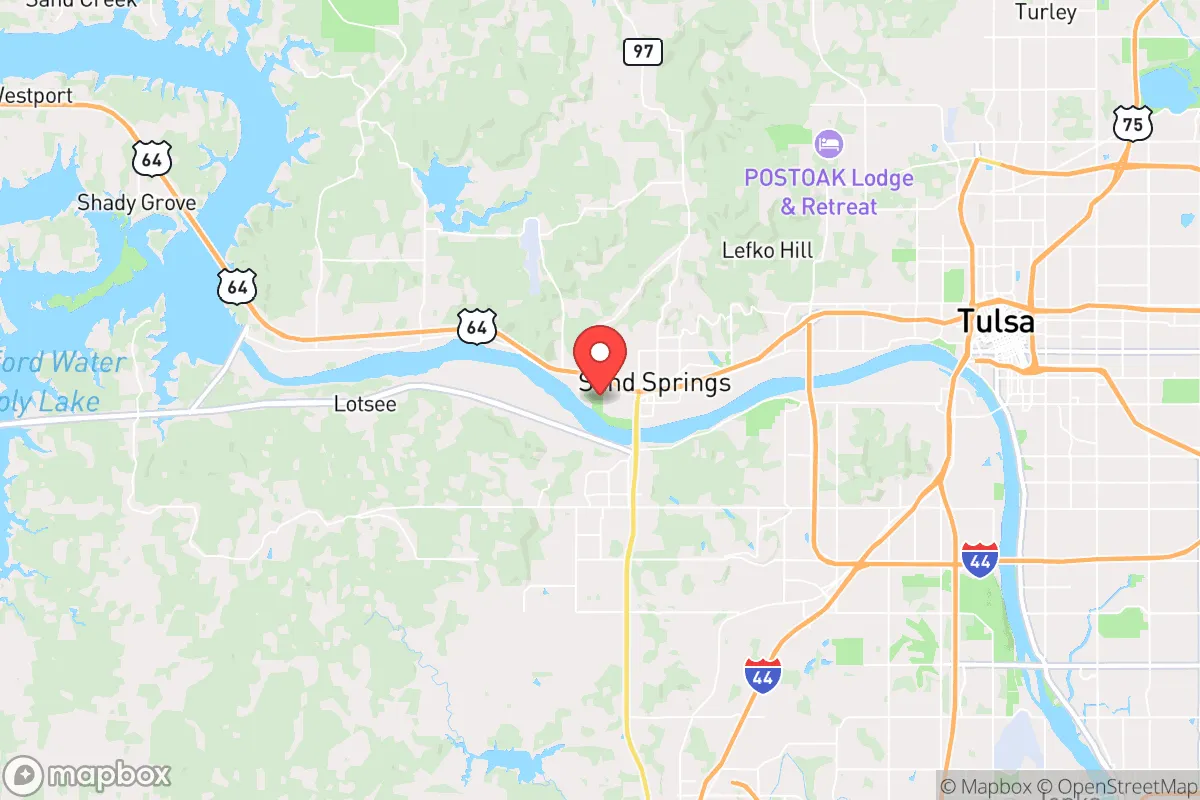
Photo: Wikipedia
Demographics of Sand Springs, OK
Affluence Level in Sand Springs, OK
A middle-class area roughly in line with national averages across income, home values, education, and employment.
People of Sand Springs, OK
The people of Sand Springs, Oklahoma, today form a predominantly white, family-oriented community of just under 20,000 residents, characterized by a strong sense of local identity and a notably low foreign-born population of 0.8%. With a population density of roughly 1,200 people per square mile, the city feels like a compact, established suburb rather than a sprawling exurb. Distinctive markers include a deep-rooted connection to the city's industrial and philanthropic founding, a population that is 77.2% white and 5.7% Hispanic, and a college attainment rate of 25.1%, reflecting a mix of working-class and professional households.
How the city was settled and grew
Sand Springs was not a pioneer settlement but a planned industrial town, founded in 1911 by oil magnate Charles Page. Page purchased the land with the explicit goal of creating a model community for the region's oil-field workers and their families, drawing the first major wave of population from the surrounding Oklahoma Territory and neighboring states. The original settlement clustered around the downtown core and the industrial corridor along the Arkansas River, with early neighborhoods like Page Park and Old Town built to house the workers of the Page Oil Company and the Sand Springs Railway. A second, distinct wave arrived during the 1920s and 1930s, when Page expanded his vision to include a home for widows and orphans, attracting a small but notable population of social-service workers and caregivers. The city's growth remained steady through the mid-20th century, fueled by the expansion of local manufacturing and the opening of the Sand Springs Home, which anchored the Home Addition neighborhood. By 1960, the population had reached roughly 7,000, almost entirely white and native-born, with a strong cultural identity tied to the Page legacy and the oil economy.
Modern era (post-1965)
Following the 1965 Immigration and Nationality Act, Sand Springs experienced minimal demographic change compared to larger Oklahoma cities. The foreign-born population remained negligible, and the city did not become a destination for post-1965 immigrant communities. Instead, the dominant population shift was domestic: suburbanization from Tulsa, located just 10 miles east. From the 1970s through the 1990s, middle-class white families moved into newer subdivisions like River Oaks and Pecan Creek, drawn by lower housing costs and the perception of safer schools. The Hispanic population, now 5.7%, began a modest increase in the 1990s and 2000s, concentrated in the Prattville area and the older, more affordable housing stock near downtown. The Black population, at 1.9%, and the East/Southeast Asian population, at 0.6%, remain very small and are dispersed across the city without forming distinct ethnic enclaves. The Indian-subcontinent population is effectively zero. The college-educated share, at 25.1%, is below the national average, reflecting the city's continued working-class character even as some professional households have moved in from Tulsa.
The future
The population of Sand Springs is heading toward slow, modest homogenization rather than rapid diversification. The city's population has grown only marginally since 2010, and the foreign-born share is unlikely to rise significantly given the lack of established immigrant networks or major employers that recruit internationally. The Hispanic share may continue a gradual increase, likely remaining concentrated in the older neighborhoods like Prattville and Old Town, but is not expected to reach double digits within the next decade. The white population, while still the overwhelming majority, may see a slight relative decline as younger families move to newer suburbs farther from Tulsa. The city is not tribalizing into distinct ethnic enclaves; rather, it is becoming a more uniformly middle-class, native-born community with a stable demographic profile. The next 10-20 years will likely see continued slow growth, with the population remaining overwhelmingly white and native-born, and the small Hispanic community gradually assimilating into the broader social fabric.
For someone moving in now, Sand Springs is becoming a stable, predictable, and culturally homogeneous suburb — a place where the population is not changing rapidly, and where the dominant identity remains rooted in the city's early-20th-century founding and its enduring connection to the Tulsa metro area. The low foreign-born share and minimal ethnic diversity mean that newcomers will find a community where the social and political norms are largely uniform, and where the pace of demographic change is slow enough to feel negligible over a typical residency.

* Values derived from national, state, county, city and local statistics and may differ in a specific area. Last updated: 2026-04-25T13:53:20.000Z
Narrative content on this page is AI-generated and may contain mistakes. Verify any details that matter before acting on them.
ReloMaps may earn a commission from affiliate links at no extra cost to you.

