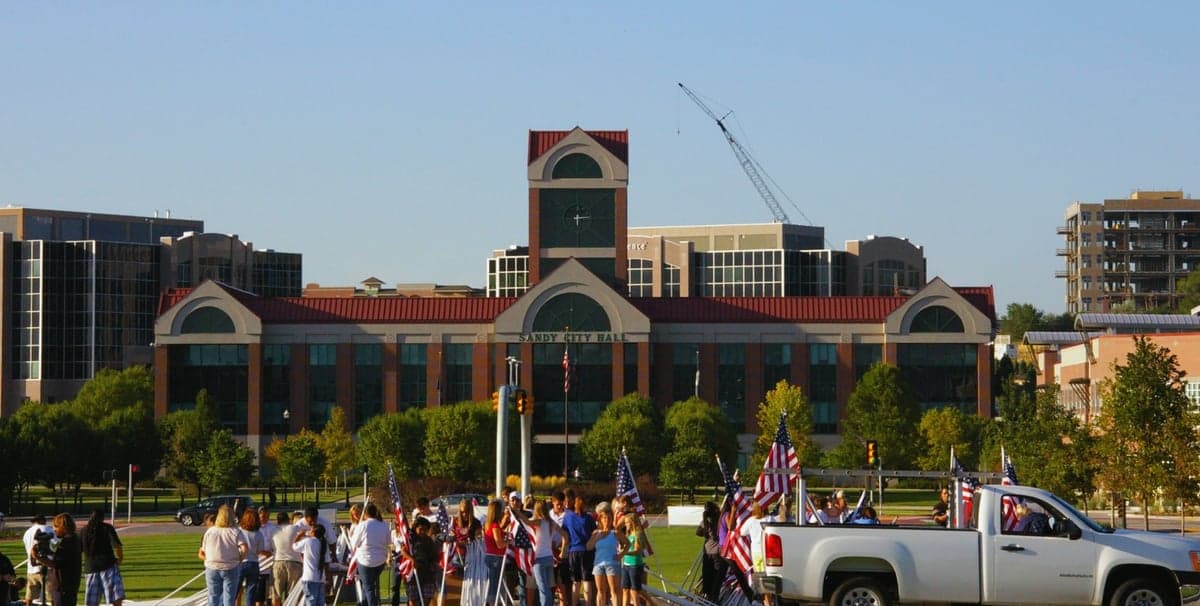
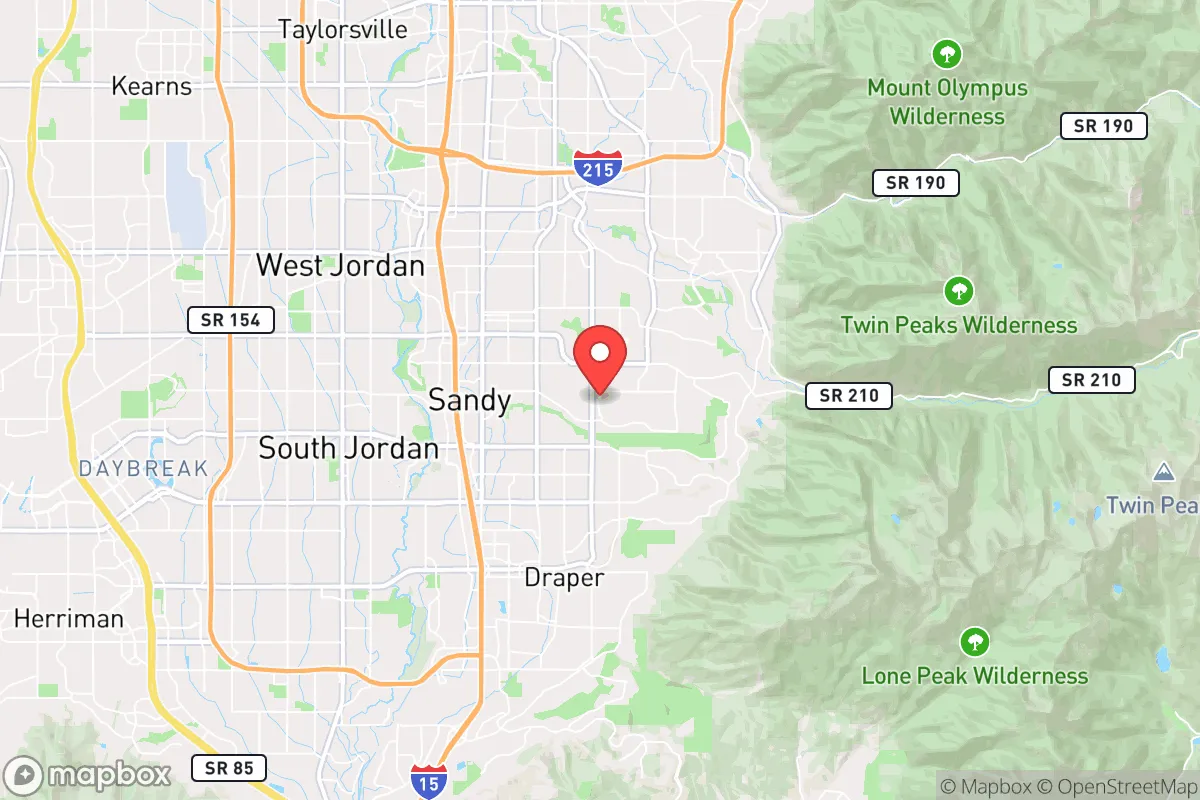
Photo: Wikipedia
Demographics of Sandy, UT
Historical data isn't available for Sandy, UT. Trends shown are for Salt Lake County, UT.
Affluence Level in Sandy, UT
An upper-middle-class area. Household wealth, education levels, and homeownership run ahead of national benchmarks.
People of Sandy, UT
The people of Sandy, Utah, today number 94,723 and form one of the most educated and economically stable suburban populations in the Salt Lake Valley. With a population that is 78.6% white, 11.3% Hispanic, and 2.7% East/Southeast Asian, the city carries a distinctly family-oriented, Latter-day Saint-influenced character while gradually diversifying. Its 5.0% foreign-born share is notably low for a metro area of its size, reflecting a community built primarily through domestic in-migration rather than international immigration. Sandy’s identity is rooted in its role as a safe, high-amenity suburb where 45.7% of adults hold a college degree and where neighborhood names like Willow Creek, Alta Canyon, and East Sandy still carry the legacy of the families who settled them.
How the city was settled and grew
Sandy was not a pioneer-era settlement. Its growth began in earnest after the transcontinental railroad reached the area in the 1870s, drawing Mormon settlers from Salt Lake City and immigrants from the British Isles and Scandinavia who worked in local smelters and farms. The original population clustered around the historic Sandy Downtown district, where small brick homes and commercial buildings still mark the city’s earliest residential core. By 1900, the population was overwhelmingly white, native-born, and LDS, with a small enclave of Italian and Greek immigrant families working in the region’s copper smelters. The city remained a modest agricultural and industrial town through the 1940s, with fewer than 2,000 residents. The post-World War II boom brought the first major wave of domestic in-migration: returning veterans and young Mormon families from rural Utah who built homes in the Hillcrest and Alta Canyon neighborhoods, drawn by affordable land and proximity to Salt Lake City’s growing job market. These subdivisions were almost entirely white and LDS, setting the cultural template that persists today.
Modern era (post-1965)
The 1965 Hart-Cellar Act had minimal direct impact on Sandy’s demographics, as the city remained overwhelmingly white and native-born through the 1980s. The real transformation came from domestic suburbanization: between 1970 and 2000, Sandy’s population exploded from roughly 6,000 to over 88,000 as families from across Utah and the Mountain West moved into master-planned communities like Willow Creek and Dimple Dell. These neighborhoods were designed around large single-family homes, cul-de-sacs, and LDS ward boundaries, reinforcing the city’s homogeneous character. The Hispanic population began to grow in the 1990s, settling primarily in the East Sandy area and along the State Street corridor, where older, more affordable housing stock and rental properties provided entry points. Today, Sandy’s Hispanic share of 11.3% is concentrated in these eastern and southern edges, while the East/Southeast Asian population of 2.7% is more dispersed, with clusters near the Alta View neighborhood and around the Sandy Civic Center. The Indian-subcontinent population remains very small at 0.8%, with no distinct enclave. The Black population, at 0.6%, is similarly scattered. Sandy’s modern era is thus defined not by international immigration but by the steady arrival of white, college-educated families from within the Intermountain West, who have maintained the city’s conservative, family-centric character even as its economy has shifted from agriculture to tech and professional services.
The future
Sandy’s demographic trajectory points toward slow, incremental diversification rather than rapid change. The foreign-born share of 5.0% is unlikely to rise sharply, as the city’s high housing costs—median home values exceed $600,000—and limited rental stock restrict in-migration from immigrant gateway cities. The Hispanic population is growing steadily through natural increase and secondary migration from other Utah cities, but remains concentrated in the East Sandy corridor and is unlikely to reach the 20% threshold seen in neighboring West Valley City. The East/Southeast Asian and Indian populations are growing from a very small base, driven by tech-sector employment at companies like eBay and Oracle in nearby Draper, but these groups are assimilating into Sandy’s existing suburban fabric rather than forming distinct ethnic enclaves. The white population, while still dominant, is aging and slowly declining in share as younger, more diverse families move into the Willow Creek and Alta Canyon neighborhoods. Over the next 10–20 years, Sandy will likely remain a predominantly white, highly educated, LDS-influenced suburb, but with a growing Hispanic minority and a thin layer of Asian and Indian professionals. The city is not tribalizing into distinct enclaves; rather, it is slowly homogenizing around a middle-class, family-oriented identity that absorbs newcomers into its existing neighborhoods.
For someone moving in now, Sandy offers a stable, safe, and well-educated community where the population is predictable and the culture is deeply rooted in Mormon traditions of family, volunteerism, and civic order. The city is not becoming more diverse in the way that coastal suburbs are; instead, it is gently diversifying while maintaining its core character. New residents—whether white, Hispanic, or Asian—will find a place where neighborhood identity still matters, where Willow Creek and Alta Canyon remain recognizable communities, and where the future looks very much like the present, only slightly more varied.

* Values derived from national, state, county, city and local statistics and may differ in a specific area. Last updated: 2026-04-21T12:15:38.000Z
Narrative content on this page is AI-generated and may contain mistakes. Verify any details that matter before acting on them.
ReloMaps may earn a commission from affiliate links at no extra cost to you.

