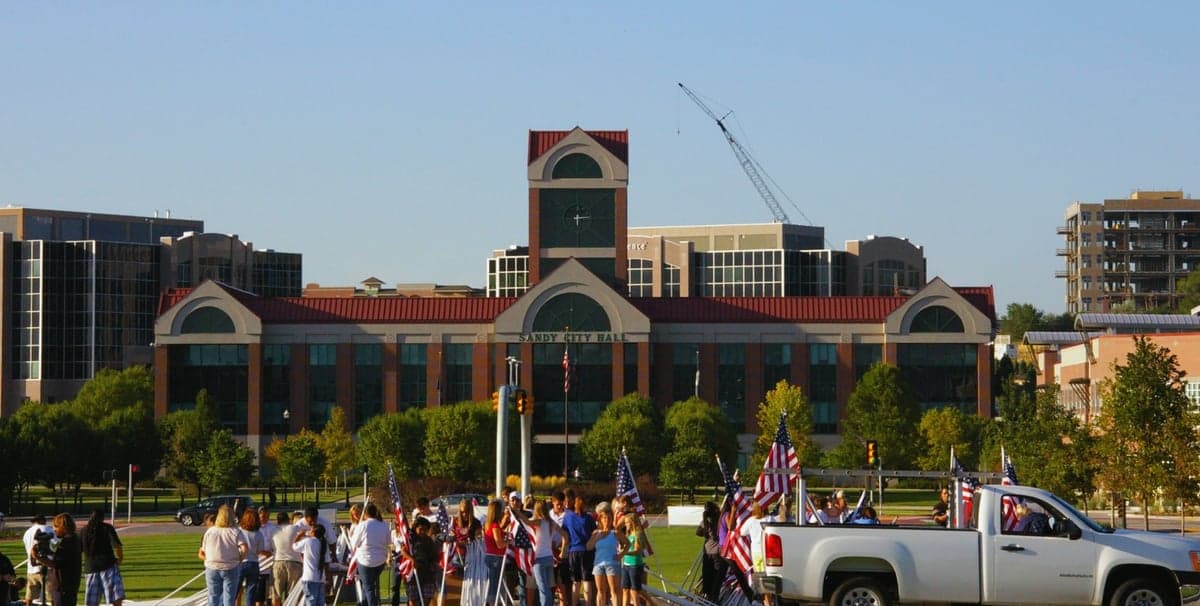
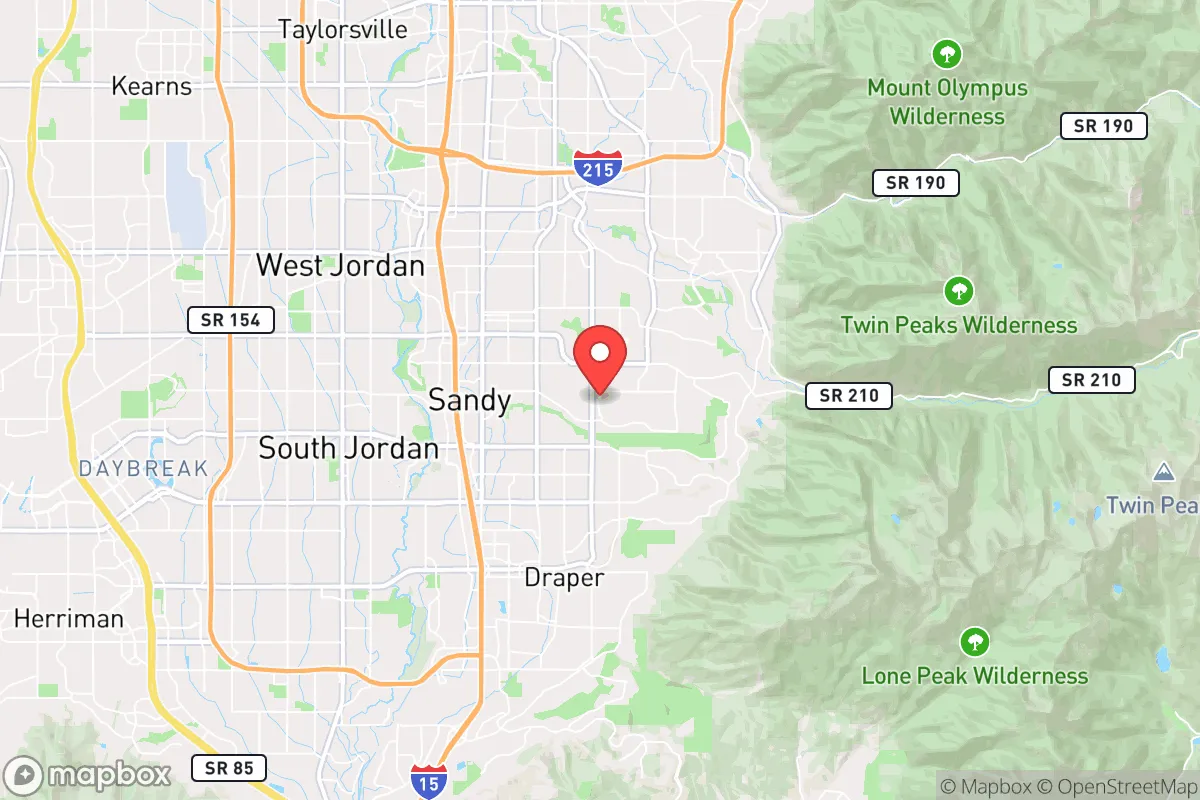
Photo: Wikipedia
Personal Sovereignty in Sandy, UT
Viable for self-reliance. Generally workable, though some barriers may limit total independence.
What does Personal Sovereignty tell us?
Personal Sovereignty measures your capacity for self-reliance and independence with minimal government friction. Higher scores mean fewer barriers between you and the way you want to live... but it assumes you have the space you need and good neighbors.
What does this tell us?
Personal Sovereignty measures your capacity for self-reliance and independence with minimal government friction. Higher scores mean fewer barriers between you and the way you want to live... but it assumes you have the space you need and good neighbors.
State Policy
Energy independence: Self-sufficient (80% of energy produced in-state)
Personal Liberty
Homesteading

Personal Liberty Analysis
Sandy, Utah, offers a notably high degree of personal sovereignty compared to many urbanized Western cities, but it is not a libertarian free-for-all. The city sits within a state that actively champions individual rights in areas like gun ownership and parental control, yet it operates under a municipal framework that enforces strict land-use codes and a moderate tax structure. For the strategic-minded individual or family concerned with government overreach, Sandy represents a calculated trade-off: strong constitutional protections at the state level, balanced against a well-ordered, suburban regulatory environment that can feel restrictive to those seeking maximum autonomy.
Tax burden and regulatory posture: How Utah’s fiscal conservatism affects Sandy
Utah’s overall tax burden is among the lowest in the nation, and Sandy residents benefit directly from this. There is no state income tax on Social Security benefits, and the flat state income tax rate of 4.65% (as of 2025) is moderate. Property taxes in Sandy are reasonable for the Wasatch Front, with effective rates typically hovering around 0.6% to 0.7% of assessed value—lower than in neighboring Salt Lake County cities like Holladay or Cottonwood Heights. The city’s regulatory posture is business-friendly but not lax. Sandy enforces a detailed zoning code that prioritizes master-planned communities and commercial corridors, which limits the ability to run a home-based manufacturing or repair business without a conditional use permit. For the prepper or survivalist, this means you won’t face the heavy-handed business licensing seen in California or Oregon, but you also cannot simply convert a residential garage into a metal fabrication shop without city approval. The state’s lack of a personal property tax on vehicles and boats is a clear win for asset holders.
Self-defense and gun law specifics: What Sandy residents can and cannot do
Utah is a shall-issue state for concealed carry permits, and Sandy residents enjoy the full force of state preemption—meaning local ordinances cannot restrict firearm possession beyond state law. Open carry is legal without a permit for anyone 21 or older who can legally possess a firearm. The state’s permitless carry law (effective since 2021) allows law-abiding adults to carry a concealed firearm without a license, though a permit is still recommended for reciprocity when traveling. Sandy itself has no additional gun control measures; the city council has not attempted to enact magazine capacity limits or safe storage mandates, unlike some municipalities in Colorado or Washington. Utah’s stand-your-ground law is unambiguous: there is no duty to retreat in any place where a person has a lawful right to be. For the survivalist, this is critical—the legal framework supports defensive use of force without the risk of prosecution for failing to flee. The only notable restriction is that carrying a firearm into a church or private residence with posted signage can result in a trespassing charge, so situational awareness is required.
Self-reliance and homesteading viability: Lot sizes, zoning, and off-grid feasibility
Sandy’s suburban character limits large-scale homesteading. Typical residential lots range from 0.15 to 0.35 acres in most subdivisions, with a few older neighborhoods offering half-acre parcels. The city’s zoning code explicitly prohibits keeping livestock—including chickens, goats, and bees—on lots under one acre, and even then, only with a special permit. Off-grid living is effectively impossible within city limits. Sandy requires connection to municipal water and sewer, and the building code mandates grid-tied electrical systems. Solar panels are allowed, but net metering rules from Rocky Mountain Power mean you cannot disconnect from the grid without facing significant legal hurdles. For the prepper seeking true self-reliance, this is a dealbreaker. However, the surrounding unincorporated areas of Salt Lake County (like parts of Copperton or the foothills near Corner Canyon) offer larger parcels—up to 5 or 10 acres—where well water, septic systems, and limited livestock are feasible. Sandy itself is better suited for the urban prepper focused on stockpiling, community defense, and financial resilience rather than agricultural independence.
Personal liberties: Parental rights, medical autonomy, speech, and property
Utah has some of the strongest parental rights laws in the nation. Utah Code §53G-6-803 explicitly grants parents the right to direct their child’s education and medical care, including the ability to opt out of any curriculum or health service without penalty. Sandy’s school district, Canyons School District, has a conservative board that generally defers to parental authority on issues like sex education and vaccination requirements. Medical autonomy is more mixed. Utah does not have a state-level vaccine mandate for adults, but employers in Sandy—especially in healthcare and tech—may require COVID-19 or flu shots as a condition of employment. The state’s 2023 law banning gender-affirming surgeries for minors is a clear win for those concerned about medical overreach. Free speech is robustly protected under Utah’s state constitution, and Sandy has not attempted to regulate political signage or public assembly beyond standard time-place-manner restrictions. Property rights are strong, but not absolute. The city’s zoning board has broad discretion to deny variances, and the state’s eminent domain laws allow for takings with just compensation—though this is rarely exercised in Sandy. For the liberty-minded individual, the biggest frustration is likely the homeowners’ association (HOA) presence: roughly 60% of Sandy’s residential properties fall under an HOA, which can impose rules on exterior paint, landscaping, and even parking. Avoiding HOA-controlled neighborhoods is possible but requires targeting older, unincorporated pockets or the few non-HOA subdivisions east of State Street.
In the broader landscape of American personal sovereignty, Sandy ranks well above the national average for a city of its size. It lacks the extreme regulatory hostility of Portland or Seattle, the tax burden of New York or California, and the gun control of Illinois or Massachusetts. However, it also lacks the wide-open autonomy of rural Montana or Idaho. For the survivalist or prepper who values community resilience, strong gun laws, and low taxes but is willing to accept suburban zoning and HOA restrictions, Sandy is a solid strategic choice. The real test of sovereignty here is not what the city allows, but what the state protects—and Utah’s constitutional framework gives Sandy residents a legal shield that many other metro areas cannot match. If you can tolerate the HOA and the 0.25-acre lot, you gain a foothold in one of the most liberty-friendly states in the Union, with a local government that generally stays out of your business as long as you stay within the lines.

* Values derived from national, state, county, city and local statistics and may differ in a specific area. Last updated: 2026-04-21T12:15:38.000Z
Narrative content on this page is AI-generated and may contain mistakes. Verify any details that matter before acting on them.
ReloMaps may earn a commission from affiliate links at no extra cost to you.

