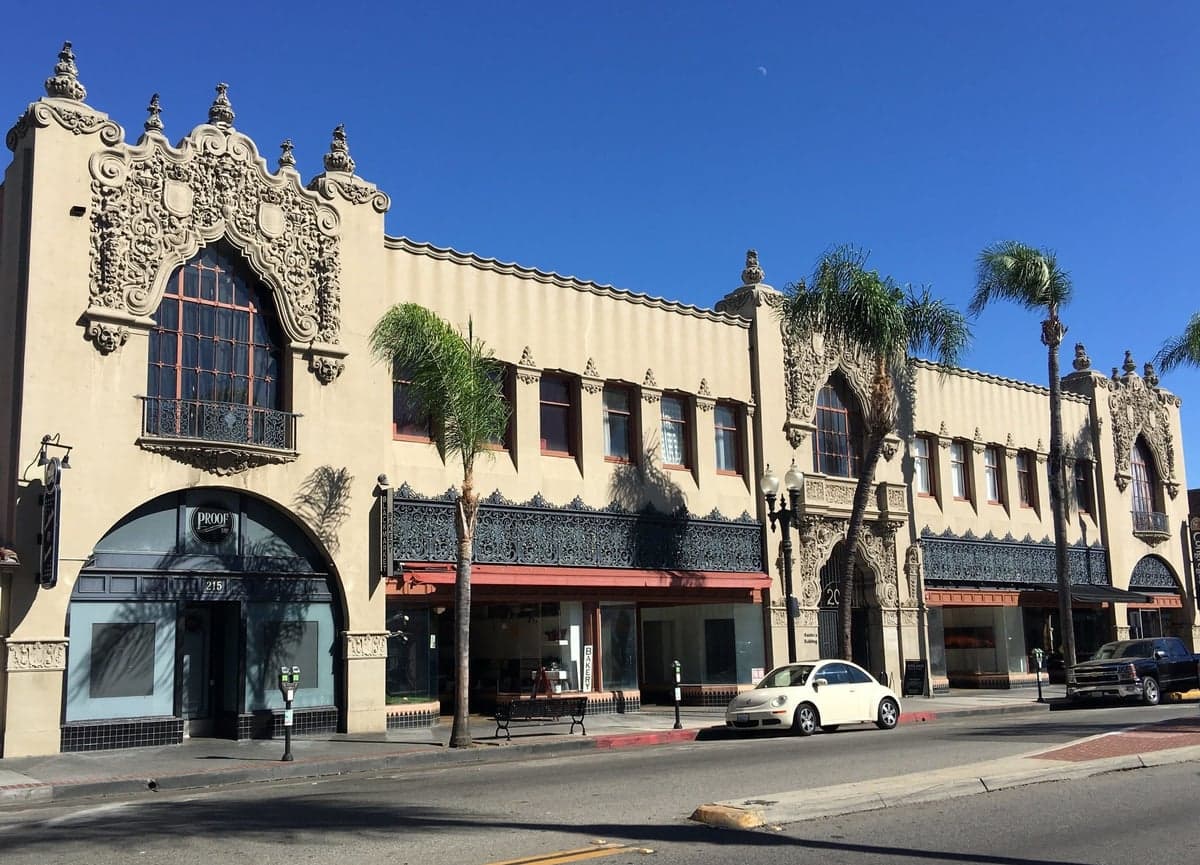
Photo: Wikipedia
Strategic Assessment of Santa Ana, CA
High tactical risk. This location is likely close to major population centers, strategic targets, or sits in a high-disaster corridor. A retreat property and careful exit planning is required.
What does the Strategic Assessment tell us?
Our Strategic Assessment grades tactical survivability of an area. Major population centers, military targets, fallout zones, natural disasters, and border exposure all drive risk — lower exposure means a more defensible position in a crisis.
This is heavily inspired by Joel Skousen's Strategic Relocation book. Highly recommended you checkout the book ($)What does this tell us?
Our Strategic Assessment grades tactical survivability of an area. Major population centers, military targets, fallout zones, natural disasters, and border exposure all drive risk — lower exposure means a more defensible position in a crisis.
This is heavily inspired by Joel Skousen's Strategic Relocation book. Highly recommended you checkout the book ($)Strategic Pillars

Key Distances
Regional Safe Places
Below is our recommended "safe zones" in California and the surrounding area based on our strategic heuristics. For most people, it's unrealistic to live in a “safe zone” full-time due to work, family or other personal reasons. They tend to be more rural. However, many of these areas are perfect for second homes and retreat properties that double as a vacation home or even a short-term rental.

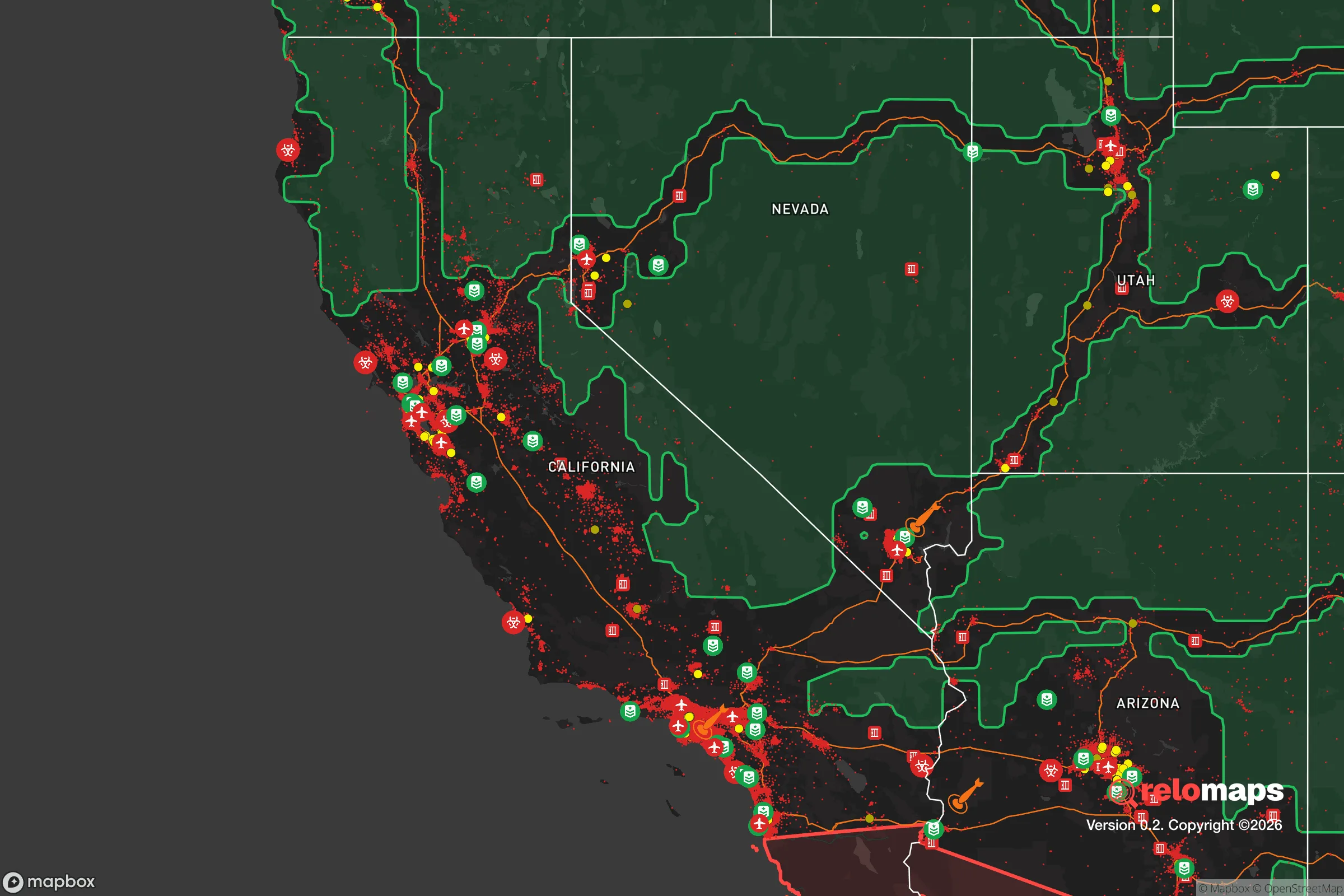


Important Note: For informational purposes only. This does not mean nothing bad ever happens in the green zones. Please use common sense. This is based on public data and modeled with AI. We tried to take a conservative approach but mistakes happen. We update this regularly as new information becomes available.
Solar Generator Recommendations
Backup power matters more here than in safer locations. We've picked three solar generators across budgets and capacity tiers — start with the budget unit if you only need a few essentials, or step up if you want to run a fridge and HVAC for days at a time.

Jackery Portable Power Station Explorer 300
Budget OptionPower on the Go: Weighing only 11 lbs, it's convenient to set up and store with book-sized foldable solar panels

BLUETTI Portable Power Station AC180
Designed for both indoor and outdoor scenarios, AC180 is highly capable as it has a robost capacity and continuous output power.

EF ECOFLOW DELTA Pro Ultra Power Station
Upgraded PickEcoFlow DELTA Pro Ultra is a whole-home energy system designed to grow with your family. Integrated with the Smart Home Panel 2, it scales to meet your evolving energy needs — keeping your home powered, intelligent, and secure through every stage of life.
We earn a commission, at no additional cost to you.
Strategic Assessment Analysis
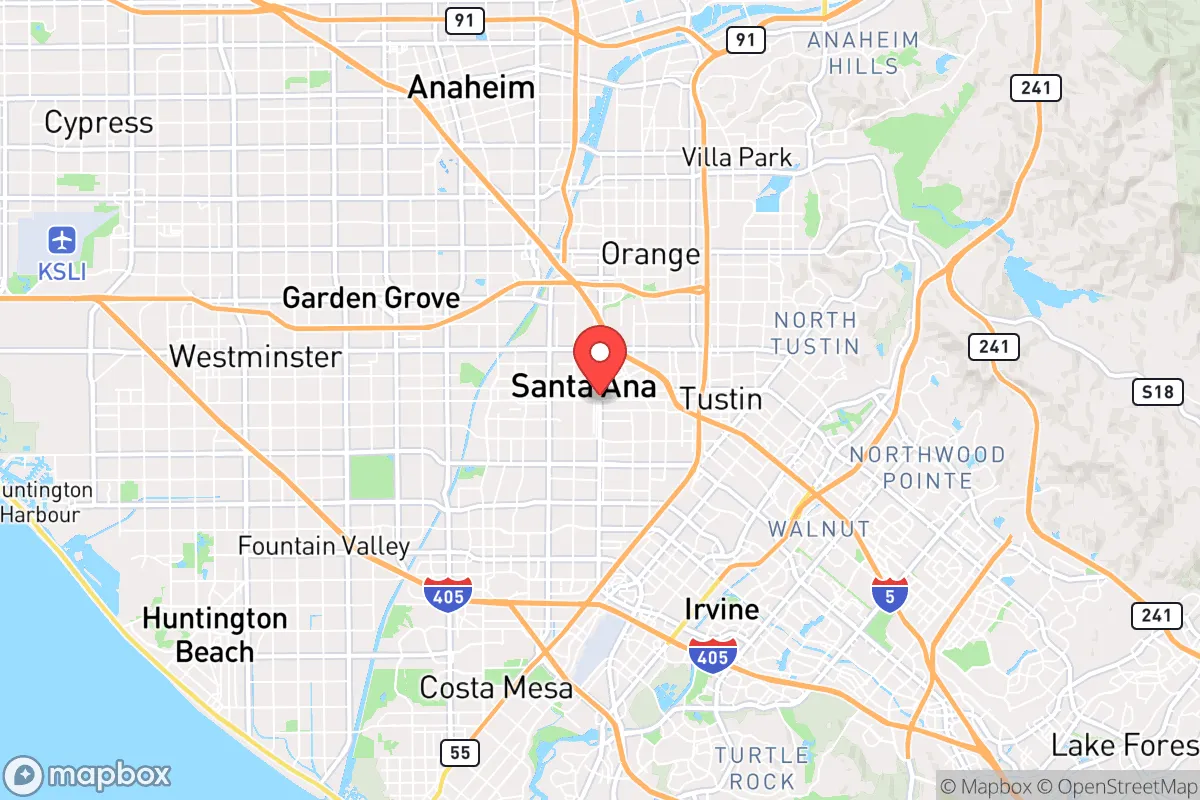
Santa Ana presents a complex strategic picture for the conservative prepper. Its location in the heart of Orange County offers undeniable economic and logistical advantages, but its density, proximity to major geopolitical targets, and deep-blue governance create significant vulnerabilities. For a relocator prioritizing long-term resilience, Santa Ana is best understood as a high-risk, high-reward staging ground—a place to build capital and connections before moving to a more defensible position, rather than a final bug-out destination.
Geographic position and natural advantages for a strategic relocation
Santa Ana sits in a flat coastal basin, roughly 10 miles from the Pacific Ocean, giving it a moderate Mediterranean climate that rarely requires extreme heating or cooling. This reduces energy dependency and makes year-round outdoor activity viable—a plus for self-sufficiency projects like gardening or rainwater catchment. The area is served by the Santa Ana River, a concrete-lined flood control channel that, while not potable, provides a potential water source in a grid-down scenario if properly filtered. The nearby Cleveland National Forest, about 20 miles east, offers a potential bug-out location with dense cover and elevation, though it's heavily patrolled and not a true wilderness. The region's major highways—I-5, I-405, and SR-55—provide multiple egress routes, but these are notorious for congestion and would be choke points during an evacuation. For a relocator, the key natural advantage is the mild climate and proximity to both ocean and mountains, offering diverse terrain for retreat planning. However, the flat, urbanized landscape offers little natural defensibility; you're relying on man-made structures and community networks for security.
Risks, exposures, and proximity to fallout-relevant landmarks
This is where Santa Ana's strategic value drops sharply. The city lies within 30 miles of Los Angeles International Airport (LAX), the Port of Long Beach, and the San Pedro Bay port complex—all high-value targets for a state-level adversary or a terrorist organization. A nuclear detonation at the ports would produce fallout that could reach Santa Ana within hours, depending on wind patterns. The nearby San Onofre Nuclear Generating Station (SONGS), though decommissioned, still stores spent fuel on site, and a catastrophic failure or attack could render large swaths of coastal Orange County uninhabitable. Santa Ana itself is a dense urban core with a population density of over 12,000 people per square mile. In a civil unrest scenario—like the 1992 Los Angeles riots or the 2020 George Floyd protests—this density becomes a liability. The city's proximity to major freeways and the John Wayne Airport (SNA) means it's a transit hub, which also makes it a target for coordinated attacks. The 2024 Orange County Sheriff's Department threat assessment noted that Santa Ana's gang activity and organized crime networks could be exploited by bad actors during a crisis, creating internal security risks. For the prepper, the calculus is clear: you are within the blast radius of multiple high-value targets, and the city's layout offers little natural cover or escape.
Practical resilience for a relocator: food, water, energy, and defensibility
On the practical side, Santa Ana offers some surprising advantages for the prepared individual. The city's water supply comes from the Metropolitan Water District of Southern California, which draws from the Colorado River and State Water Project. This is a fragile system—vulnerable to earthquake disruption, drought, and sabotage. A savvy relocator should install a 1,500-gallon rainwater catchment system (legal in California with proper permits) and stock at least 90 days of water. The local soil is sandy loam, suitable for raised-bed vegetable gardens, and the year-round growing season allows for continuous harvests of tomatoes, peppers, and leafy greens. Energy-wise, the region has high solar insolation; a rooftop solar array with battery storage (like a Tesla Powerwall) can provide off-grid power for months, though the city's building codes and HOA restrictions can be a headache. Defensibility is the weak link. Santa Ana is a grid of flat, straight streets with limited chokepoints. A single-family home with a solid fence, reinforced doors, and a clear line of sight to the street is about the best you can do. The city's police department is well-funded but stretched thin—response times in a major event could be hours. For food storage, the local Costco and Smart & Final are reliable, but in a panic, they'll be stripped within hours. The better play is to build relationships with local farmers at the Santa Ana Farmers Market (Saturdays) and establish a barter network. The city's large immigrant population means diverse culinary skills and knowledge of food preservation—a cultural asset that can be leveraged for mutual aid. But make no mistake: this is not a bug-in location for a long-term collapse. It's a place to build resources and then relocate to a rural property in Riverside or San Diego County.
The overall strategic picture for Santa Ana is one of calculated risk. It offers economic opportunity, mild climate, and access to diverse terrain, but it sits in a high-threat zone with poor natural defensibility and proximity to multiple fallout-relevant landmarks. For the conservative prepper, the smart play is to treat Santa Ana as a temporary base—a place to earn income, stockpile supplies, and build a network before moving to a more secure location like Temecula or Julian. If you're determined to stay, invest heavily in water storage, solar power, and a solid perimeter. But the honest assessment is that when the balloon goes up, Santa Ana is not where you want to be. It's a staging ground, not a sanctuary.

* Values derived from national, state, county, city and local statistics and may differ in a specific area. Last updated: 2026-04-19T04:25:24.000Z
Narrative content on this page is AI-generated and may contain mistakes. Verify any details that matter before acting on them.
ReloMaps may earn a commission from affiliate links at no extra cost to you.

