Photo: Wikipedia
Personal Sovereignty in Santa Fe, NM
Viable for self-reliance. Generally workable, though some barriers may limit total independence.
What does Personal Sovereignty tell us?
Personal Sovereignty measures your capacity for self-reliance and independence with minimal government friction. Higher scores mean fewer barriers between you and the way you want to live... but it assumes you have the space you need and good neighbors.
What does this tell us?
Personal Sovereignty measures your capacity for self-reliance and independence with minimal government friction. Higher scores mean fewer barriers between you and the way you want to live... but it assumes you have the space you need and good neighbors.
State Policy
Energy independence: Net exporter (250% of energy produced in-state)
Personal Liberty
Homesteading

Personal Liberty Analysis
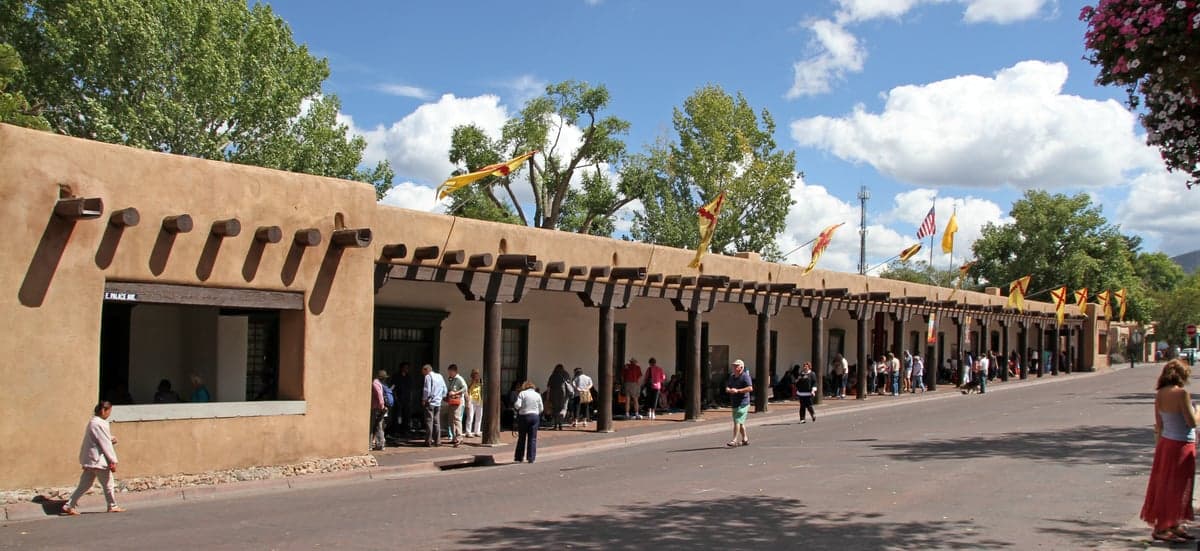
For the strategic-minded individual or family evaluating Santa Fe, New Mexico, as a relocation destination, the concept of personal sovereignty—the ability to live life on your own terms with minimal government interference—presents a deeply mixed picture. While the high desert landscape and historic culture offer a compelling backdrop for self-reliance, the state and local policy environment creates significant headwinds for those prioritizing autonomy. The overall assessment is that Santa Fe offers a beautiful, but heavily regulated, environment where personal freedoms are often secondary to progressive governance, making it a location that requires careful navigation rather than a straightforward haven for liberty-minded individuals.
Tax burden and regulatory posture: what it costs to be left alone
New Mexico’s tax structure is a double-edged sword for those seeking financial sovereignty. On one hand, the state’s gross receipts tax (GRT) is a broad-based consumption tax that applies to most services and goods, including many that are exempt in other states. In Santa Fe, the combined state and local GRT rate hovers around 8.4%, which directly increases the cost of everything from a contractor’s labor to a grocery bill. This is a regressive tax that hits self-reliant individuals hard, as it taxes the very act of building or maintaining a homestead. On the positive side, New Mexico has no state-level estate tax, and property taxes are among the lowest in the nation, with Santa Fe County averaging an effective rate of roughly 0.6% of assessed value. This can be a major advantage for those who own land outright. However, the state’s income tax is progressive, with a top marginal rate of 5.9% on income over $210,000, which can impact high-earning professionals or those with substantial passive income. The regulatory posture in Santa Fe is distinctly interventionist. The city and county have robust land-use codes, strict building codes, and a powerful historic preservation office that can dictate everything from paint colors to window styles. For the prepper or survivalist, this means that the simple act of building a secure, off-grid structure or installing a large water catchment system can require multiple permits and approvals, directly challenging the principle of doing as you please on your own land.
Self-defense and gun law specifics: navigating the legal landscape
For those who view the Second Amendment as a cornerstone of personal sovereignty, New Mexico presents a complex and, in recent years, increasingly restrictive environment. The state is a "shall-issue" jurisdiction for concealed carry permits, meaning that if you meet the statutory requirements—including a background check and a state-approved training course—the county sheriff must issue the permit. Open carry is legal without a permit for anyone 19 or older who can legally possess a firearm. However, the landscape shifted significantly with the passage of the 2021 "Bipartisan Gun Safety Act," which introduced a 7-day waiting period for most firearm purchases and expanded background checks to private sales. More concerning for the liberty-minded is the state's "red flag" law (Extreme Risk Firearm Protection Order), which allows law enforcement or family members to petition a court to temporarily seize firearms from an individual deemed a risk to themselves or others, without a criminal conviction. In Santa Fe itself, local ordinances can further restrict where firearms can be carried, including in city parks and government buildings. The practical reality is that while you can legally own and carry firearms, the process is more bureaucratic than in neighboring states like Texas or Arizona, and the legal climate is one where the state government actively seeks to limit access and ownership. For the survivalist, this means maintaining a legal arsenal requires diligent compliance with a shifting regulatory framework.
Self-reliance and homesteading viability: lot sizes, zoning, and off-grid feasibility
The high desert environment around Santa Fe offers genuine potential for self-reliance, but it is tightly constrained by zoning and water rights. Within the city limits, lot sizes are typically small (under a quarter-acre), and zoning codes are strict. Raising chickens is generally permitted, but larger livestock like goats or pigs is often prohibited. The city’s water supply is managed by the Santa Fe Water Division, and while rainwater harvesting is encouraged and even mandated for new construction, the system is heavily regulated. Off-grid living—meaning no connection to municipal water, sewer, or electric—is effectively impossible within the city and extremely difficult in the county. The county requires a minimum lot size of one acre for a well and septic system, but water rights are a complex and expensive legal matter. The region is in a state of chronic drought, and new well permits are difficult to obtain. Solar power is a viable option, with abundant sunshine, but net metering policies are subject to change by the state’s Public Regulation Commission. For the serious homesteader, the most viable path is to purchase land outside the city limits, in areas like the Galisteo Basin or near the town of Edgewood, where zoning is more permissive and larger parcels (5-20+ acres) are available. Even there, however, you will face the realities of arid land: limited water, wildfire risk, and the need for significant capital investment in infrastructure. The romantic ideal of self-sufficient living is achievable, but it requires substantial financial resources and a willingness to navigate a bureaucratic maze.
Personal liberties: parental rights, medical autonomy, speech, and property
On the spectrum of personal liberties, Santa Fe and New Mexico lean heavily toward a collectivist, government-as-provider model. Parental rights are a particularly contentious area. New Mexico has some of the most permissive laws in the nation regarding minors' access to reproductive healthcare, including abortion and gender-affirming care, without parental consent. This is a major red flag for conservative parents who believe they should have the final say in their children’s medical decisions. The state also has mandatory vaccination requirements for school attendance, with limited opt-out provisions. Medical autonomy for adults is also constrained. New Mexico has a medical cannabis program, but it is tightly regulated, and the state has not been friendly to alternative medical treatments or health freedom movements. Free speech is protected by the First Amendment, but Santa Fe’s political culture is overwhelmingly progressive, meaning that expressing dissenting views—particularly on topics like immigration, gender, or government overreach—can lead to social ostracism or professional consequences. Property rights are perhaps the strongest area for sovereignty. New Mexico is a "Dillon's Rule" state, meaning local governments have only the powers explicitly granted by the state, but in practice, Santa Fe exercises its authority aggressively through zoning and historic preservation. The state does not have a statewide property rights law like Texas's SB 1478, which limits local government overreach. For the individual who values the right to speak freely, raise their children according to their values, and make their own medical decisions, Santa Fe presents a challenging environment where these freedoms are actively contested.
In the final analysis, Santa Fe offers a low-tax, high-regulation environment that is a poor fit for those seeking maximum personal sovereignty. The state’s progressive governance, restrictive gun laws, and erosion of parental rights create a landscape where the individual is often subordinate to the state’s agenda. While the natural beauty and low property taxes are attractive, the bureaucratic hurdles to self-reliance, the high consumption taxes, and the cultural hostility to conservative values make it a location that demands a defensive posture. Compared to states like Texas, Idaho, or Wyoming, Santa Fe and New Mexico rank low on the sovereignty scale. For the strategic relocator, it is a place to visit for the scenery, but not a place to build a fortress of personal liberty. The cost of being left alone here is simply too high.

* Values derived from national, state, county, city and local statistics and may differ in a specific area. Last updated: 2026-04-19T07:01:32.000Z
Narrative content on this page is AI-generated and may contain mistakes. Verify any details that matter before acting on them.
ReloMaps may earn a commission from affiliate links at no extra cost to you.

