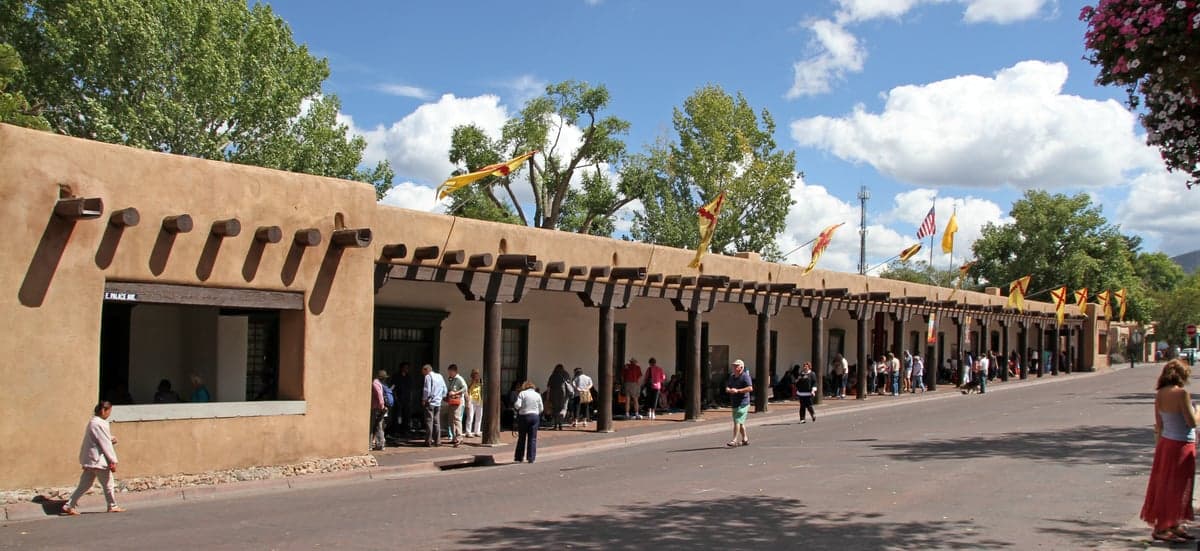
Photo: Wikipedia
Quality of Life in Santa Fe, NM
Above-average quality of iife. The area offers a reasonable cost of living, decent mobility, and a mix of neighborhood amenities.
What does Quality of Life tell us?
Quality of Life blends cost of living, nearby amenities, socioeconomic signals, and neighborhood character. City-level scores represent the whole municipality; individual neighborhoods can differ.
What does this tell us?
Quality of Life blends cost of living, nearby amenities, socioeconomic signals, and neighborhood character. City-level scores represent the whole municipality; individual neighborhoods can differ.
Cost of Living
30% above national average
The Real Cost of Living in Santa Fe, NM for 2026
| Tier | Individual | Family (4) |
|---|---|---|
| Survival | $22k | $41k |
| Comfortable | $80k | $118k |
| Luxury | $127k+ | $196k+ |
| Elite (Top 5%) | $164k+ | $253k+ |
60%
The Area Signal
A metric tracking the socioeconomic signals of the area.


Hobbies
Explore the areaGroceries
5 within 10 miles
Gas
0 within 10 miles
Hospital
3 within 20 miles
Airport
LAS — Las Vegas, New Mexico Municipal
Post Office
USPS — Santa Fe, NM
Critical Amenities
Quality-of-Life Analysis
Santa Fe, New Mexico, presents a quality of life defined by a unique blend of high cultural affluence and a slower, more intentional pace, attracting a population of artists, retirees, second-home owners, and remote workers drawn to its historic charm and mountain setting. With a cost of living index of 130 (30% above the national average), the city is notably more expensive than the rest of New Mexico, yet it remains a relative bargain compared to other Western cultural hubs like Santa Fe’s peer cities of Taos or Aspen. The population skews older and wealthier than the state average, with a significant portion of residents employed in the arts, tourism, government, and the growing remote-work sector, creating a community that values preservation, creativity, and outdoor access over rapid economic expansion.
Cost of living, housing, and affordability compared to Albuquerque and Taos
Santa Fe’s elevated cost of living is driven almost entirely by its housing market, where the median home value sits at $411,500—roughly double that of Albuquerque, just 60 miles south. This price point places Santa Fe firmly in the "luxury market" tier for New Mexico, though it remains significantly cheaper than comparable arts-centric towns like Taos (where median values often exceed $500,000) or resort communities in Colorado. The median rent of $1,380 is also steep for the state, but it is still below the national average for similar-sized cities, making renting a more accessible entry point than buying. While groceries and utilities are slightly above average, the biggest affordability challenge is housing supply: inventory is tight, especially for single-family homes under $350,000, pushing many working-class residents and service-industry workers to commute from lower-cost areas like Española or the Southside. The average commute of 20.2 minutes is notably short for a city of its size, reflecting the compact urban core and the fact that many higher-income residents live close to the Plaza or Canyon Road.
What daily life is like for families, artists, and remote workers
Daily life in Santa Fe revolves around a distinctive rhythm of outdoor activity, cultural events, and a strong local food scene, with the city’s 300+ days of sunshine enabling year-round hiking in the Sangre de Cristo Mountains or skiing at Ski Santa Fe (16 miles away). The public school system is a mixed bag: the Santa Fe Public Schools district has some highly rated elementary schools (like Acequia Madre and Chaparral), but many families opt for private or charter options such as the Santa Fe Waldorf School or Desert Academy. Amenities are robust for a city of 90,000, including the renowned Georgia O’Keeffe Museum, the Santa Fe Opera, and the historic Railyard District with its farmers’ market and art galleries. For remote workers, internet infrastructure is generally reliable, though fiber-optic coverage is not universal, and coworking spaces like the Santa Fe Business Incubator and Iconik Coffee Roasters provide solid alternatives to home offices. The city’s walkable downtown and strong sense of community are offset by limited late-night entertainment and a relatively quiet social scene after 9 p.m., which suits those seeking a peaceful, culturally rich environment over a bustling nightlife.
Santa Fe is best suited for individuals and families who prioritize cultural depth, natural beauty, and a slower pace over career growth in large industries or low housing costs. Retirees, established artists, and remote workers with stable incomes will find the city’s amenities and community highly rewarding, while young professionals or families on a tight budget may struggle with the housing market and limited job diversity outside of government, healthcare, and tourism. For those who can afford the premium, Santa Fe offers a quality of life that is difficult to replicate—a place where art, history, and the outdoors are woven into the fabric of everyday living.

Crime in Santa Fe, NM
Higher crime rates than 67% of comparable U.S. locations.
Violent CrimeViolent Crime Analysis
Property CrimeProperty Crime Analysis
Crime Analysis
Santa Fe, New Mexico, presents a challenging safety landscape for potential residents, with crime rates significantly exceeding national averages. The city's violent crime rate stands at 517.2 incidents per 100,000 residents, while property crime is reported at 2,892.6 per 100,000. These figures place Santa Fe among the higher-risk communities in the state and nation, a reality shaped in part by local criminal justice policies that prioritize offender rehabilitation over public protection.
Crime in context
Santa Fe's violent crime rate is roughly 1.4 times the national average, and its property crime rate is nearly 1.8 times higher than the U.S. median. Compared to other New Mexico cities, Santa Fe is safer than Albuquerque—which has a violent crime rate near 1,100 per 100,000—but still more dangerous than smaller towns like Los Alamos. The city's crime statistics reflect broader statewide challenges, including high rates of property theft and drug-related offenses. However, a critical factor is the influence of progressive district attorneys and judges in Santa Fe County, who have implemented policies such as cash bail reform and reduced sentencing for nonviolent offenders. While these measures aim to address systemic inequities, they have been linked to higher recidivism and a perception of lawlessness, as repeat offenders are released quickly back onto the streets. For readers considering relocation, this ideological approach to justice should be a serious concern, as it directly undermines public safety and victim rights.
What residents experience
Daily life in Santa Fe involves heightened vigilance, particularly regarding property crime. Car break-ins, package theft, and burglaries are common, especially in tourist-heavy areas like the Plaza and Canyon Road. Residents report that leaving valuables visible in a parked car is an open invitation to theft. Violent crime, while less frequent than property crime, includes aggravated assault and robbery, often concentrated in specific neighborhoods. The city's police department has faced staffing shortages, leading to slower response times for non-emergency calls. Many locals invest in home security systems, steering wheel locks, and neighborhood watch programs as practical countermeasures. The presence of homeless encampments along the Santa Fe River and near the Rail Yard also contributes to a sense of unease, with some residents avoiding those areas after dark.
Neighborhood-level variation
Safety in Santa Fe varies sharply by location. The historic downtown core and the Southside—particularly areas near Cerrillos Road and Airport Road—see the highest crime volumes. In contrast, the East Side and the gated communities of Las Campanas report far fewer incidents, with violent crime rates dropping below 200 per 100,000 in those enclaves. The northern foothills and the area around Bishop's Lodge Road also offer relative safety, though property crime remains a concern citywide. Prospective residents should prioritize neighborhoods with active homeowners' associations and private security patrols, as these areas tend to have lower crime and faster police response. Ultimately, Santa Fe's safety profile demands careful neighborhood selection and a proactive approach to personal security, especially given the lenient criminal justice environment that critics argue emboldens offenders.
* Values derived from national, state, county, city and local statistics and may differ in a specific area. Last updated: 2026-04-19T07:01:32.000Z
Narrative content on this page is AI-generated and may contain mistakes. Verify any details that matter before acting on them.
ReloMaps may earn a commission from affiliate links at no extra cost to you.

