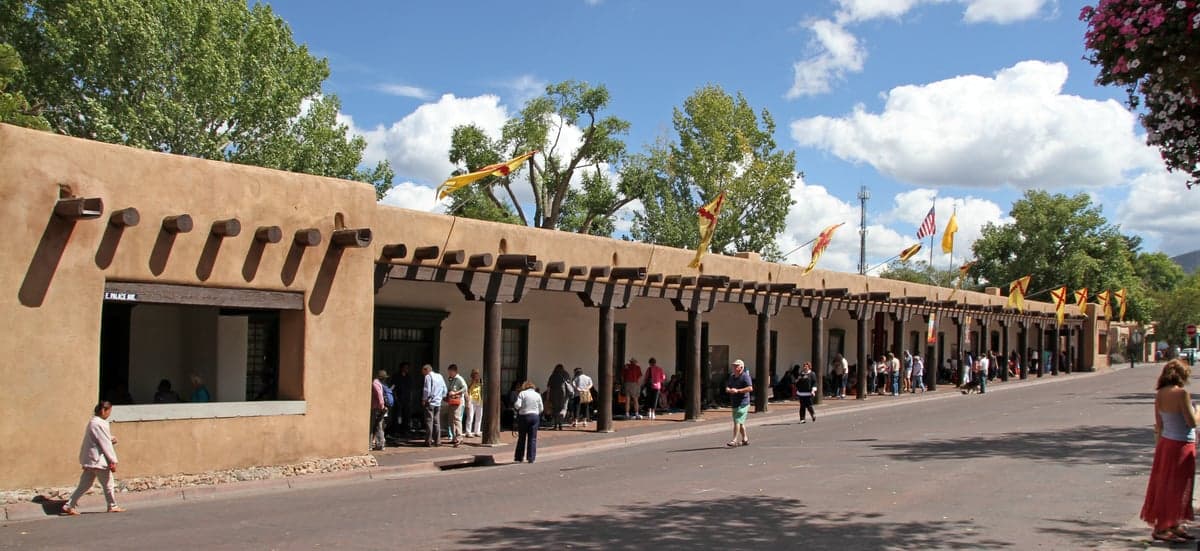
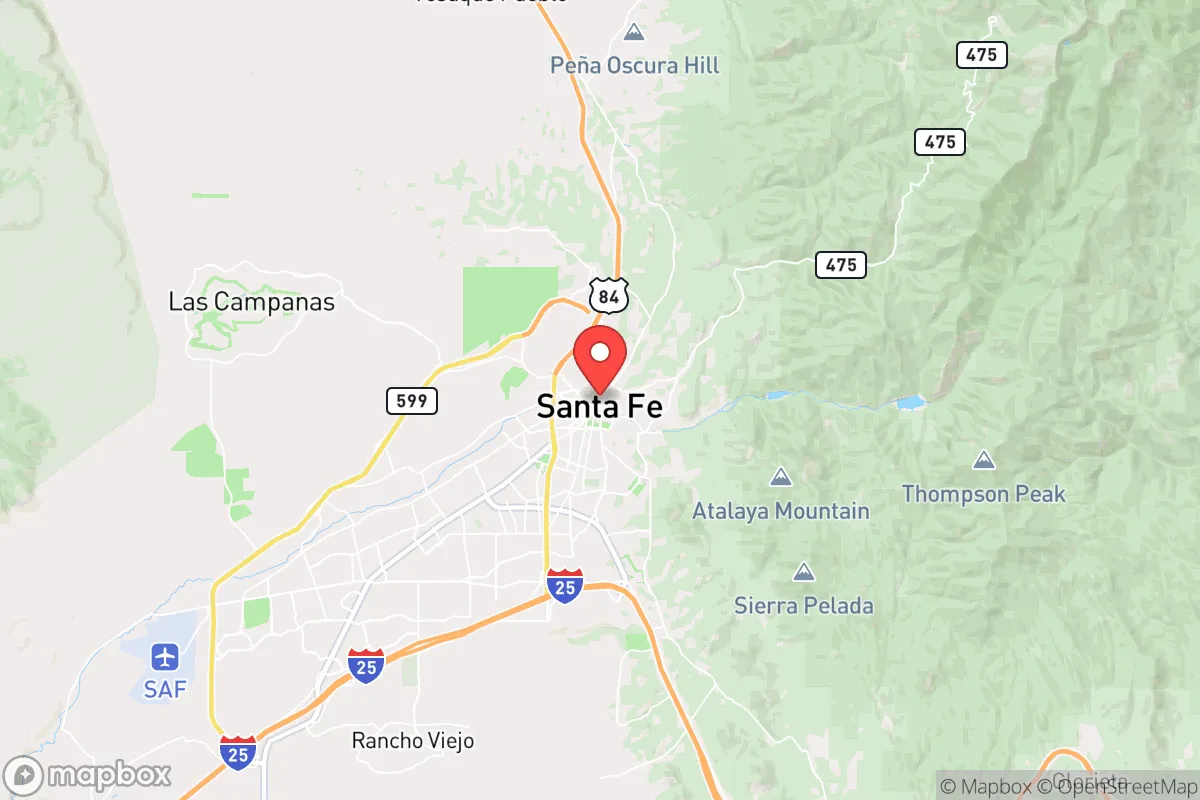
Photo: Wikipedia
Strategic Assessment of Santa Fe, NM
Meaningful friction. Expect exposure to either population pressure, blast zones, or natural disaster risk. Consider buying a retreat property.
What does the Strategic Assessment tell us?
Our Strategic Assessment grades tactical survivability of an area. Major population centers, military targets, fallout zones, natural disasters, and border exposure all drive risk — lower exposure means a more defensible position in a crisis.
This is heavily inspired by Joel Skousen's Strategic Relocation book. Highly recommended you checkout the book ($)What does this tell us?
Our Strategic Assessment grades tactical survivability of an area. Major population centers, military targets, fallout zones, natural disasters, and border exposure all drive risk — lower exposure means a more defensible position in a crisis.
This is heavily inspired by Joel Skousen's Strategic Relocation book. Highly recommended you checkout the book ($)Strategic Pillars

Key Distances
Regional Safe Places
Below is our recommended "safe zones" in New Mexico and the surrounding area based on our strategic heuristics. For most people, it's unrealistic to live in a “safe zone” full-time due to work, family or other personal reasons. They tend to be more rural. However, many of these areas are perfect for second homes and retreat properties that double as a vacation home or even a short-term rental.

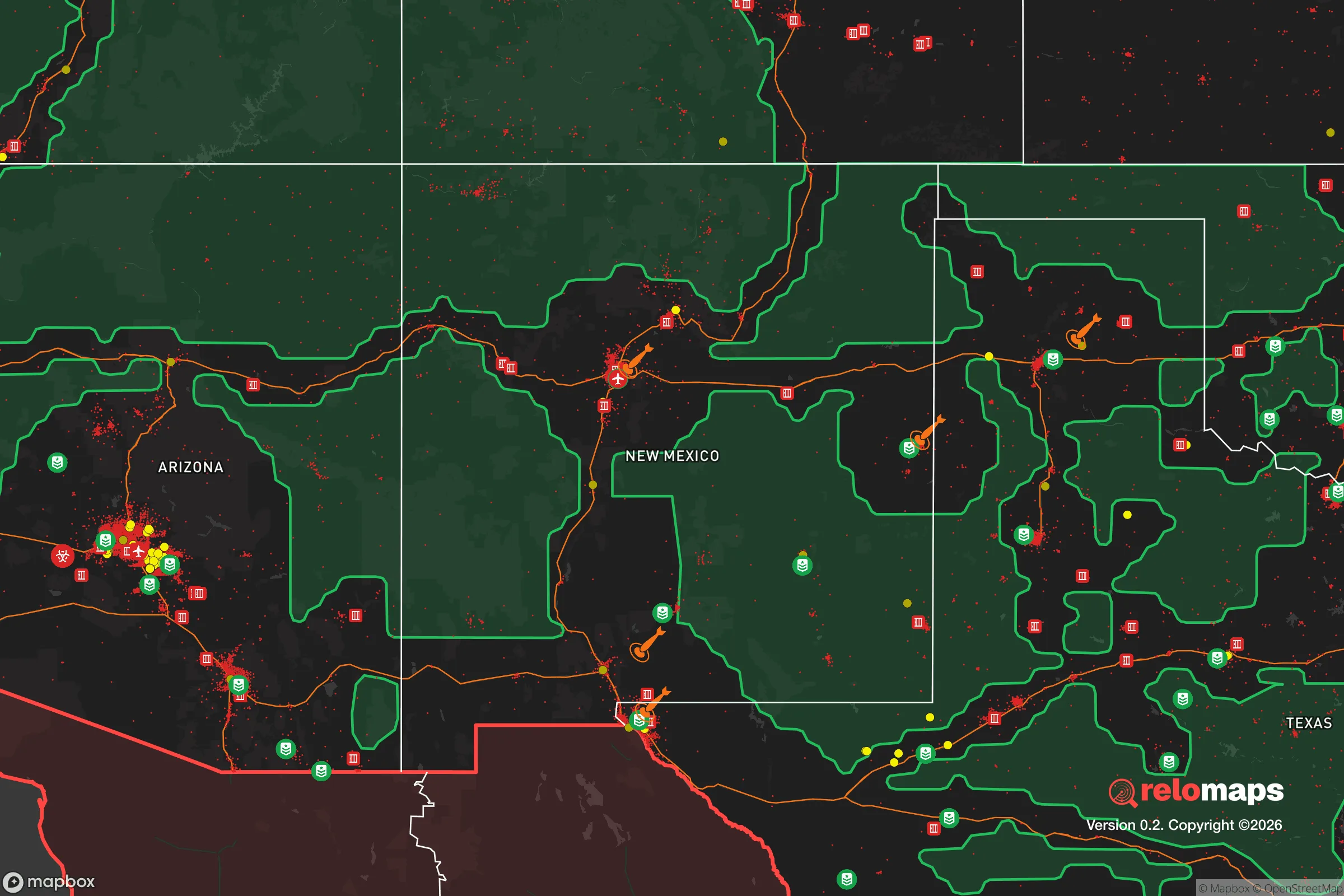


Important Note: For informational purposes only. This does not mean nothing bad ever happens in the green zones. Please use common sense. This is based on public data and modeled with AI. We tried to take a conservative approach but mistakes happen. We update this regularly as new information becomes available.
Solar Generator Recommendations
Backup power matters more here than in safer locations. We've picked three solar generators across budgets and capacity tiers — start with the budget unit if you only need a few essentials, or step up if you want to run a fridge and HVAC for days at a time.

Jackery Portable Power Station Explorer 300
Budget OptionPower on the Go: Weighing only 11 lbs, it's convenient to set up and store with book-sized foldable solar panels

BLUETTI Portable Power Station AC180
Designed for both indoor and outdoor scenarios, AC180 is highly capable as it has a robost capacity and continuous output power.

EF ECOFLOW DELTA Pro Ultra Power Station
Upgraded PickEcoFlow DELTA Pro Ultra is a whole-home energy system designed to grow with your family. Integrated with the Smart Home Panel 2, it scales to meet your evolving energy needs — keeping your home powered, intelligent, and secure through every stage of life.
We earn a commission, at no additional cost to you.
Strategic Assessment Analysis
Santa Fe offers a mixed strategic picture for the conservative prepper. Its high elevation (7,000+ feet), arid climate, and distance from major coastal targets provide genuine natural buffers against sea-level rise, tsunami, and the worst of a pandemic’s initial spread. However, its proximity to Los Alamos National Laboratory—a prime nuclear and geopolitical target—and its deep-blue state government create a resilience calculus that demands careful, unsentimental assessment. For the relocator prioritizing long-term survivability over lifestyle amenities, Santa Fe is a location of trade-offs, not a safe harbor.
Geographic position and natural advantages for long-term survival
Santa Fe sits in the southern Rocky Mountain foothills, a region with inherent strategic value. The city’s elevation means cooler summers and less reliance on air conditioning, a meaningful energy advantage during grid-down scenarios. The surrounding Sangre de Cristo Mountains provide natural chokepoints and defensible terrain; a small group could control access routes like the Old Santa Fe Trail or the narrow canyons to the east. The area’s low humidity reduces mold, rust, and equipment degradation, extending the lifespan of stored supplies. Critically, Santa Fe is over 800 miles from the nearest nuclear submarine base (Bangor, WA) and over 1,000 miles from the major EMP-vulnerable population centers of the Northeast Corridor. The Rio Grande Valley offers a perennial water source, though it is heavily contested and managed by federal and state agencies. For the relocator willing to drill a private well or negotiate water rights, the region’s groundwater is generally potable and deep. The high desert also means fewer disease vectors—mosquito-borne illnesses are rare, and the dry climate inhibits many fungal pathogens that plague humid regions.
Risks, exposures, and proximity to high-value targets
The single greatest strategic liability is Los Alamos National Laboratory, located just 35 miles northwest of Santa Fe. This facility is a Tier-1 target for any adversary capable of a precision nuclear strike, electromagnetic pulse attack, or sabotage. A detonation at Los Alamos would likely devastate Santa Fe with blast, fire, and fallout, depending on wind patterns. Additionally, the lab stores significant quantities of plutonium and other radiological materials; a conventional attack or accident could render large swaths of northern New Mexico uninhabitable for decades. Beyond Los Alamos, Santa Fe lies within 60 miles of the Kirtland Air Force Base and Sandia National Laboratories in Albuquerque, both high-value military and research assets. The city itself is a state capital, meaning it would be a focal point for civil unrest, federal intervention, and resource redistribution during a national crisis. The local population is heavily dependent on tourism, government, and arts—industries that vanish in a collapse, leaving a workforce with few practical survival skills. The political culture is overwhelmingly progressive, which may create friction for conservative relocators seeking to build a self-reliant, firearms-friendly, and low-tax household. New Mexico’s state government has enacted strict gun control measures, including a 2025 red-flag law and magazine capacity limits, which could complicate prepper logistics.
Practical resilience for a relocator: food, water, energy, and defensibility
Water is the most critical constraint. Santa Fe averages only 14 inches of precipitation annually, and the city’s municipal supply is drawn from the Santa Fe River and a series of reservoirs that are chronically low. A relocator cannot rely on surface water without legal and physical risk. The practical solution is a deep well (300-500 feet) on private land outside city limits, ideally in Santa Fe County’s more rural eastern or northern zones. Rainwater catchment is legal but limited by state law to 10,000 gallons per property—enough for supplemental use, not primary supply. Food production is possible but challenging. The growing season is short (April to October), and the soil is alkaline and rocky. Raised beds, greenhouses, and drip irrigation are essential. Local farmers’ markets exist but are expensive and not reliable in a crisis. For long-term food security, a relocator should plan to import seeds, soil amendments, and irrigation infrastructure. Energy is a relative strength. Santa Fe averages 280 sunny days per year, making solar photovoltaic systems highly effective. Off-grid solar with battery storage is feasible, though initial costs are high. Wind is less reliable in the valley but can supplement in higher elevations. Natural gas is available in town but vulnerable to pipeline disruption. Defensibility is moderate. The city’s layout—winding roads, arroyos, and hills—creates natural ambush points and observation posts. However, the population density (about 90,000 in the city, 150,000 in the county) means that a determined mob or organized group could overwhelm a single homestead. The ideal setup is a rural property at least 20 miles from the city center, with a single access road, good sightlines, and a well. The local sheriff’s office is generally professional but underfunded; in a collapse, law enforcement will be stretched thin. Firearms are common in rural Santa Fe County, but the state’s legal environment is hostile to magazine capacity and certain rifle configurations. A relocator should plan to comply with state law while maintaining operational capability through training and low-profile storage.
The overall strategic picture for Santa Fe is one of high potential reward paired with high, specific risk. The natural environment—elevation, dry climate, defensible terrain—is genuinely favorable for a prepared individual or family. The water and food challenges are solvable with capital and planning, not luck. But the proximity to Los Alamos and Albuquerque, combined with a state government that is actively hostile to self-reliance and firearms ownership, means that Santa Fe is not a retreat for the casual prepper. It is a location for the serious, well-funded, and politically adaptable relocator who can navigate the contradictions: a beautiful, high-desert sanctuary that sits in the shadow of the most dangerous facility in the American Southwest. If you can secure a well, build a solar array, and keep a low profile, Santa Fe offers a defensible base with access to mountain resources and a small, resilient community. If you cannot, the risks will find you faster than the scenery can soothe you.

* Values derived from national, state, county, city and local statistics and may differ in a specific area. Last updated: 2026-04-19T07:01:32.000Z
Narrative content on this page is AI-generated and may contain mistakes. Verify any details that matter before acting on them.
ReloMaps may earn a commission from affiliate links at no extra cost to you.

