Photo: Wikipedia
Demographics of Saratoga Springs, NY
Affluence Level in Saratoga Springs, NY
An upper-middle-class area. Household wealth, education levels, and homeownership run ahead of national benchmarks.
People of Saratoga Springs, NY
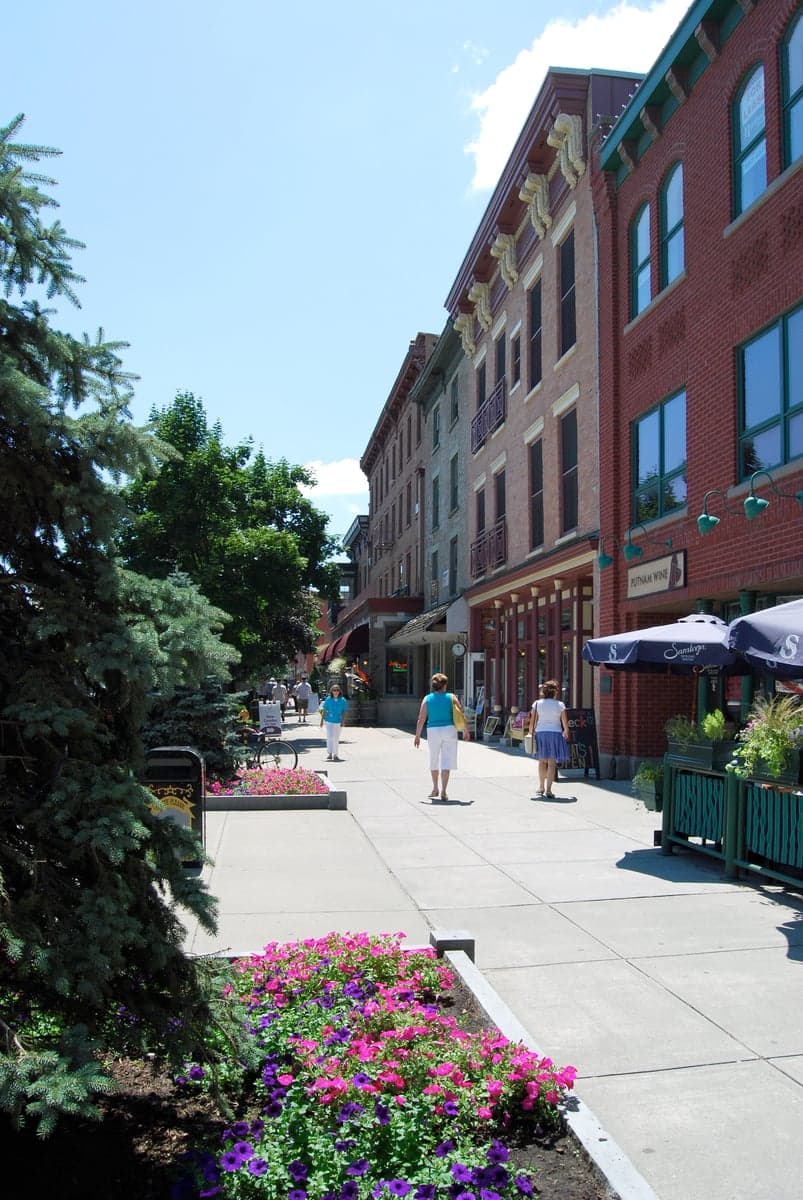
The people of Saratoga Springs, New York, today form a predominantly white (85.0%), highly educated (58.8% college-educated) population of 28,542, characterized by a blend of long-standing local families, seasonal second-home owners, and professionals drawn by the city's historic charm and tourism economy. The city's foreign-born share is notably low at 2.4%, with Hispanic residents at 4.7%, Black residents at 3.0%, and East/Southeast Asian communities at 2.7%, while Indian-subcontinent residents make up just 0.3%. This demographic profile reflects a city that has remained overwhelmingly native-born and white, even as its economy has diversified from a resort and racing hub into a year-round center for healthcare, education, and the arts. The population is stable but aging, with a median age of 40.2, and the city's identity is increasingly split between a historic downtown core and newer suburban-style developments on its periphery.
How the city was settled and grew
Saratoga Springs was originally settled by European colonists in the late 17th and early 18th centuries, drawn by the mineral springs that would later define its identity. The area was part of the Kayaderosseras Patent, a massive land grant from the British Crown, and early settlers were primarily of English, Dutch, and German stock, establishing farms and small hamlets. The city's transformation began in the early 19th century when the springs' reputed medicinal properties attracted wealthy visitors, leading to the construction of grand hotels and the rise of a resort economy. The arrival of the railroad in the 1830s accelerated growth, bringing a wave of Irish immigrants who built the tracks and worked in the hotels, settling in the West Side neighborhood around the rail yards. Later, Italian immigrants arrived in the late 19th and early 20th centuries, finding work in construction and service industries, and established a strong presence in the South Side near the racetrack. The city's permanent population grew steadily through the early 20th century, but it remained a seasonal resort town at heart, with a small, stable year-round community centered on the historic Downtown and North Broadway districts.
Modern era (post-1965)
After the 1965 Hart-Cellar Act, Saratoga Springs saw minimal impact from new immigration, as the city's economy and housing stock did not attract large numbers of foreign-born residents. Instead, the post-1965 era was defined by domestic in-migration, particularly from the New York City metropolitan area and other parts of the Northeast. The opening of the Saratoga Performing Arts Center (SPAC) in 1966 and the expansion of Skidmore College drew educated professionals and artists, many of whom settled in the East Side neighborhoods near the college and the arts center. Suburbanization in the 1970s and 1980s pushed development outward, with new subdivisions and apartment complexes rising in the Geyser Crest area and along Route 9, attracting families and commuters. The city's racial composition remained overwhelmingly white throughout this period, with the Black population hovering around 3% and the Hispanic population growing slowly from a very low base. The small East/Southeast Asian community, primarily of Chinese and Korean descent, grew modestly through professional migration tied to Skidmore College and the local healthcare sector, concentrating in the East Side near the college campus. The Indian-subcontinent population remained negligible, reflecting the city's limited draw for high-tech or medical professionals compared to larger upstate cities like Albany or Rochester.
The future
The population of Saratoga Springs is projected to remain stable or grow slowly, driven by continued domestic in-migration of retirees and remote workers from downstate New York and the Northeast, rather than by international immigration. The city's low foreign-born share (2.4%) is unlikely to rise significantly, as housing costs have increased sharply—the median home value exceeds $400,000—and the local economy does not offer the entry-level jobs that typically attract immigrant populations. The Hispanic and Black populations are expected to grow incrementally, but from a very small base, and will likely remain concentrated in the more affordable South Side and West Side neighborhoods. The East/Southeast Asian population may see modest growth as Skidmore College and the Saratoga Hospital system recruit internationally, but this will remain a niche trend. The city is not tribalizing into distinct ethnic enclaves; rather, it is homogenizing as a predominantly white, affluent, and highly educated community, with the main demographic divide being between long-term residents and newer, wealthier transplants. The aging of the population—with a median age of 40.2 and a growing share of residents over 65—suggests that the city will continue to cater to retirees and second-home owners, while younger families may be priced out of the core neighborhoods.
For someone moving in now, Saratoga Springs is a stable, predominantly white, and highly educated city with a strong sense of place rooted in its historic downtown and seasonal tourism. The population is not diversifying rapidly, and the city's future will likely see a continuation of its current demographic profile: affluent, native-born, and aging, with a growing divide between the historic core and the suburban periphery. New residents should expect a community that values its traditions and natural amenities, but one where housing costs and a limited job market outside of tourism, healthcare, and education may constrain long-term affordability for younger families.

* Values derived from national, state, county, city and local statistics and may differ in a specific area. Last updated: 2026-05-01T05:23:08.000Z
Narrative content on this page is AI-generated and may contain mistakes. Verify any details that matter before acting on them.
ReloMaps may earn a commission from affiliate links at no extra cost to you.

