 Popular
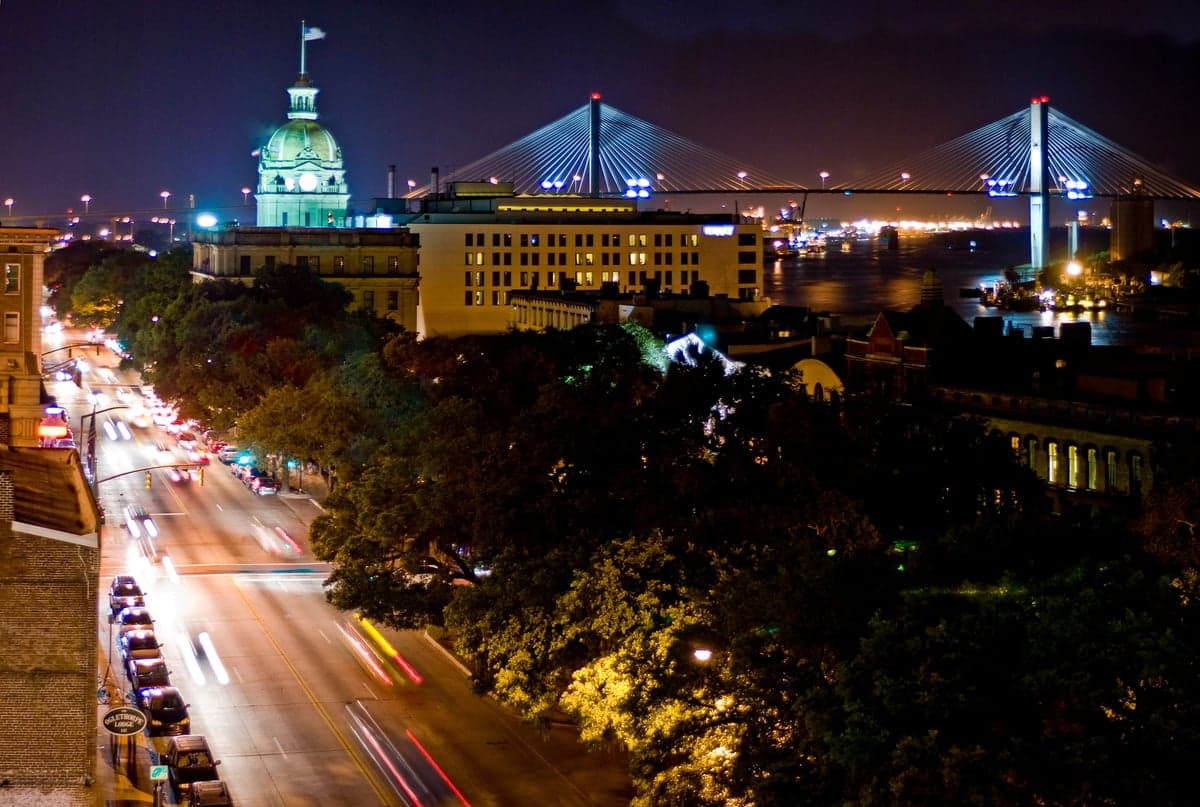
Photo: Wikipedia
Demographics of Savannah, GA
Affluence Level in Savannah, GA
A below-average socioeconomic profile. Incomes, home values, and educational attainment trail the U.S., with higher poverty and unemployment.
People of Savannah, GA
The people of Savannah, Georgia today form a predominantly Black-majority city (51.1%) with a substantial White minority (35.5%) and smaller Hispanic (7.1%) and East/Southeast Asian (2.3%) communities. With a population of 147,546, Savannah is denser and more urban than much of the surrounding Coastal Empire, and its identity is shaped by a deep-rooted Gullah Geechee heritage, a historic Catholic and Jewish presence, and a growing professional class drawn to the port and creative economy. The city’s foreign-born share is just 3.6%, well below the national average, making it a place where generational American families — Black and White alike — dominate the social fabric.
How the city was settled and grew
Savannah was founded in 1733 by General James Oglethorpe as a British colonial buffer against Spanish Florida, and its original population was a mix of English, Scottish, and German settlers, along with a small number of Sephardic Jews who arrived in 1733 and established one of the oldest Jewish congregations in the United States. The city’s grid plan, with its iconic squares, was designed for defense and community, and the early economy relied on rice, indigo, and later cotton — all built on the labor of enslaved Africans. By the antebellum period, Savannah had a large enslaved Black population, and after the Civil War, freedmen established neighborhoods like Cuyler-Brownville and Frogtown (now part of the Victorian District), which became centers of Black civic and religious life. Irish and German immigrants arrived in the mid-19th century, settling in the Old Fort and Yamacraw neighborhoods, working on the docks and railroads. The early 20th century saw a wave of Italian immigrants in the Italian Village area near the port, while the Great Migration drew rural Black Georgians to Savannah’s expanding industrial and service sectors, concentrating in neighborhoods like West Savannah and Cloverdale.
Modern era (post-1965)
After the 1965 Hart-Cellar Act, Savannah saw only modest international immigration — the foreign-born share remains low at 3.6% — but domestic migration reshaped the city significantly. White flight to suburbs like Pooler, Richmond Hill, and the Islands (Whitemarsh, Talahi, Wilmington) accelerated in the 1970s and 1980s, leaving the city core increasingly Black and poor. The Black population peaked at roughly 57% in the 1990s before stabilizing near its current 51.1% share as some White and Hispanic families returned to historic districts. The Hispanic population grew from under 2% in 1990 to 7.1% today, driven largely by Mexican and Central American workers in construction, hospitality, and agriculture, with a notable cluster in the West Savannah and Garden City areas. East/Southeast Asian communities (2.3%) are concentrated in the Southside and Georgetown neighborhoods, with Vietnamese and Filipino families drawn to the port and healthcare sectors. The Indian-subcontinent population (0.5%) is small but visible in the medical and tech fields, with no single enclave. The college-educated share has risen to 32.0%, reflecting the growth of Savannah College of Art and Design (SCAD) and the expansion of Gulfstream Aerospace and the Port of Savannah, which have attracted a younger, more diverse professional class to the Historic District and Starland neighborhoods.
The future
Savannah’s population is slowly diversifying, but the city remains deeply segregated by race and class. The Black majority is aging in place in historic neighborhoods like Cuyler-Brownville and West Savannah, while younger White and Hispanic families are moving into the Victorian District and Thomas Square areas, driving gentrification and rising property values. The Hispanic share is growing steadily, likely reaching 10-12% by 2040, as new arrivals from Central America and Mexico continue to settle in the western and southern fringes. East/Southeast Asian and Indian communities are growing slowly from a small base, primarily through professional migration tied to the port and healthcare, but they are unlikely to become a major demographic force. The foreign-born share may rise to 5-6% over the next decade, still well below the national average. The city is not homogenizing — rather, it is tribalizing into distinct enclaves: affluent Whites in the Historic District and the Islands, middle-class Blacks in the Southside and Georgetown, working-class Hispanics in West Savannah, and a small but growing professional class of all races in the Starland corridor. For a conservative-leaning newcomer, Savannah offers a stable, family-oriented environment with strong community institutions, but the racial and economic divisions are real and visible in daily life — from school quality to public safety to neighborhood amenities.
Savannah is becoming a more diverse but still deeply stratified Southern city, where the port economy and tourism drive growth, but where historic patterns of segregation persist. For someone moving in now, the key question is which neighborhood aligns with their priorities: the walkable, historic core with its high costs and liberal tilt, or the suburban, car-dependent fringes with lower taxes and more conservative politics. The city’s future is one of managed growth, not explosive change, and its character will remain rooted in its Black-majority identity and Gullah Geechee heritage for decades to come.

* Values derived from national, state, county, city and local statistics and may differ in a specific area. Last updated: 2026-04-15T23:50:20.000Z
Narrative content on this page is AI-generated and may contain mistakes. Verify any details that matter before acting on them.
ReloMaps may earn a commission from affiliate links at no extra cost to you.

