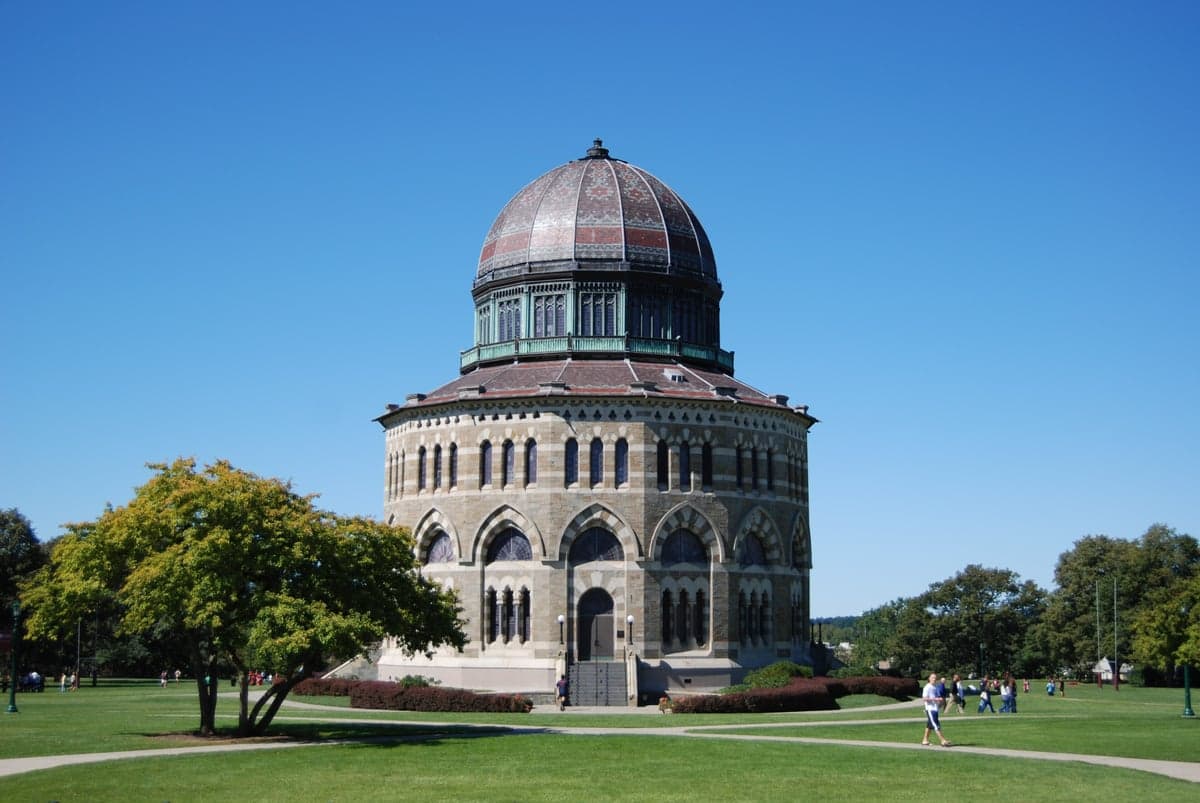
Photo: Wikipedia
Demographics of Schenectady, NY
Affluence Level in Schenectady, NY
A below-average socioeconomic profile. Incomes, home values, and educational attainment trail the U.S., with higher poverty and unemployment.
People of Schenectady, NY
The people of Schenectady, New York today form a dense, diverse, and historically layered population of 68,521. The city is a majority-minority community where no single racial or ethnic group holds a numerical majority, with a distinctive identity shaped by successive waves of industrial migration, suburban flight, and recent immigrant resettlement. Its character is notably working-class and urban, with a college-educated rate of 23.6%, and its population density of roughly 5,500 people per square mile creates a tight-knit, walkable feel that contrasts with the sprawling suburbs of neighboring Niskayuna and Clifton Park.
How the city was settled and grew
Schenectady was founded in 1661 by Dutch colonists as a fur-trading post on the Mohawk River, making it one of the oldest settlements in the United States. The original European settlers were Dutch and French Huguenot families who established the Stockade Historic District, the city's oldest neighborhood, where their descendants built the distinctive Dutch-style homes that still line its streets. The city's population exploded in the 19th century with the arrival of the Erie Canal in 1825 and the rise of General Electric (GE) in the 1890s, which drew massive waves of immigrants. Irish laborers built the canal and settled in the Goose Hill neighborhood, while Italian immigrants arrived in the early 1900s to work in GE's factories and concentrated in the Mont Pleasant and Bellevue neighborhoods, where Italian-American social clubs and bakeries remain. Eastern European Jews, fleeing pogroms, established a tight-knit community in the Hamilton Hill neighborhood, building synagogues and a thriving commercial corridor along Albany Street. By 1950, Schenectady's population peaked at nearly 95,000, overwhelmingly white and heavily Catholic and Jewish, with a strong unionized workforce anchored by GE and the American Locomotive Company (ALCO).
Modern era (post-1965)
After the 1965 Hart-Cellar Act and the broader decline of manufacturing, Schenectady's demographic landscape shifted dramatically. The city lost roughly 30% of its population between 1970 and 2000 as white families moved to suburbs like Rotterdam and Glenville, leaving behind a hollowed-out urban core. Hamilton Hill, once a Jewish and Italian enclave, became the epicenter of Black in-migration from the rural South during the Great Migration's later waves, and today it remains the city's most predominantly Black neighborhood, with a poverty rate above 40%. The Mont Pleasant neighborhood absorbed a growing Hispanic population, primarily Puerto Ricans and later Dominicans and Mexicans, who now make up 13.3% of the city's total population. The most notable post-1965 shift is the arrival of Indian subcontinent immigrants, who now constitute 4.0% of the population—a share larger than the East/Southeast Asian community (1.6%). These Indian families, many employed in healthcare and tech at GE's revived research arm and Albany Medical Center, have concentrated in the Woodlawn neighborhood and the eastern edge of the city near the Niskayuna border, where newer housing stock and better schools attract them. The foreign-born population stands at 5.8%, a modest figure compared to larger upstate cities like Albany or Buffalo, but one that is growing steadily through family reunification and H-1B visa holders.
The future
Schenectady's population is slowly stabilizing after decades of decline, but the city is not homogenizing—it is tribalizing into distinct ethnic and economic enclaves. The white population, now 48.0%, is aging and concentrated in the Stockade and Upper Union Street areas, where gentrification is attracting young professionals and empty-nesters to renovated historic homes. The Black population (19.4%) is plateauing, with younger generations moving to suburbs like Colonie or Latham, while the Hispanic population (13.3%) is growing through both birth rates and continued immigration, particularly in Mont Pleasant and Bellevue. The Indian community (4.0%) is the fastest-growing segment, driven by tech and medical jobs, and is likely to double its share within 15 years as chain migration continues. The East/Southeast Asian population (1.6%) remains small and stable, centered around the Union College faculty and GE's research labs. Over the next 10–20 years, Schenectady will likely become a tripartite city: a gentrifying, white-majority core along the river; a Hispanic-majority middle ring; and a Black-majority western edge, with a growing Indian enclave in the east. The city's overall population may tick up slightly to 72,000–75,000 as new market-rate apartments in the downtown area attract younger residents, but the school district's struggles—only 23.6% of adults hold a college degree—will limit the return of middle-class families with children.
For a conservative-leaning individual or parent considering relocation, Schenectady offers a genuinely diverse, walkable urban environment with a strong sense of place, but it is a city of stark contrasts: historic charm in the Stockade, working-class grit in Mont Pleasant, and persistent poverty in Hamilton Hill. The population is becoming more Indian and Hispanic, less Black, and slowly re-whitening in the core—a pattern that rewards those who buy into the gentrifying neighborhoods but challenges those seeking a stable, homogeneous community. The bottom line: Schenectady is a city in demographic transition, where the next decade will determine whether it becomes a thriving, mixed-income hub or a patchwork of isolated enclaves.

* Values derived from national, state, county, city and local statistics and may differ in a specific area. Last updated: 2026-05-01T19:42:52.000Z
Narrative content on this page is AI-generated and may contain mistakes. Verify any details that matter before acting on them.
ReloMaps may earn a commission from affiliate links at no extra cost to you.

