 Popular
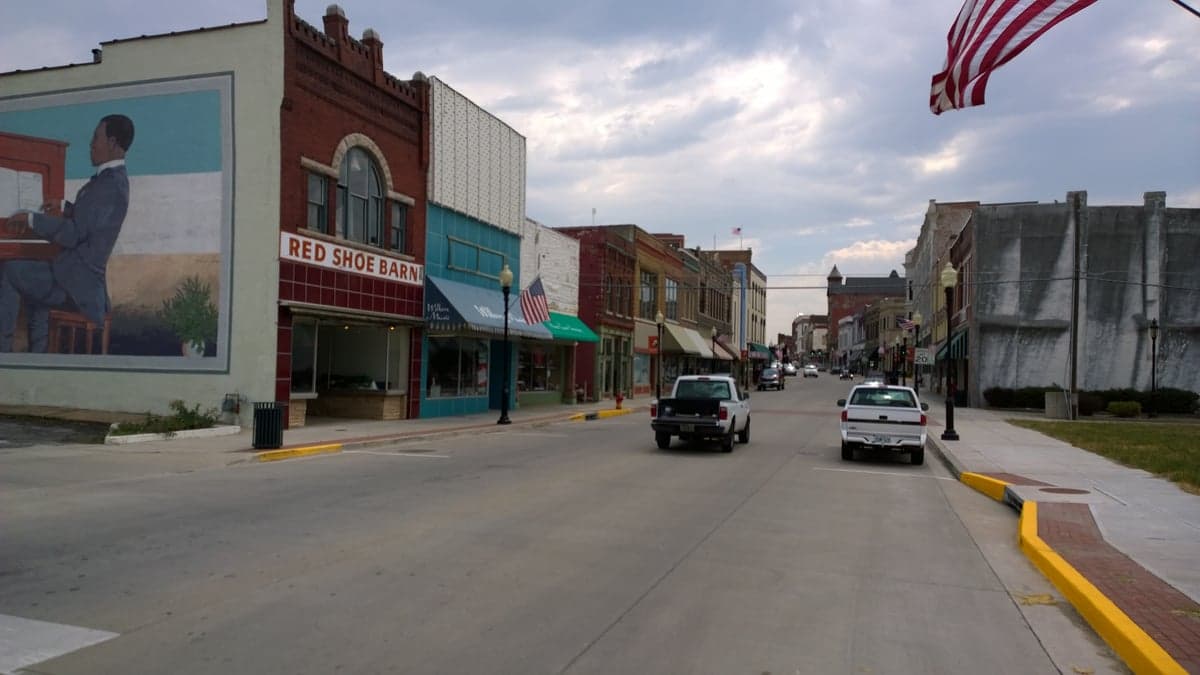
Photo: Wikipedia
Demographics of Sedalia, MO
Affluence Level in Sedalia, MO
A below-average socioeconomic profile. Incomes, home values, and educational attainment trail the U.S., with higher poverty and unemployment.
People of Sedalia, MO
Sedalia, Missouri, is a city of 21,869 residents where the population is overwhelmingly native-born and white (74.2%), with a significant and growing Hispanic minority (15.3%) that has reshaped parts of the city over the past two decades. The city’s character remains rooted in its railroad and agricultural heritage, with a lower college attainment rate (17.0%) than the national average and a modest foreign-born share (5.2%). Distinct neighborhoods still reflect the waves of settlement that built Sedalia, from German Catholic enclaves to railroad-worker districts to modern Hispanic hubs.
How the city was settled and grew
Sedalia was founded in 1857 as a planned railroad town, named after the daughter of a railroad official. The Missouri Pacific Railroad arrived in 1861, and the city quickly became a regional hub for shipping livestock, grain, and timber. The first major wave of settlers were Anglo-American farmers and merchants from Kentucky, Tennessee, and the Upper South, who established the city’s early political and economic elite in the West Sedalia neighborhood, near the original courthouse square. A second wave of German Catholic immigrants arrived in the 1870s and 1880s, drawn by railroad construction jobs and cheap farmland. They settled in East Sedalia, building St. Patrick’s Church (1871) and forming a tight-knit community centered on the parish and German-language schools. A smaller wave of Italian immigrants came around 1900 to work on the railroads and in the brick yards, clustering in the South Sedalia area near the rail yards. By 1910, Sedalia’s population had reached roughly 15,000, and the city’s racial composition was nearly all white, with a small Black population (under 5%) concentrated in the North Sedalia neighborhood, near the Missouri Pacific shops, where segregated housing patterns persisted through the mid-20th century.
Modern era (post-1965)
After the 1965 Immigration and Nationality Act, Sedalia saw little immediate change in its demographic makeup. The city’s population peaked at around 23,000 in 1970 and then declined slightly as railroad employment shrank and younger residents moved to larger cities. The most significant post-1965 shift began in the late 1990s and accelerated after 2000: a wave of Hispanic immigrants, primarily from Mexico and Central America, arrived to work in the city’s meatpacking plants (notably the Cargill and Tyson facilities in nearby Marshall and Sedalia itself) and in construction and agriculture. These newcomers settled in the Southwest Sedalia area, particularly around West 16th Street and South Engineer Avenue, where a cluster of Hispanic-owned businesses, churches, and rental housing now forms a visible ethnic enclave. The Hispanic share of Sedalia’s population rose from under 3% in 1990 to 15.3% by 2024. The Black population, historically small, has remained stable at 3.6%, with most Black residents still living in the North Sedalia neighborhood, though housing discrimination has lessened. The East/Southeast Asian population (0.9%) is tiny and scattered, with no distinct ethnic neighborhood. The Indian-subcontinent population (0.1%) is negligible. The white population, while still the majority, has aged and declined in absolute numbers as younger white families have moved to suburban subdivisions on the city’s fringe, such as Broadway Estates and Hillcrest.
The future
Sedalia’s population is likely to remain stable or grow slowly, driven primarily by Hispanic in-migration and higher birth rates among Hispanic families. The white population will continue to shrink as older residents die and younger ones leave for college or jobs in larger metros like Kansas City or Columbia. The Hispanic community is not plateauing: it is still growing, both through immigration and natural increase, and is gradually spreading beyond Southwest Sedalia into previously white neighborhoods like West Sedalia and East Sedalia, though without significant tension. The city is not tribalizing into hostile enclaves; rather, it is slowly becoming more Hispanic, with the white majority aging and the Hispanic share projected to reach 20-25% by 2040. The Black and Asian populations are likely to remain small and stable. The foreign-born share (5.2%) will rise modestly but will remain below the national average, as Sedalia lacks the large immigrant-employing sectors (tech, academia, healthcare) that draw foreign-born professionals to larger cities.
For someone moving to Sedalia now, the city is becoming a more diverse, working-class community where the old Anglo-Germanic character is giving way to a bicultural (white/Hispanic) identity. The schools, churches, and retail landscape are already reflecting this shift. A conservative-leaning family or individual will find a city that is still politically red (Pettis County voted +42 R in 2024), culturally traditional, and economically tied to manufacturing and agriculture, but with a growing Hispanic presence that is reshaping everyday life in neighborhoods like Southwest Sedalia. The city is not homogenizing; it is slowly integrating, with the main story being the gradual replacement of an aging white population by a younger, more family-oriented Hispanic one.

* Values derived from national, state, county, city and local statistics and may differ in a specific area. Last updated: 2026-04-29T19:18:09.000Z
Narrative content on this page is AI-generated and may contain mistakes. Verify any details that matter before acting on them.
ReloMaps may earn a commission from affiliate links at no extra cost to you.

