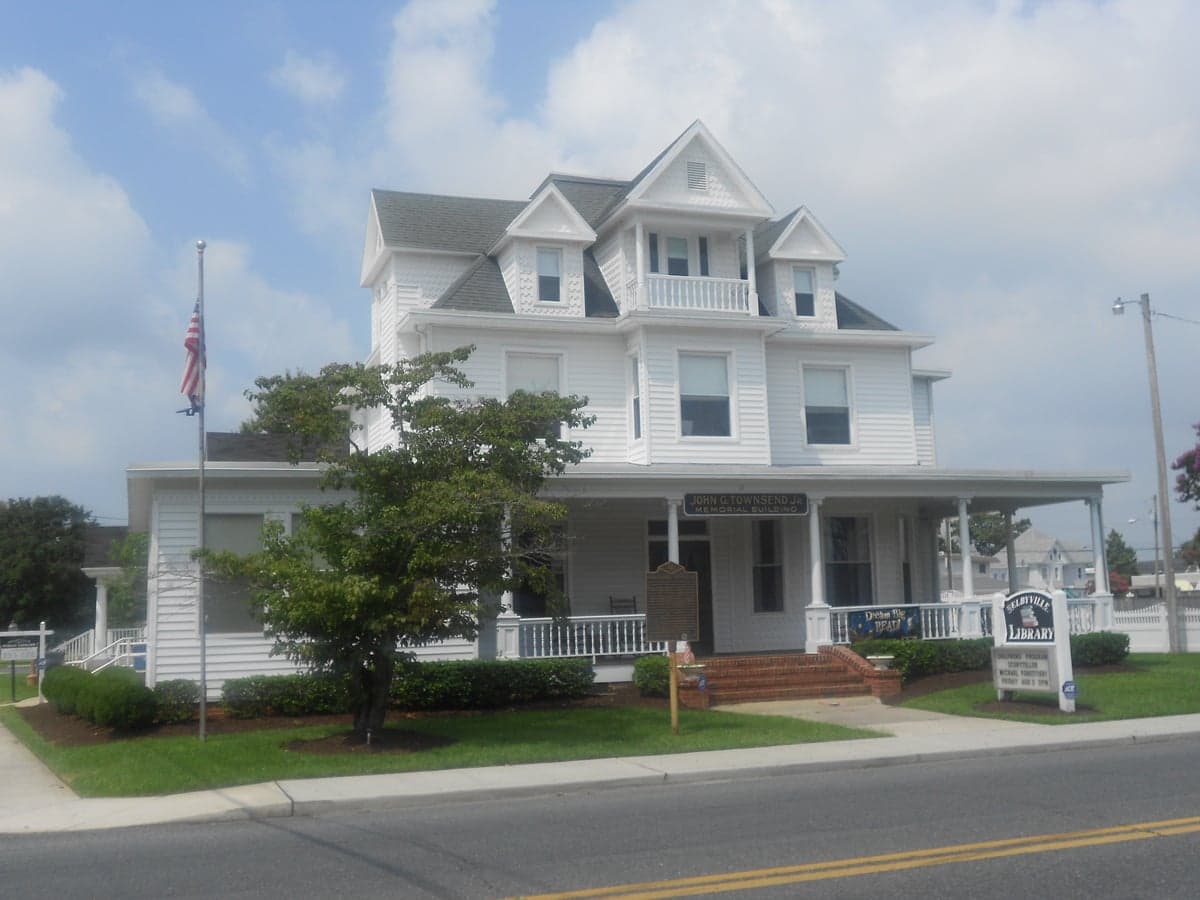
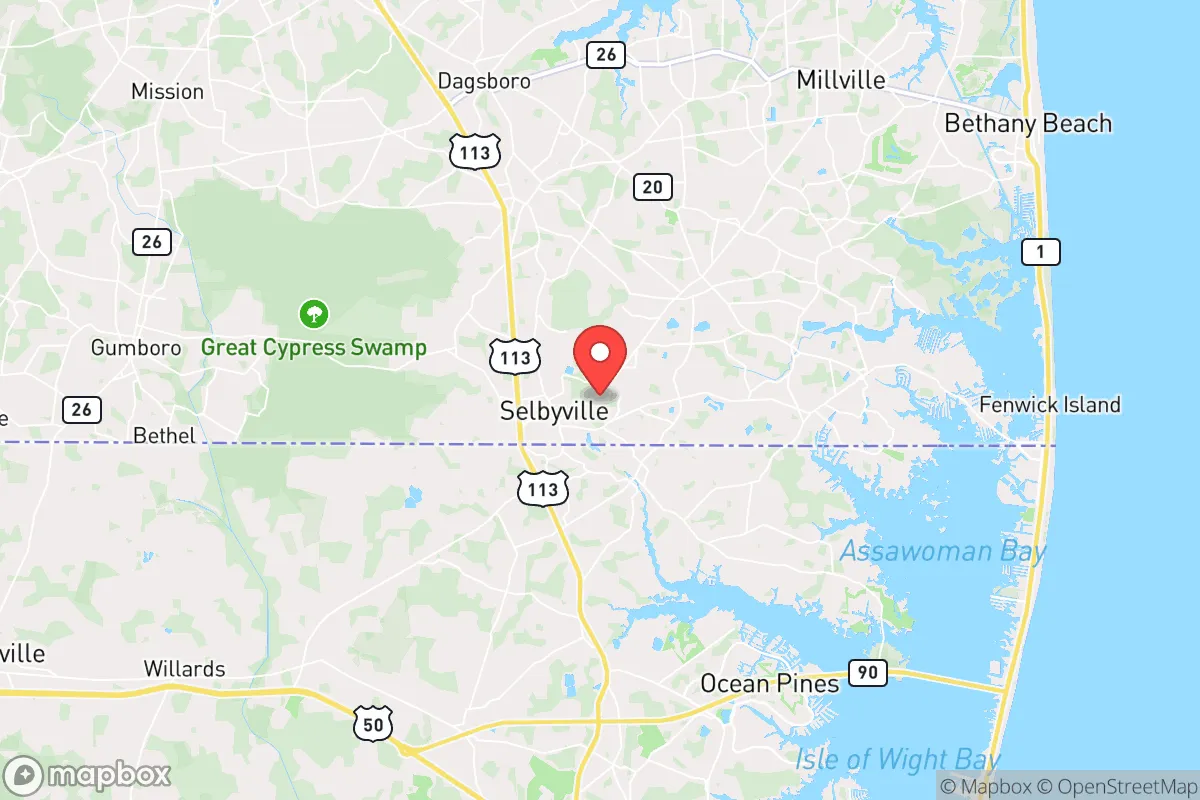
Photo: Wikipedia
Demographics of Selbyville, DE
Affluence Level in Selbyville, DE
A middle-class area roughly in line with national averages across income, home values, education, and employment.
People of Selbyville, DE
The people of Selbyville, Delaware today number roughly 3,005, forming a small but diversifying community in Sussex County where the white population (72.8%) remains the majority but Hispanic residents (18.5%) and Black residents (7.8%) represent growing shares. The town’s character blends its agricultural roots with a rising working-class and middle-class population drawn by lower housing costs compared to coastal resort towns like Rehoboth Beach and Bethany Beach. With a foreign-born population of 8.2% and a college-educated rate of 24.9%, Selbyville is more blue-collar and ethnically mixed than many inland Delaware towns, yet retains a distinctly small-town, family-oriented identity. The population is densest along the Route 54 corridor and in newer subdivisions that have replaced farmland on the town’s eastern and southern edges.
How the city was settled and grew
Selbyville’s original settlers were English and Scots-Irish farmers who arrived in the late 18th century, drawn by the fertile, flat coastal plain and the promise of land grants from the Penn family proprietors. The town itself was formally platted in the 1850s around a railroad stop on the Delaware, Maryland and Virginia Railroad, which connected local farmers to Philadelphia and Baltimore markets. The earliest residential core, now known as Old Town Selbyville (centered on Church Street and Main Street), was built by these Anglo-American families, who constructed simple frame houses and established the town’s first churches—Methodist and Presbyterian. A second wave came after the Civil War, when freed Black families moved into the area to work as farm laborers and domestic workers, settling in what became West Selbyville, a historically Black neighborhood along West Street and parts of Wilson Highway. By 1900, the population had reached roughly 500, with the economy anchored by peach orchards, strawberry farming, and a handful of canneries. The early 20th century brought a small influx of Italian and Polish immigrants who worked in the canneries and railroad yards, settling in Railroad Avenue and South Main Street—areas that remain working-class today. The town’s growth remained slow through the 1950s, topping 1,200 by 1960, as agriculture continued to dominate and suburban development bypassed Selbyville for coastal towns.
Modern era (post-1965)
The post-1965 period reshaped Selbyville’s population in two distinct phases. First, the 1970s and 1980s saw a steady outflow of younger white residents to nearby Sussex County suburbs and coastal job centers, while the town’s Black population stabilized at around 10-12% of the total. The second and more transformative phase began in the 1990s, when Hispanic immigrants—primarily from Mexico and Central America—arrived to work in the region’s expanding poultry processing plants (notably the Mountaire Farms facility in nearby Millsboro) and in construction tied to the coastal building boom. These families concentrated in East Selbyville, a newer area east of Route 113 along Cypress Road and parts of Old Mill Road, where modest ranch homes and mobile home parks offered affordable entry points. By 2010, the Hispanic share had risen to roughly 15%, and it has since climbed to 18.5%. The Asian population remains negligible at 0.4%, and the Indian subcontinent population is 0.0%, reflecting Selbyville’s lack of professional-sector jobs that attract those groups. The white population, while still the majority, has aged in place in Old Town Selbyville and West Selbyville, while younger white families have gravitated toward newer subdivisions like Selbyville Estates (built in the 2000s off Route 54) and Bishop’s Landing (a 2010s development near the Maryland line). The town’s overall population grew by roughly 12% between 2010 and 2020, driven almost entirely by Hispanic in-migration and new housing construction.
The future
Selbyville’s population is heading toward greater ethnic diversity and a modestly younger median age, but the town is not tribalizing into starkly separate enclaves. Hispanic families are increasingly moving into previously white-dominated neighborhoods like Selbyville Estates and Bishop’s Landing, suggesting assimilation rather than permanent segregation. The Black population share has held steady at 7-8% for two decades, indicating a plateau rather than growth. The white population is projected to continue its slow decline as older residents pass away or move to retirement communities, while the Hispanic share could reach 22-25% by 2035 if current migration patterns persist. The foreign-born share (8.2%) is likely to rise modestly but will remain below the Delaware state average (10.5%) because Selbyville lacks the rental housing stock and public transit that attract larger immigrant flows in cities like Wilmington or Georgetown. The college-educated rate (24.9%) is unlikely to climb significantly unless the town attracts remote workers or light industrial employers, which would require infrastructure improvements that are not currently planned. The next 10-20 years will likely see Selbyville become a more Hispanic-influenced community while retaining its small-town, family-oriented character, with new subdivisions filling remaining farmland along the Route 54 corridor.
For someone moving in now, Selbyville is becoming a quietly diversifying, blue-collar town where housing remains affordable relative to coastal Delaware, but where the social fabric is shifting from a predominantly white, agricultural past to a more mixed, working-class future. The schools are absorbing the demographic change without major tension, and the town’s identity as a safe, low-cost base for commuters to the beach resorts and poultry plants is likely to persist. The key question for newcomers is whether the town can attract enough economic investment to keep property values rising and services stable as its ethnic composition continues to evolve.

* Values derived from national, state, county, city and local statistics and may differ in a specific area. Last updated: 2026-04-23T03:52:20.000Z
Narrative content on this page is AI-generated and may contain mistakes. Verify any details that matter before acting on them.
ReloMaps may earn a commission from affiliate links at no extra cost to you.

