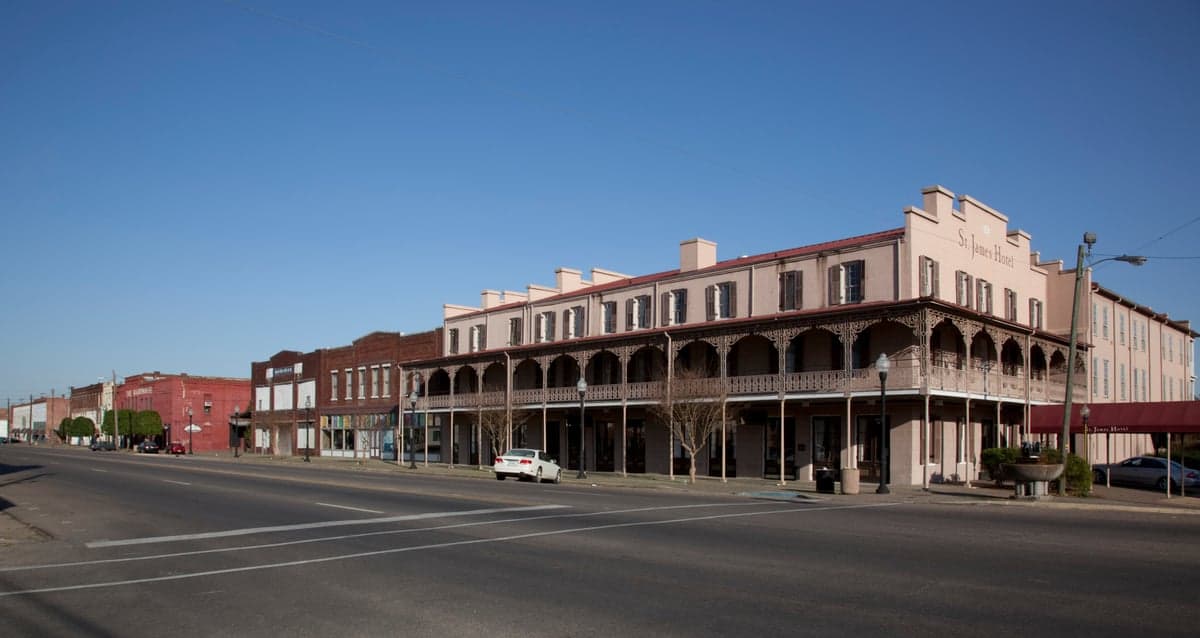
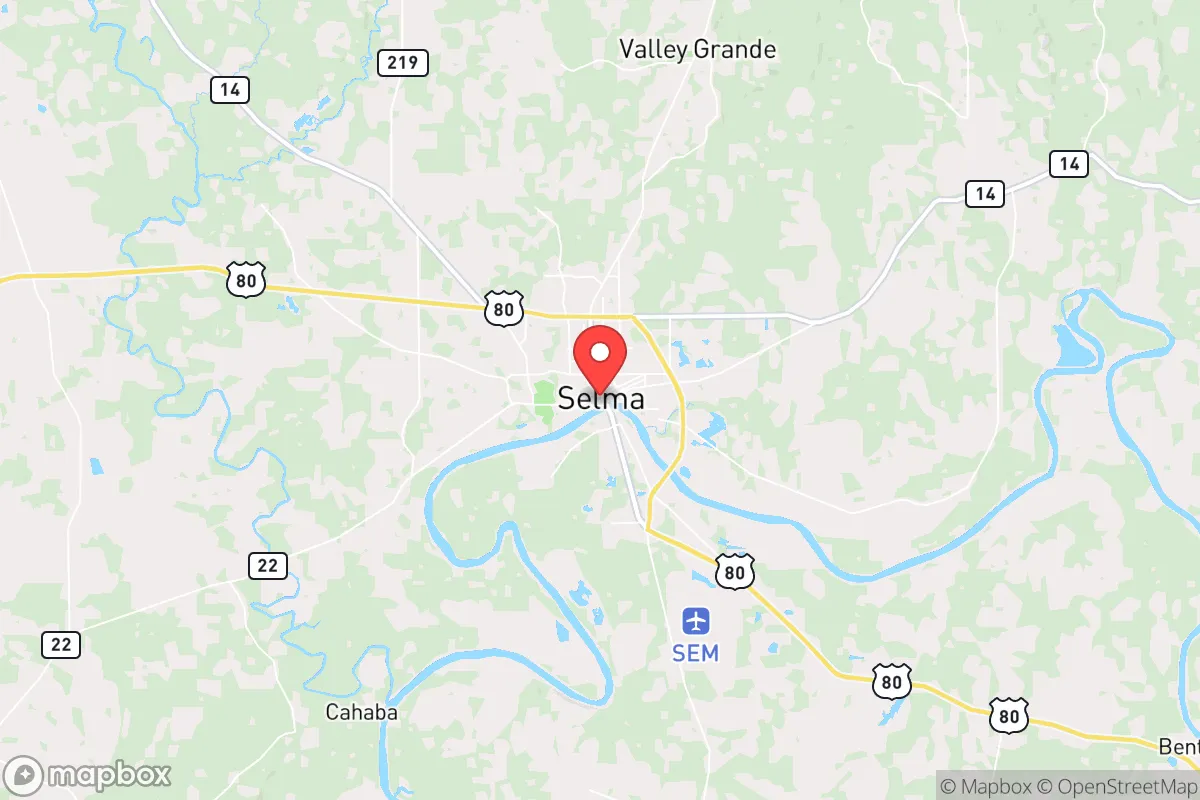
Photo: Wikipedia
Demographics of Selma, AL
Affluence Level in Selma, AL
A low-income area with significant economic hardship. Household wealth and educational attainment are well below national averages.
People of Selma, AL
The people of Selma, Alabama, today number 17,442, forming a city that is overwhelmingly Black (81.0%) with a small White minority (16.0%) and a tiny foreign-born population (1.8%). The city is characterized by deep historical roots, a strong sense of community identity tied to the Civil Rights Movement, and a population density of roughly 1,100 people per square mile. Distinctive markers include a low college attainment rate (19.0%) and a demographic profile that has remained remarkably stable in racial composition over the past two decades, with minimal growth from immigrant communities.
How the city was settled and grew
Selma was founded in 1820 as a river town on the Alabama River, initially drawing settlers from the Upper South—primarily Virginia, North Carolina, and Tennessee—who were attracted by fertile cotton lands. The original White planter class established large plantations along the river, while enslaved Black laborers, who soon outnumbered Whites, built the city’s early wealth. The historic Old Town district, centered around Water Avenue, housed the merchant and planter elite in Federal-style homes. After the Civil War, freedmen concentrated in neighborhoods like East Selma and West Selma, forming self-sufficient communities with churches, schools, and small businesses. By 1900, Selma’s population was roughly 60% Black, a ratio that held through the early 20th century as the city industrialized with cotton mills and a railroad hub. The Valley Creek area became a working-class White neighborhood, while Riverside remained predominantly Black. The Great Migration (1910–1970) saw tens of thousands of Black residents leave Selma for Northern cities, but the city’s Black population share actually grew as White residents began suburbanizing to Dallas County’s unincorporated areas after World War II.
Modern era (post-1965)
The 1965 Voting Rights Act, born from Selma’s Bloody Sunday, accelerated White flight. By 1970, Selma was 65% Black; by 2000, it was 78% Black. The post-1965 period saw little new immigration—Selma’s foreign-born share has never exceeded 2%—so demographic change came almost entirely from domestic migration. Black middle-class families moved into previously White neighborhoods like Summerfield Road and Marie Foster Drive areas, while White population concentrated in the Skyline Drive corridor near the city’s northern edge. The city’s small Asian (0.5%) and Indian (0.7%) populations are largely professionals working at Vaughan Regional Medical Center or teaching at Selma University and Concordia College; they live scattered rather than in a distinct enclave. The Hispanic population (0.7%) is negligible, mostly migrant workers in surrounding dairy and poultry farms who do not settle in Selma proper. Since 2000, Selma has lost roughly 3,000 residents (down from 20,512), with the decline driven by Black out-migration to Atlanta, Birmingham, and Montgomery for better jobs, while the White population has held steady in absolute numbers.
The future
Selma’s population is projected to continue a slow decline, likely falling below 16,000 by 2035, as the city struggles to retain young adults. The population is homogenizing—the Black share is stable near 81%, but the small White minority is aging (median age 47 for Whites vs. 35 for Blacks), suggesting further White numerical decline. No immigrant community is growing: the East/Southeast Asian and Indian populations are plateauing, and the foreign-born share remains below 2%. The city is not tribalizing into distinct enclaves; rather, it is becoming more uniformly Black, with class divisions (college-educated vs. not) replacing racial ones. The Historic District near downtown is seeing modest reinvestment from Black professionals and a handful of White newcomers drawn to historic homes, but this is too small to reverse trends. The next 10–20 years will likely see Selma become an older, poorer, and more uniformly Black city, with population concentrated in the same historic neighborhoods—East Selma, West Selma, and Riverside—that have defined it for a century.
For someone moving in now, Selma offers a deeply rooted Black cultural identity and a low cost of living, but the demographic trajectory points toward continued population loss and economic stagnation. The city is not diversifying; it is consolidating around its existing Black majority, with little influx of new groups. A new resident should expect a close-knit, historically conscious community where racial demographics are stable and the small White and immigrant populations are long-established rather than growing.

* Values derived from national, state, county, city and local statistics and may differ in a specific area. Last updated: 2026-10-10T16:28:52.000Z
Narrative content on this page is AI-generated and may contain mistakes. Verify any details that matter before acting on them.
ReloMaps may earn a commission from affiliate links at no extra cost to you.

