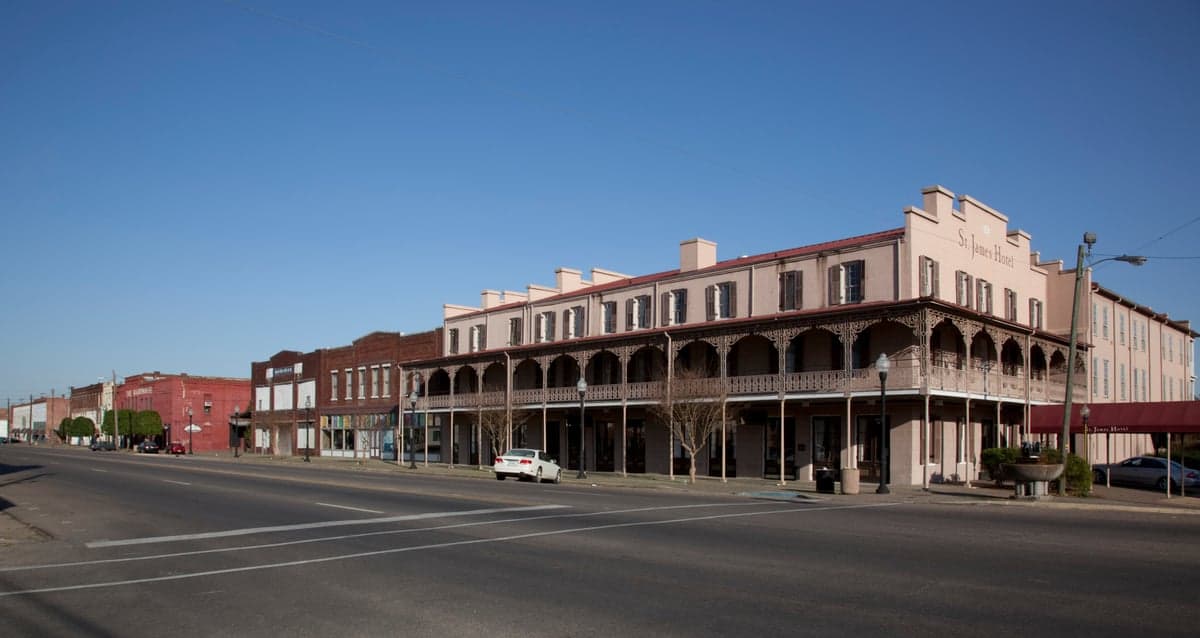
Photo: Wikipedia
Personal Sovereignty in Selma, AL
Viable for self-reliance. Generally workable, though some barriers may limit total independence.
What does Personal Sovereignty tell us?
Personal Sovereignty measures your capacity for self-reliance and independence with minimal government friction. Higher scores mean fewer barriers between you and the way you want to live... but it assumes you have the space you need and good neighbors.
What does this tell us?
Personal Sovereignty measures your capacity for self-reliance and independence with minimal government friction. Higher scores mean fewer barriers between you and the way you want to live... but it assumes you have the space you need and good neighbors.
State Policy
Energy independence: Importer (45% of energy produced in-state)
Personal Liberty
Homesteading

Personal Liberty Analysis
Selma, Alabama, offers a personal sovereignty environment that is markedly stronger than most of the United States, largely due to Alabama’s constitutional and statutory framework that resists federal overreach and prioritizes individual autonomy. For the survivalist or prepper, this means fewer legal barriers to self-reliance, self-defense, and family-based decision-making than in coastal or Midwestern states. While Selma itself carries the economic and social challenges of a small, historically significant city in the Black Belt, the state-level legal climate provides a foundation where a determined individual can live largely unbothered by government intrusion—provided they are prepared to navigate local realities like limited infrastructure and a struggling tax base.
Tax burden and regulatory posture: How Alabama’s low-tax, low-regulation environment supports self-reliance
Alabama consistently ranks among the most tax-friendly states in the nation, and Selma residents benefit directly from this posture. There is no state-level tax on groceries or Social Security income, and the state’s flat income tax rate of 5% is among the lowest in the South. Property taxes in Dallas County are exceptionally low—typically around 0.4% of assessed value—meaning a modest homestead can be held for a few hundred dollars annually. For the prepper focused on land ownership and long-term holding, this is a critical advantage: the state does not punish property accumulation with escalating tax burdens. On the regulatory side, Alabama operates under a “right-to-work” framework and has no state-level occupational licensing requirements for many trades, which allows individuals to engage in barter, small-scale manufacturing, or home-based businesses without excessive bureaucratic friction. The state also has no general business inventory tax, and local zoning in Selma is minimal outside of designated historic districts. This regulatory posture means a person can build a workshop, store supplies, or operate a small farm without needing multiple permits or facing constant inspections—a stark contrast to states like California or New York where government oversight can strangle self-sufficiency.
Self-defense and gun law specifics: Constitutional carry, castle doctrine, and stand your ground in Selma
Alabama is a gold standard for firearm freedom, and Selma sits squarely within that framework. The state enacted permitless (constitutional) carry in 2022, meaning any law-abiding adult 18 or older can carry a concealed handgun without a permit, background check, or training requirement. This is a non-negotiable for the survivalist mindset: the government does not require permission to exercise the right to self-defense. Alabama also has a strong castle doctrine with no duty to retreat—inside one’s home, vehicle, or occupied structure—and a broad stand-your-ground law that extends to any place where a person has a legal right to be. This means that in Selma, where property crime rates are higher than national averages, a homeowner or business owner can use deadly force against an intruder without fear of prosecution, provided the threat is reasonable. The state preempts local gun ordinances, so Selma city council cannot impose its own restrictions on magazine capacity, firearm types, or storage requirements. For the prepper, this legal environment allows stockpiling of firearms and ammunition without worrying about future bans or registration schemes. The only notable limitation is that Alabama does not recognize out-of-state permits for non-residents, but for a resident, the freedom is near-absolute.
Self-reliance and homesteading viability: Lot sizes, zoning, and off-grid feasibility in Selma
Selma’s rural character and weak municipal enforcement make it one of the more viable locations in Alabama for off-grid living and homesteading, though with important caveats. Residential lots in the city proper can be as small as 5,000 square feet, but just outside city limits—in areas like Valley Creek or along the Alabama River—parcels of 1 to 5 acres are common and affordable, often under $5,000 per acre. Zoning is lax: Dallas County has no county-wide zoning, and Selma’s zoning code is primarily concerned with commercial districts and historic preservation. There are no explicit prohibitions on rainwater collection, composting toilets, or solar panel installation, though the city does require connection to municipal water and sewer within the city limits. For true off-grid independence, purchasing land in unincorporated Dallas County is the better play—there, no building permits are required for structures under 200 square feet, and agricultural exemptions allow for livestock, beekeeping, and crop cultivation without special permits. The climate supports year-round growing (USDA Zone 8a), with a 230-day growing season, and water access is straightforward via wells. However, the prepper should note that Selma’s municipal infrastructure is aging and unreliable—the city has faced water system failures and boil advisories—which ironically makes off-grid water and power systems not just a lifestyle choice but a practical necessity for true self-reliance.
Personal liberties: Parental rights, medical autonomy, speech, and property protections
Alabama has enacted some of the strongest parental rights laws in the country, which directly benefit families in Selma. The state’s “Parental Rights Protection Act” (2022) requires schools to obtain written parental consent before administering any health-related survey or instruction, and it prohibits school personnel from encouraging a child to withhold information from parents regarding gender identity or sexual orientation. For the conservative parent concerned about government overreach into family matters, this is a significant safeguard. Medical autonomy is similarly protected: Alabama has a broad medical freedom law that prohibits mandatory vaccination for employment or public accommodation (with limited exceptions for healthcare workers), and the state does not participate in federal vaccine databases. The state also has a strong conscience clause allowing healthcare providers to refuse participation in procedures they object to. On speech, Alabama has no hate speech laws that could criminalize political or religious expression, and the state’s constitution explicitly protects the right to keep and bear arms as an individual right. Property rights are reinforced by Alabama’s strict eminent domain laws, which require “public use” (not just public benefit) and full market-value compensation. For the prepper, this means that building a bunker, storing supplies, or posting political signs on your own land is unlikely to draw government scrutiny—a far cry from states where HOAs or local ordinances can restrict everything from flagpoles to garden sheds.
Overall, Selma offers a personal sovereignty profile that is among the strongest in the Southeast, but it is not without trade-offs. The state-level legal framework is exceptional for gun rights, low taxes, minimal regulation, and parental autonomy—core pillars for the survivalist or liberty-minded individual. However, the local reality in Selma includes higher crime rates, a struggling economy, and aging infrastructure that can test self-reliance in ways that are not always positive. Compared to areas like rural Montana or Idaho, Selma lacks the same level of geographic isolation and natural resource abundance, but it compensates with lower land costs, a longer growing season, and a legal environment that is actively hostile to federal overreach. For the strategic relocator who values personal sovereignty above all else and is willing to accept the challenges of a small Southern city, Selma represents a viable base of operations where the government is more likely to leave you alone than to interfere.

* Values derived from national, state, county, city and local statistics and may differ in a specific area. Last updated: 2026-10-10T16:28:52.000Z
Narrative content on this page is AI-generated and may contain mistakes. Verify any details that matter before acting on them.
ReloMaps may earn a commission from affiliate links at no extra cost to you.

