Photo: Wikipedia
Demographics of Shelby, MT
Affluence Level in Shelby, MT
A middle-class area roughly in line with national averages across income, home values, education, and employment.
People of Shelby, MT
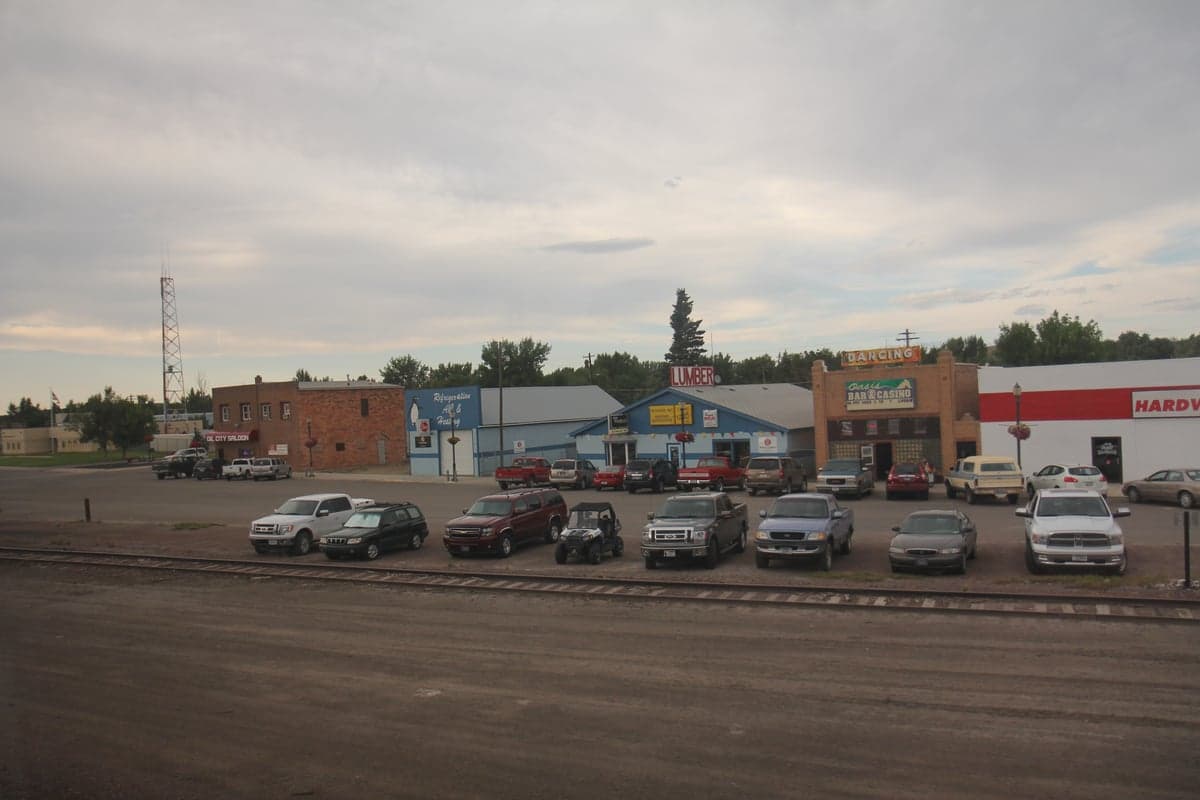
The people of Shelby, Montana, today form a small, predominantly white community of 3,129 residents, characterized by a strong working-class identity rooted in the railroad and agriculture. With 79.2% of the population identifying as white and a foreign-born share of just 1.9%, Shelby is notably less diverse than the national average, reflecting its history as a rural railroad town. The city’s identity is shaped by a conservative, self-reliant culture, where family ties and local institutions like the Marias Fairgrounds anchor social life. For those considering relocation, Shelby offers a tight-knit, low-density environment where community involvement is expected and newcomers are often measured by their willingness to contribute.
How the city was settled and grew
Shelby’s population history begins with the Great Northern Railway, which established the town in 1891 as a division point along its transcontinental line. The original settlers were predominantly Northern European immigrants—Irish, German, and Scandinavian railroad workers and their families—who built the first homes in what is now the Old Town District along Main Street. The 1910 discovery of oil in the nearby Kevin-Sunburst field triggered a brief boom, drawing a wave of laborers and speculators who settled in the Oil Camp Addition neighborhood, a cluster of modest homes and boarding houses just west of the rail yards. By the 1920s, the population peaked near 3,500, then declined as oil production waned. The Great Northern’s continued presence stabilized the town, with railroad families forming the core of the Railroad Addition neighborhood, a grid of worker cottages south of the tracks. No significant non-white population settled during this era; the 1930 census recorded fewer than 10 Black or Hispanic residents, reflecting the railroad’s segregated hiring practices and Montana’s overall homogeneity.
Modern era (post-1965)
After the 1965 Hart-Cellar Act, Shelby saw minimal immigration-driven change. The foreign-born population today stands at 1.9%, with most being Canadian or European retirees, not new arrivals from Asia or Latin America. The small Hispanic share (5.1%) is largely composed of families who moved from the Southwest in the 1990s to work in the region’s sugar beet fields and oil fields; they are concentrated in the Westside neighborhood, a lower-density area of mobile homes and older ranch houses. The Black population (3.0%) is almost entirely tied to the Montana Department of Corrections’ Crossroads Correctional Center, which opened in 1999 and brought a small number of staff and inmates’ families to the South Hill area. East/Southeast Asian residents (0.3%) and Indian-subcontinent residents (0.8%) are negligible, typically transient professionals at the local hospital or oil service companies. Suburbanization has been minimal—Shelby lacks the exurban subdivisions common in larger Montana towns—so most residents still live in the original historic neighborhoods, with newer construction limited to a few cul-de-sacs in the North Park Addition near the golf course. The college-educated share (19.4%) is low, reflecting the blue-collar economy; most professionals commute from Great Falls or live in the Downtown Core near the courthouse and hospital.
The future
Shelby’s population is projected to remain flat or decline slightly over the next decade, mirroring rural Montana trends. The white share (79.2%) is aging, with a median age near 45, and young adults often leave for college or jobs in Billings or Missoula. The Hispanic population is growing slowly, driven by births rather than new immigration, and is likely to concentrate further in the Westside as families expand. The Black population tied to the prison is stable but not growing, as the facility has no expansion plans. No significant immigrant enclave is forming—the 1.9% foreign-born share is among the lowest in Montana—and the city is homogenizing rather than tribalizing into distinct ethnic neighborhoods. The next 10-20 years will likely see a continued slow decline, with the population becoming older, whiter, and more dependent on the railroad and prison for employment. Newcomers will be rare, and those who arrive will likely be retirees seeking low-cost living or workers in the energy sector.
Shelby is becoming a quieter, more insular version of itself—a place where demographic stability, not change, defines the experience. For a conservative-leaning individual or family moving in now, this means joining a community where neighbors know each other, local politics lean right, and the pace of life is slow. The trade-off is limited diversity, a shrinking tax base, and fewer services than a growing city would offer.

* Values derived from national, state, county, city and local statistics and may differ in a specific area. Last updated: 2026-04-20T08:57:05.000Z
Narrative content on this page is AI-generated and may contain mistakes. Verify any details that matter before acting on them.
ReloMaps may earn a commission from affiliate links at no extra cost to you.

