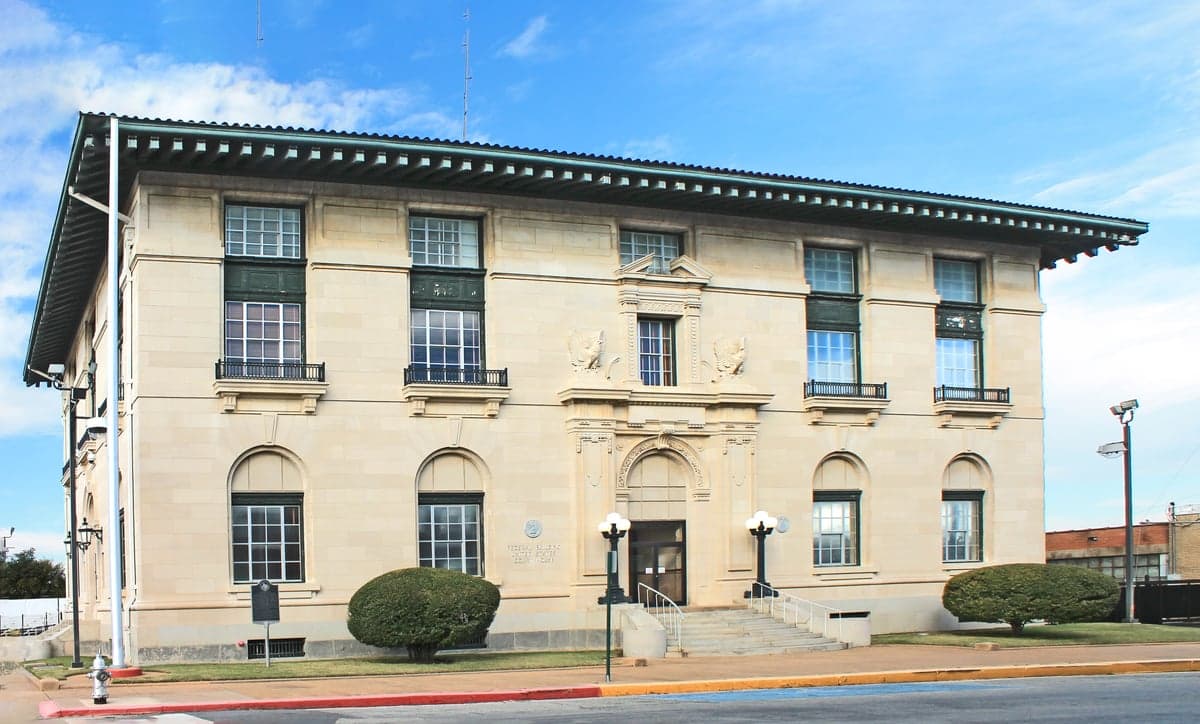
Photo: Wikipedia
Demographics of Sherman, TX
Affluence Level in Sherman, TX
A middle-class area roughly in line with national averages across income, home values, education, and employment.
People of Sherman, TX
The people of Sherman, Texas today number 45,036, forming a community that is predominantly White (60.7%) with a substantial Hispanic minority (22.4%) and a smaller Black population (9.6%). The city’s identity is shaped by its roots as a railroad and agricultural hub, now evolving into a manufacturing and logistics center, with a relatively low college attainment rate of 23.1% reflecting its blue-collar heritage. Distinctive markers include a strong sense of local tradition, a growing but still modest foreign-born population (7.0%), and a demographic landscape that is gradually diversifying while remaining anchored by long-established White and Hispanic families.
How the city was settled and grew
Sherman was founded in 1846 as the seat of Grayson County, named after General Sidney Sherman, a hero of the Texas Revolution. The original settlers were primarily Anglo-American farmers and merchants from the Upper South and Midwest, drawn by the promise of fertile blackland prairie and the arrival of the Houston and Texas Central Railway in 1872. This railroad connection transformed Sherman into a cotton and grain shipping center, attracting a wave of German and Irish immigrants who settled in the West Sherman neighborhood, where their descendants still maintain a visible presence. By the early 20th century, African American families arrived as part of the Great Migration, finding work in the cotton fields and rail yards, and establishing the historic Fairview Park area, which remains a cultural anchor for the Black community. The city’s population grew steadily through the mid-20th century, reaching about 30,000 by 1970, with the Old Settlers district near downtown preserving many of the original Victorian homes built by the merchant class.
Modern era (post-1965)
After the 1965 Hart-Cellar Act, Sherman saw a modest but notable influx of Hispanic immigrants, primarily from Mexico, who came for agricultural and later industrial jobs. This wave concentrated in the South Sherman area, south of the railroad tracks, where Hispanic-owned businesses and churches now form a vibrant corridor along U.S. Highway 75. The 1980s and 1990s brought a smaller wave of East/Southeast Asian families—primarily Vietnamese and Filipino—who settled in the North Sherman neighborhoods near the growing industrial parks, though their share remains just 1.0% today. The Indian subcontinent population (0.8%) is even smaller, with families typically living in newer subdivisions like Westwood Estates, drawn by professional opportunities at the nearby Texas Instruments plant and the expanding healthcare sector. Suburbanization since 2000 has pushed some White families into newer developments on the city’s northern and western edges, while the historic core has seen a slight increase in Hispanic and Black residents, reflecting a gradual but incomplete diversification.
The future
Sherman’s population is projected to grow moderately over the next decade, driven by the expansion of manufacturing and logistics employers like the GlobiTech semiconductor plant and the new Tyson Foods facility. The Hispanic share is likely to continue rising, potentially reaching 28-30% by 2035, as younger families move into South Sherman and newer subdivisions like Pecan Grove. The White population, while still the majority, is aging and may decline slightly as younger adults leave for larger metro areas. The East/Southeast Asian and Indian communities are expected to remain small but stable, with growth tied to specific professional niches rather than broad immigration. The city is not tribalizing into distinct enclaves—most neighborhoods remain mixed—but Fairview Park and South Sherman retain strong cultural identities. The foreign-born share (7.0%) is below the national average and is plateauing, suggesting that future growth will come more from domestic in-migration than international arrivals.
For someone moving in now, Sherman is becoming a more diverse but still predominantly White and Hispanic community with a working-class character. The city offers a stable, family-oriented environment where neighborhoods like West Sherman and Old Settlers provide a sense of history, while newer areas like Pecan Grove cater to those seeking modern suburban amenities. The demographic trajectory points toward gradual Hispanic growth and a steady White majority, with little risk of rapid, disruptive change—a place where tradition and modest evolution coexist.

* Values derived from national, state, county, city and local statistics and may differ in a specific area. Last updated: 2026-05-11T13:39:36.000Z
Narrative content on this page is AI-generated and may contain mistakes. Verify any details that matter before acting on them.
ReloMaps may earn a commission from affiliate links at no extra cost to you.

