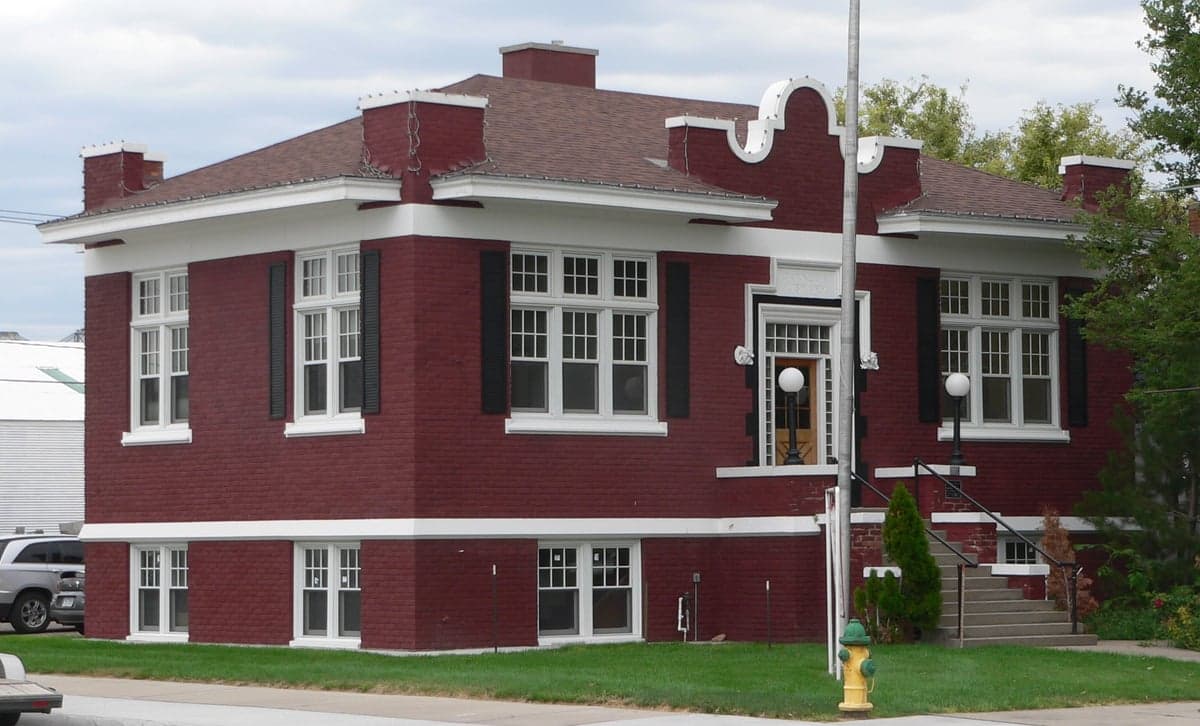
Photo: Wikipedia
Strategic Assessment of Sidney, NE
Deep buffer from population centers and strategic targets. Low natural disaster risk and minimal exposure to border or coastal threats.
What does the Strategic Assessment tell us?
Our Strategic Assessment grades tactical survivability of an area. Major population centers, military targets, fallout zones, natural disasters, and border exposure all drive risk — lower exposure means a more defensible position in a crisis.
This is heavily inspired by Joel Skousen's Strategic Relocation book. Highly recommended you checkout the book ($)What does this tell us?
Our Strategic Assessment grades tactical survivability of an area. Major population centers, military targets, fallout zones, natural disasters, and border exposure all drive risk — lower exposure means a more defensible position in a crisis.
This is heavily inspired by Joel Skousen's Strategic Relocation book. Highly recommended you checkout the book ($)Strategic Pillars

Key Distances
Regional Safe Places
Below is our recommended "safe zones" in Nebraska and the surrounding area based on our strategic heuristics. For most people, it's unrealistic to live in a “safe zone” full-time due to work, family or other personal reasons. They tend to be more rural. However, many of these areas are perfect for second homes and retreat properties that double as a vacation home or even a short-term rental.
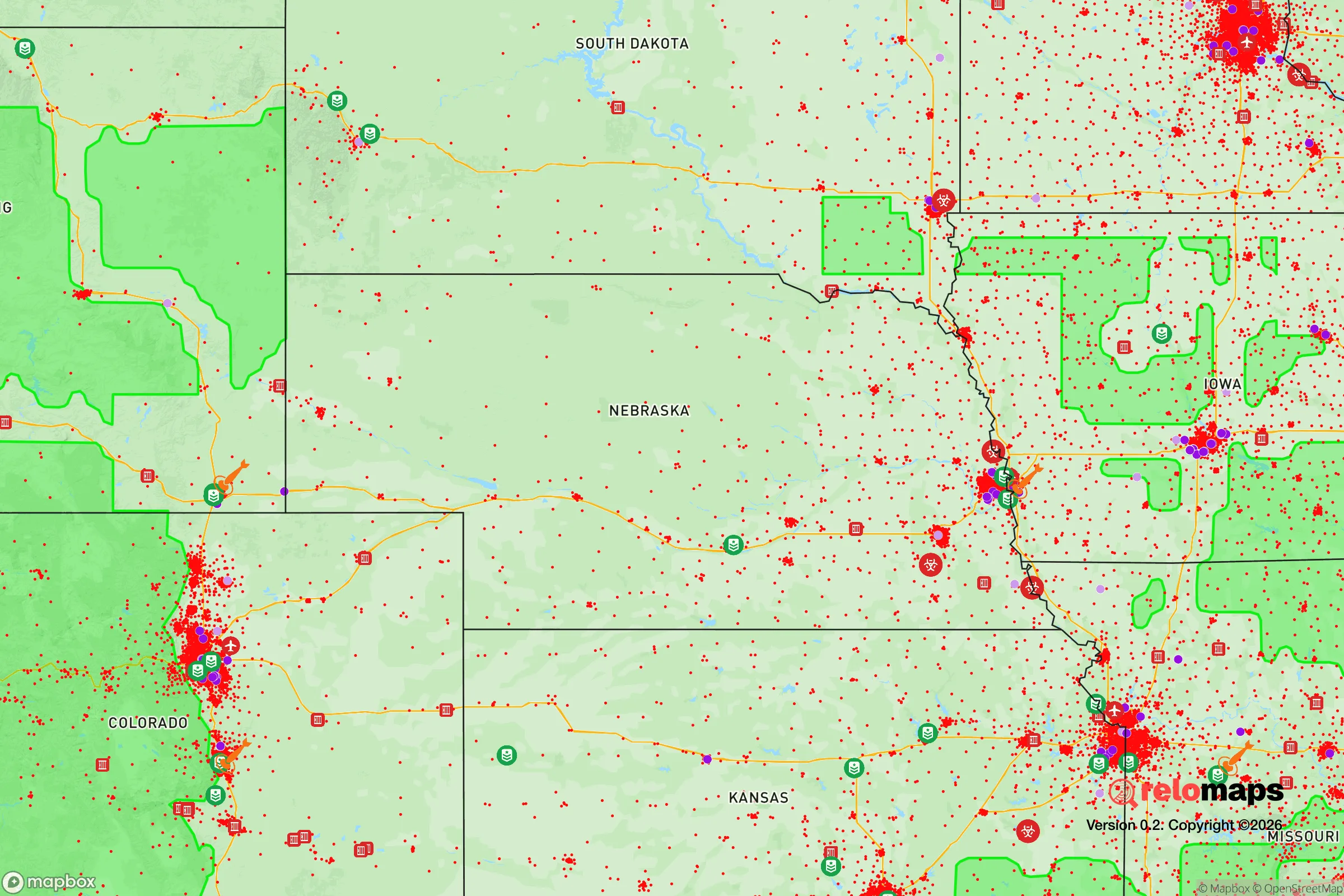
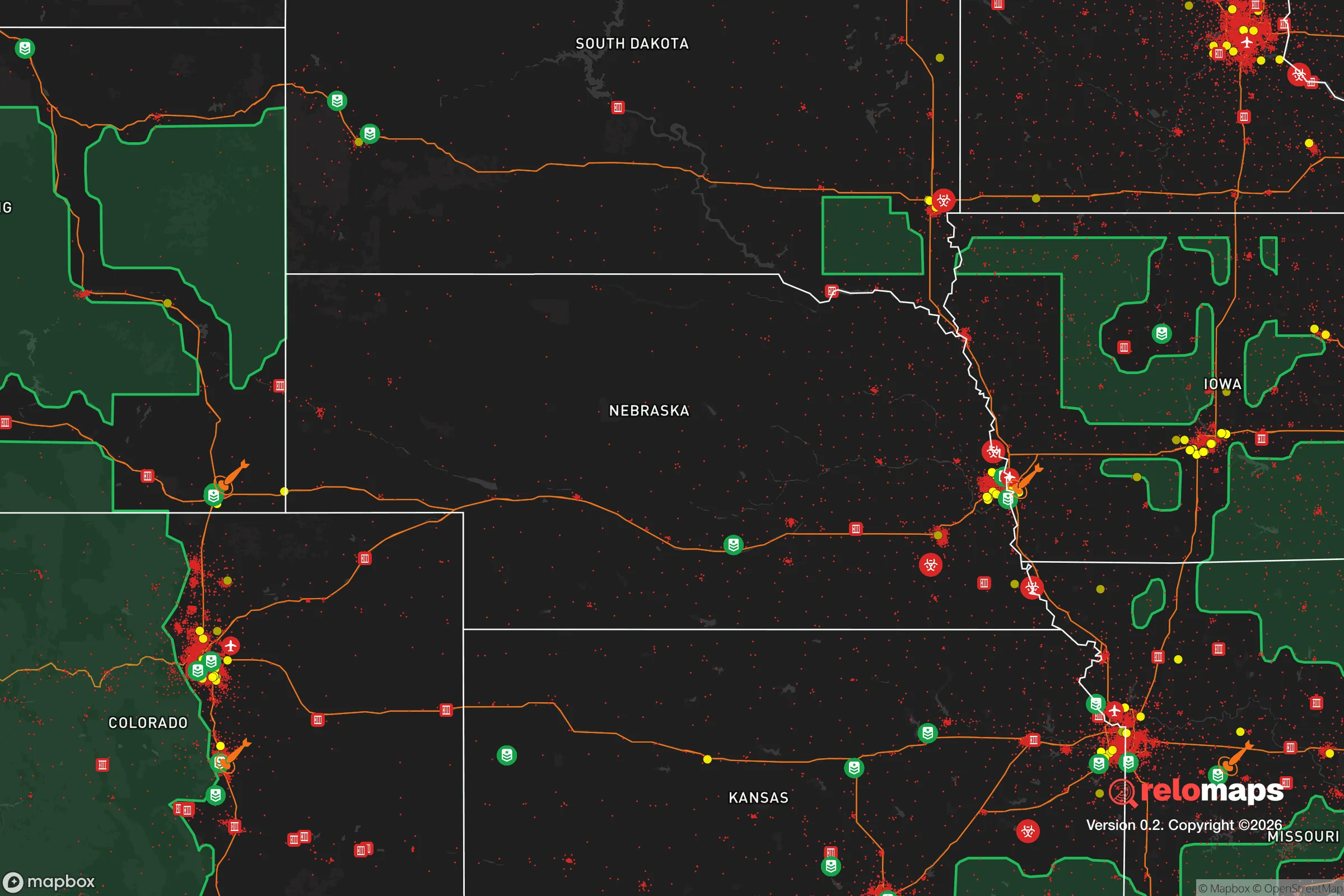


Important Note: For informational purposes only. This does not mean nothing bad ever happens in the green zones. Please use common sense. This is based on public data and modeled with AI. We tried to take a conservative approach but mistakes happen. We update this regularly as new information becomes available.
Solar Generator Recommendations
Backup power matters more here than in safer locations. We've picked three solar generators across budgets and capacity tiers — start with the budget unit if you only need a few essentials, or step up if you want to run a fridge and HVAC for days at a time.

Jackery Portable Power Station Explorer 300
Budget OptionPower on the Go: Weighing only 11 lbs, it's convenient to set up and store with book-sized foldable solar panels

BLUETTI Portable Power Station AC180
Designed for both indoor and outdoor scenarios, AC180 is highly capable as it has a robost capacity and continuous output power.

EF ECOFLOW DELTA Pro Ultra Power Station
Upgraded PickEcoFlow DELTA Pro Ultra is a whole-home energy system designed to grow with your family. Integrated with the Smart Home Panel 2, it scales to meet your evolving energy needs — keeping your home powered, intelligent, and secure through every stage of life.
We earn a commission, at no additional cost to you.
Strategic Assessment Analysis
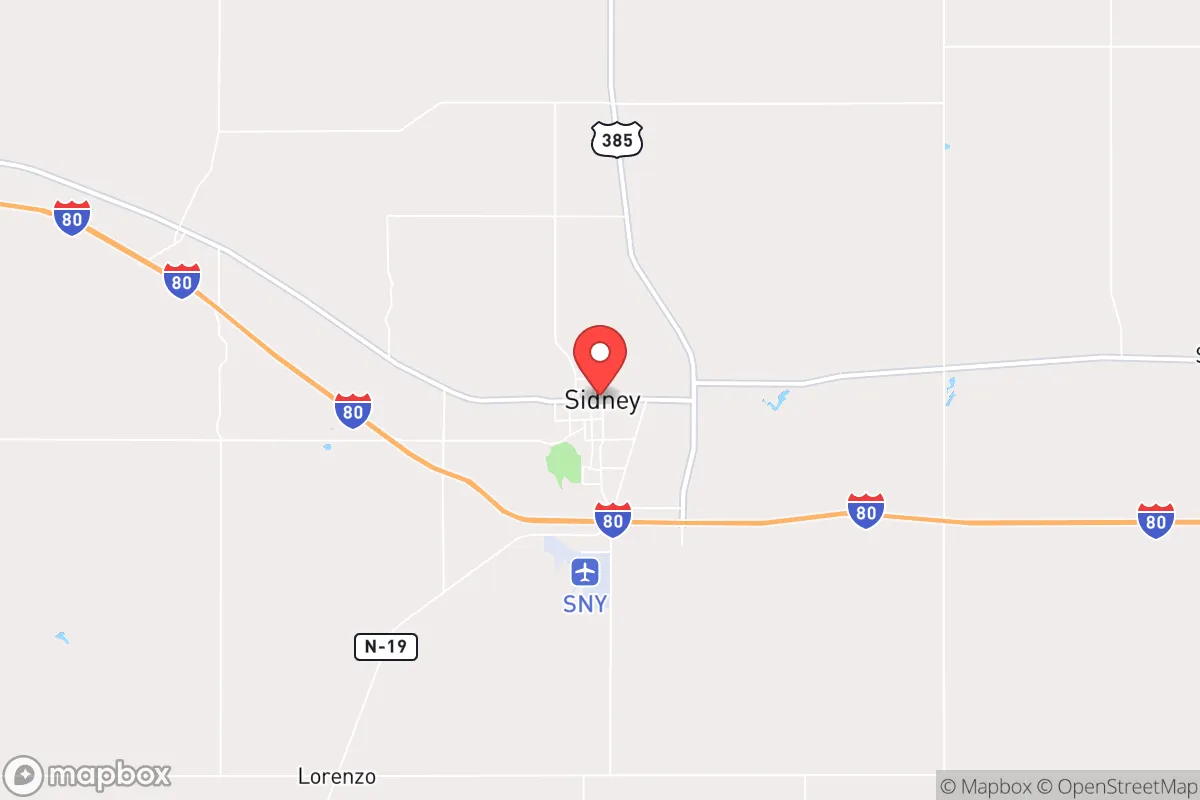
Sidney, Nebraska, sits as a quiet outlier in the Great Plains—a town of roughly 6,400 people that offers a rare combination of geographic isolation, logistical connectivity, and low strategic vulnerability. For a relocator with a survivalist or prepper mindset, Sidney’s primary advantage is its position as a minor transportation hub without the target profile of a major city. It lies along Interstate 80 and the Union Pacific mainline, giving it solid supply-chain access, yet it’s far enough from Denver (about 185 miles east) and Cheyenne (about 85 miles east) to avoid the immediate fallout zones or civil unrest spillover from those population centers. The town’s economic anchor is Cabela’s headquarters—a massive outdoor retailer that, in a crisis, could become a de facto resource hub for those with the means to barter or secure supplies. Sidney’s resilience isn’t flashy, but it’s functional: low crime, a stable agricultural base, and a population that largely keeps to itself. For a conservative-leaning individual or family looking to ride out national instability, this is a place that rewards preparation without drawing attention.
Geographic position and natural advantages for long-term security
Sidney’s location in the Nebraska Panhandle is its strongest card. The town sits on the high plains at roughly 4,100 feet elevation, which means a dry climate with fewer natural disasters than coastal or tornado-alley regions. The area averages about 18 inches of precipitation annually—enough for dryland farming but not so much that flooding is a recurring threat. The South Platte River runs just south of town, providing a surface water source that, with proper filtration, could sustain a household. The surrounding terrain is flat to gently rolling, offering good visibility and limited cover for anyone approaching—a defensive advantage if you’re securing a rural property. Sidney is also roughly 30 miles from the Colorado border, giving residents the option to relocate south if conditions deteriorate, though the Nebraska side is generally more politically stable and less prone to the population pressures seen along the Front Range. The nearest major military installation is F.E. Warren Air Force Base in Cheyenne, about 85 miles west—close enough to provide a security buffer in a national emergency, but far enough that a strike on the base wouldn’t directly threaten Sidney. The town’s position along the I-80 corridor means it’s a natural choke point for east-west travel, which could be a double-edged sword: useful for trade and movement, but also a potential route for refugees fleeing Denver or Cheyenne in a collapse scenario.
Risks, exposures, and proximity to fallout-relevant landmarks
The primary risk for Sidney is its proximity to Cheyenne and, by extension, the nuclear missile fields of the Great Plains. F.E. Warren AFB is a major ICBM base, and while Sidney is outside the likely blast radius of a direct strike, it sits within the broader target zone for a first-strike scenario. The prevailing winds in the region blow from west to east, meaning fallout from a strike on Cheyenne or the missile silos scattered across western Nebraska and eastern Wyoming could drift over Sidney within hours. That said, the town’s small size and lack of strategic industry make it a low-priority target compared to Denver, Omaha, or the missile fields themselves. The real exposure is secondary: if Denver or Cheyenne experiences a mass casualty event—whether from terrorism, civil unrest, or a nuclear incident—Sidney could see a surge of refugees along I-80. The town has limited infrastructure to absorb a sudden population influx; the hospital, Sidney Regional Medical Center, is a 25-bed critical access facility, adequate for routine care but quickly overwhelmed in a crisis. There are no major dams, chemical plants, or nuclear power plants within 100 miles, which reduces the risk of industrial accidents. The biggest natural hazard is blizzards and extreme cold, which can cut off roads for days—a factor that favors those with stored food, fuel, and winter gear. For a prepper, the key takeaway is that Sidney’s risks are manageable with standard preparation: a fallout shelter, a water filtration system, and a plan to secure your perimeter against transient threats.
Practical resilience for a relocator: food, water, energy, and defensibility
Sidney offers a solid baseline for self-sufficiency, but it requires active effort. The local water supply comes from the Ogallala Aquifer, which is deep but reliable—wells in the area typically produce good-quality water at depths of 200-400 feet. A private well with a hand pump or solar-powered pump is a realistic investment for a rural property. The agricultural land around Sidney is primarily dryland wheat and corn, with some cattle ranching; a family with a few acres could supplement their diet with a garden and small livestock, though the short growing season (about 130 frost-free days) limits options. The town itself has a grocery store, a hardware store, and the Cabela’s, which stocks camping gear, firearms, ammunition, and freeze-dried food—useful for initial stocking but not a long-term supply chain. Energy is a mixed picture: the local grid is served by high-voltage transmission lines from coal and natural gas plants, but these are vulnerable to disruption. Solar is viable given the region’s 260 sunny days per year, and wind is abundant—small wind turbines are a practical addition for off-grid power. Defensibility is where Sidney shines for a prepared relocator. The town’s layout is compact, with a grid of streets that can be barricaded at key intersections. The surrounding farmland offers clear sightlines, and the lack of dense tree cover means few places for an adversary to hide. A rural property with a perimeter fence, a well, and a backup generator could be held with a small group. The local culture is heavily conservative and gun-friendly—Nebraska is a constitutional carry state—so a newcomer who keeps to themselves and demonstrates competence will be left alone, not targeted. The biggest practical challenge is the lack of a robust local economy outside of Cabela’s and agriculture; a relocator needs to bring either remote income, savings, or a trade that’s in demand (welding, mechanics, medical skills).
The overall strategic picture for Sidney is one of calculated trade-offs. It’s not a fortress, and it’s not a self-sufficient homestead—but it’s a defensible, low-profile base with good logistics and a population that won’t panic at the sight of a rifle. The risks from Cheyenne and the missile fields are real but manageable with basic preparation, and the isolation from Denver’s chaos is a genuine asset. For a conservative-leaning individual or family who wants to be out of the way but not completely off the grid, Sidney offers a middle ground: close enough to a major highway to move supplies, far enough from the cities to avoid the worst of the fallout. The key is to arrive prepared—stocked, skilled, and ready to keep your head down. In a world where the federal government is increasingly unreliable and urban centers are ticking time bombs, Sidney is a place where a determined person can build a resilient life without being a target. It’s not paradise, but it’s a solid bet for those who see the writing on the wall.

* Values derived from national, state, county, city and local statistics and may differ in a specific area. Last updated: 2026-05-03T20:31:48.000Z
Narrative content on this page is AI-generated and may contain mistakes. Verify any details that matter before acting on them.
ReloMaps may earn a commission from affiliate links at no extra cost to you.

