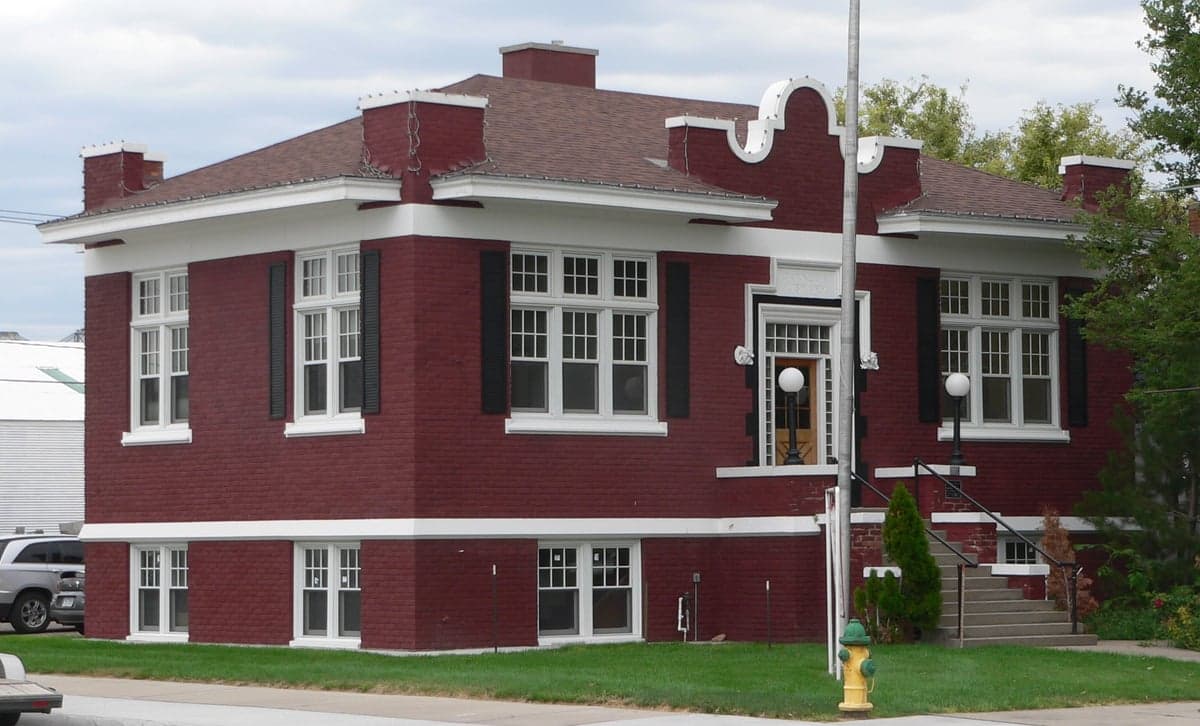
Photo: Wikipedia
Demographics of Sidney, NE
Affluence Level in Sidney, NE
A middle-class area roughly in line with national averages across income, home values, education, and employment.
People of Sidney, NE
The people of Sidney, Nebraska today form a predominantly white, working-class community of 6,396 residents, with a small but established Hispanic population of 10.5% and a Black population of 3.1%. The city’s character is shaped by its history as a railroad and agricultural service hub, with a notably low foreign-born share of just 0.7% and a college attainment rate of 19.3%, reflecting a population rooted in blue-collar trades and local industry. Distinctive identity markers include a strong sense of self-reliance, a deep connection to the surrounding High Plains ranching economy, and a social fabric that remains largely homogeneous compared to Nebraska’s larger cities.
How the city was settled and grew
Sidney was founded in 1867 as a construction camp for the Union Pacific Railroad, which drove the first major wave of settlers. The original population consisted largely of Irish and German railroad workers, who built the initial homes in what is now the Old Town district along the tracks. The 1870s and 1880s brought a second wave of German and Czech homesteaders drawn by the 1862 Homestead Act, who established farms on the surrounding prairie and formed the core of the West Sidney neighborhood, where many of their descendants still live in older single-family homes. A third wave arrived in the early 1900s with the expansion of the Cabela’s mail-order business (founded in 1961 but rooted in earlier retail), which attracted workers from the Midwest and Great Plains. By the mid-20th century, Sidney’s population had stabilized around 6,000, with the South Park neighborhood developing as a post-war subdivision for returning veterans and their families, many employed at the local Cabela’s headquarters or the nearby Union Pacific rail yard.
Modern era (post-1965)
The post-1965 period saw limited demographic change compared to national trends, largely because Sidney’s economy did not attract the large-scale immigration seen in coastal cities. The 1970s and 1980s brought a small influx of Hispanic workers, primarily from Texas and Mexico, who found employment in meatpacking and agricultural processing. These families concentrated in the East Sidney area, near the industrial corridor along U.S. Route 30, where rental housing and mobile home parks provided affordable entry points. The Black population, at 3.1%, is a more recent addition, arriving in the 1990s and 2000s as workers for the Cabela’s distribution center and later the Bass Pro Shops logistics hub (after the 2017 acquisition). These households settled primarily in the Northridge subdivision, a newer development on the city’s north side built in the early 2000s. The East/Southeast Asian share (0.7%) and Indian subcontinent share (0.2%) remain negligible, reflecting Sidney’s limited draw for professional or tech-sector migration. The city’s foreign-born population of 0.7% is among the lowest in Nebraska, underscoring its status as a predominantly native-born community.
The future
Sidney’s population is projected to remain stable or decline slightly over the next 10–20 years, mirroring trends across rural Nebraska. The Hispanic share is likely to grow modestly as families already in the area have children and attract limited chain migration from Texas and the Southwest, but the city’s lack of major new employers limits in-migration. The white population will continue to age and shrink, as younger residents leave for college or jobs in Lincoln, Omaha, or Denver. The city is not tribalizing into distinct enclaves—neighborhoods like Old Town and West Sidney remain overwhelmingly white, while East Sidney is becoming more Hispanic but not segregated. The Black and Asian populations are too small to form concentrated communities. The biggest demographic risk is out-migration of young adults, which could accelerate if the Bass Pro Shops distribution center reduces its workforce or if agricultural consolidation continues to reduce local farm jobs.
For someone moving in now, Sidney is becoming a quieter, older, and more homogeneous community—a place where newcomers will find a stable, low-crime environment but limited ethnic diversity and few professional opportunities. The city’s future depends on retaining its remaining industrial base and attracting remote workers or retirees who value the low cost of living and strong community ties. The population is not diversifying rapidly, and the next decade will likely see a continuation of the current demographic profile, with a slight increase in Hispanic residents and a gradual decline in overall numbers.

* Values derived from national, state, county, city and local statistics and may differ in a specific area. Last updated: 2026-05-03T20:31:48.000Z
Narrative content on this page is AI-generated and may contain mistakes. Verify any details that matter before acting on them.
ReloMaps may earn a commission from affiliate links at no extra cost to you.

