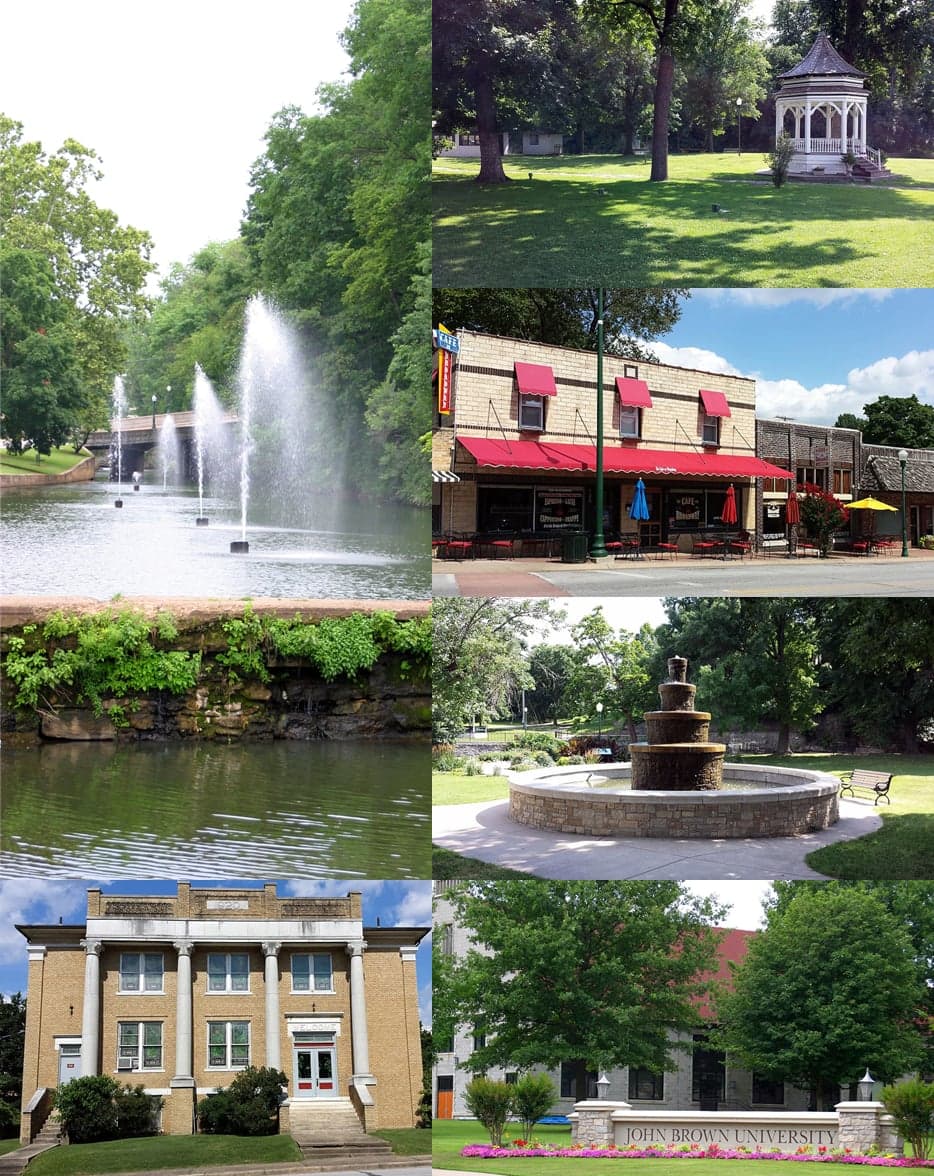
Photo: Wikipedia
Demographics of Siloam Springs, AR
Affluence Level in Siloam Springs, AR
A middle-class area roughly in line with national averages across income, home values, education, and employment.
People of Siloam Springs, AR
The people of Siloam Springs, Arkansas, today form a community of roughly 18,096 residents characterized by a significant Hispanic presence (22.8%) alongside a White majority (51.3%), with small but notable East/Southeast Asian (1.6%) and Indian-subcontinent (1.3%) populations. The city is denser than much of northwest Arkansas, with a foreign-born share of 9.7% that reflects its role as a manufacturing and logistics hub within the rapidly growing region. Distinctive identity markers include a strong evangelical Christian institutional presence (John Brown University) and a working-class ethos tied to poultry processing and food manufacturing. The population is younger and more diverse than the state average, but college attainment (27.1%) lags behind nearby Fayetteville and Bentonville.
How the city was settled and grew
Siloam Springs was founded in the 1880s as a railroad town and health resort, drawing settlers primarily from the Ozark hill country and the Midwest. The original population was almost entirely White, Anglo-Saxon, and Protestant, with families arriving via the St. Louis–San Francisco Railway to work in the timber and fruit-growing industries. The historic Downtown Siloam Springs district, centered on Broadway Street, was built by these early merchants and railroad workers, with many of the original brick storefronts still standing. A second wave arrived in the 1910s–1930s, drawn by the establishment of John Brown University (1919) and the growing poultry industry. These newcomers settled in the University Heights neighborhood near the campus, a modest area of Craftsman bungalows and postwar ranch homes. The city remained overwhelmingly White through the mid-20th century, with the 1960 census recording a population that was 99.2% White.
Modern era (post-1965)
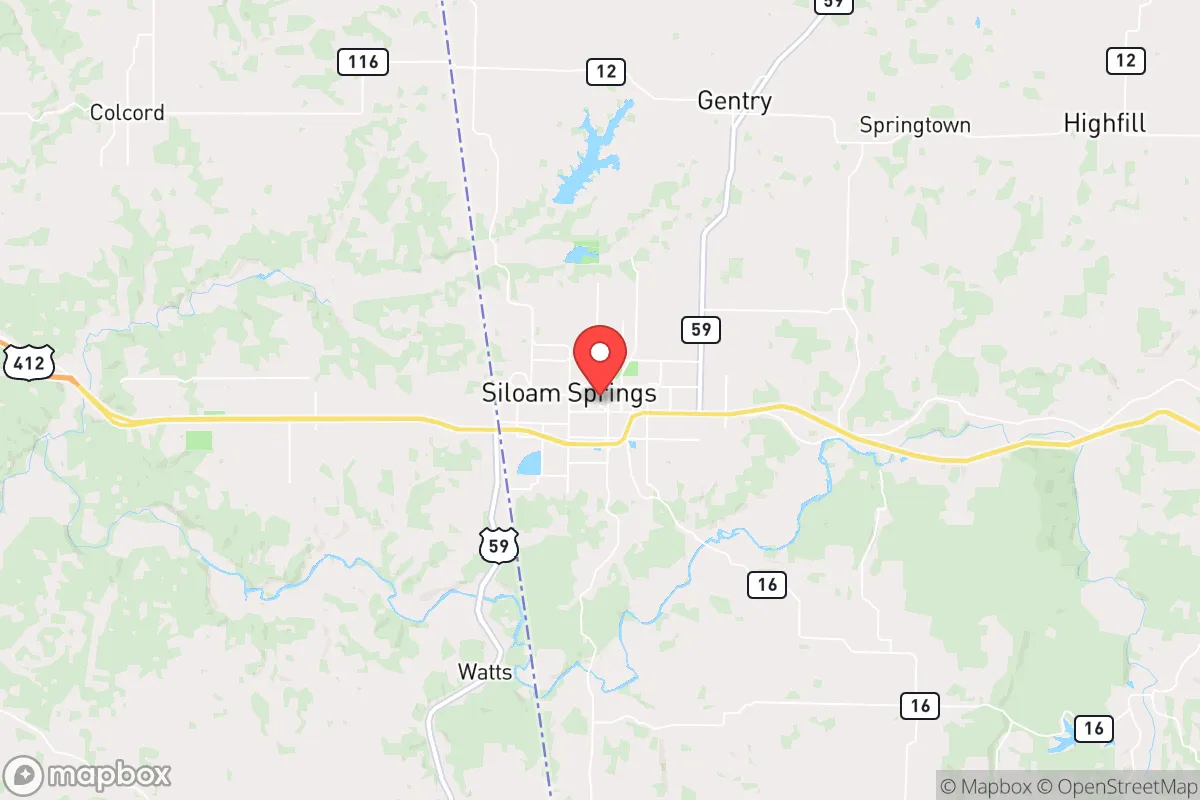
The 1965 Hart-Cellar Act and subsequent immigration reforms opened the door for the city’s first significant non-White populations. The primary driver was the poultry processing industry: Tyson Foods and Simmons Foods expanded operations in the 1970s and 1980s, recruiting labor from Mexico and Central America. These workers settled in the South Siloam Springs area, particularly along Dawn Hill Road and the neighborhoods south of Highway 412, where rental housing and mobile home parks absorbed the influx. By 2000, the Hispanic share had risen to 12%, and it now stands at 22.8%. A smaller but distinct wave of East/Southeast Asian immigrants (1.6%) arrived in the 1990s and 2000s, many working as engineers or technicians at the expanding Mid-America Industrial Park east of town; they concentrated in the Willow Springs subdivision, a newer development of mid-range single-family homes. The Indian-subcontinent population (1.3%) is more recent, largely tied to professional roles at John Brown University and regional healthcare facilities, with families settling in the Pecan Creek area near the university. Domestic in-migration from other parts of Arkansas and the Midwest has been steady but slower than in Bentonville or Fayetteville, as Siloam Springs lacks the high-end white-collar job base of those cities.
The future
The population is heading toward continued diversification, driven by sustained Hispanic immigration and natural increase. The Hispanic share is projected to approach 30% by 2040, based on current birth rates and migration patterns, while the White share will likely fall below 45%. The East/Southeast Asian and Indian populations are expected to grow slowly, plateauing at 2–3% each, as the city’s economy remains anchored in manufacturing rather than tech or finance. There is little evidence of tribalization into distinct enclaves: Hispanic families are increasingly moving into previously White neighborhoods like Lakeview Estates and Briarwood, while the older South Siloam Springs area is becoming more mixed. The main demographic tension is between long-term White residents and newer Hispanic arrivals, but intermarriage rates are rising and bilingual signage is now common in public spaces. The city is homogenizing in terms of class (working-to-middle income) while diversifying ethnically.
For someone moving in now, Siloam Springs offers a stable, family-oriented community with a growing multicultural character, but limited upward mobility for those without college degrees. The population is becoming more Hispanic and younger, which will reshape local schools and churches over the next decade. The city is not a high-growth boomtown like its neighbors to the north, but a steady, affordable alternative for those who value community cohesion over rapid change.

* Values derived from national, state, county, city and local statistics and may differ in a specific area. Last updated: 2026-04-23T03:42:02.000Z
Narrative content on this page is AI-generated and may contain mistakes. Verify any details that matter before acting on them.
ReloMaps may earn a commission from affiliate links at no extra cost to you.

