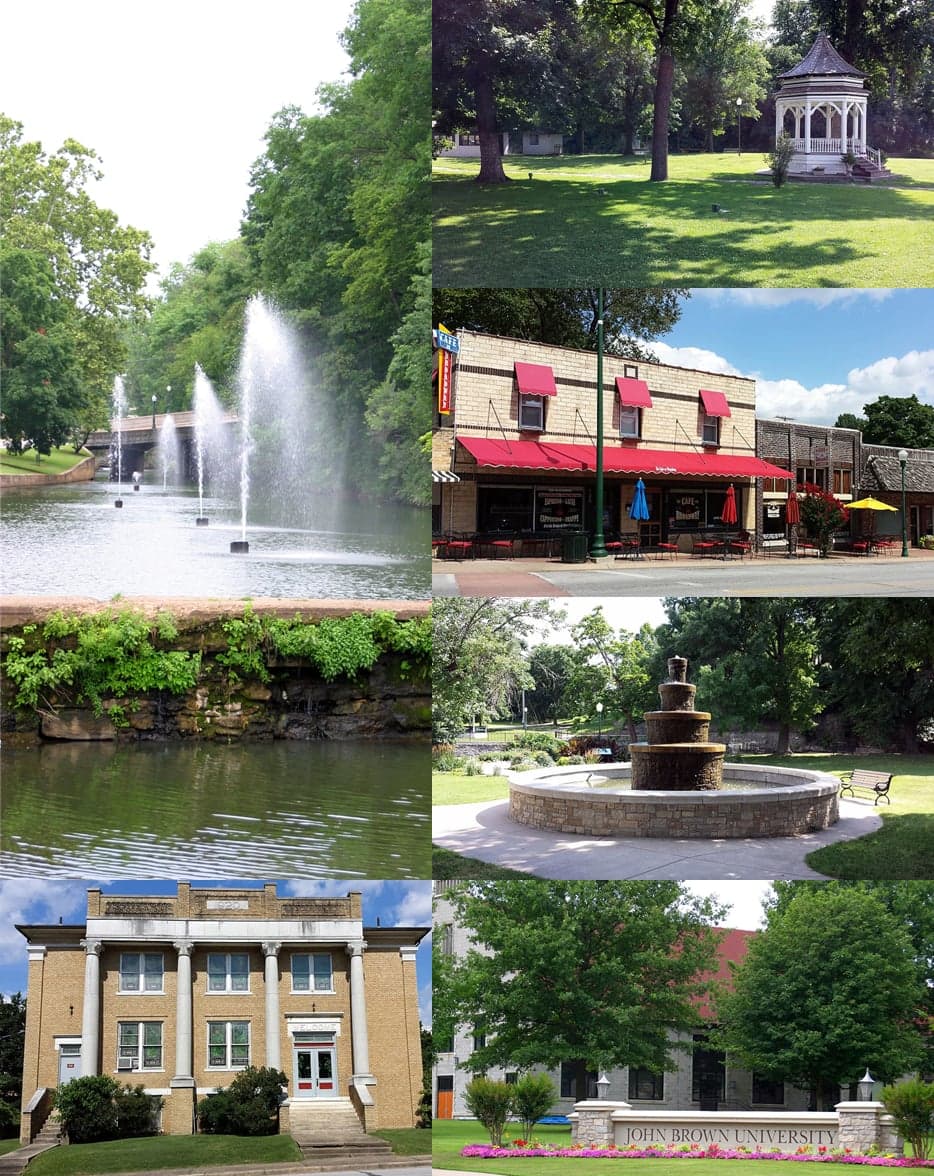
Photo: Wikipedia
Political ClimatePolitical Climate in Siloam Springs, AR
District shown is the primary district for this city’s centroid. Cities may span multiple districts.
Local Political AnalysisPolitical Analysis of Siloam Springs, AR
Siloam Springs has long been a reliably conservative community, and that hasn't changed much despite the region's rapid growth. The area's Cook PVI of R+13 tells you the basics—this is solid red territory, and it's been that way for as long as anyone can remember. But if you've lived here a while, you know the political climate isn't just about voting patterns; it's about a deep-seated belief in limited government, personal responsibility, and the freedom to live your life without a bunch of bureaucratic red tape. That said, you can feel the winds shifting a little as more folks move in from places like California or Chicago, bringing with them ideas that don't always sit well with the old guard.
How it compares
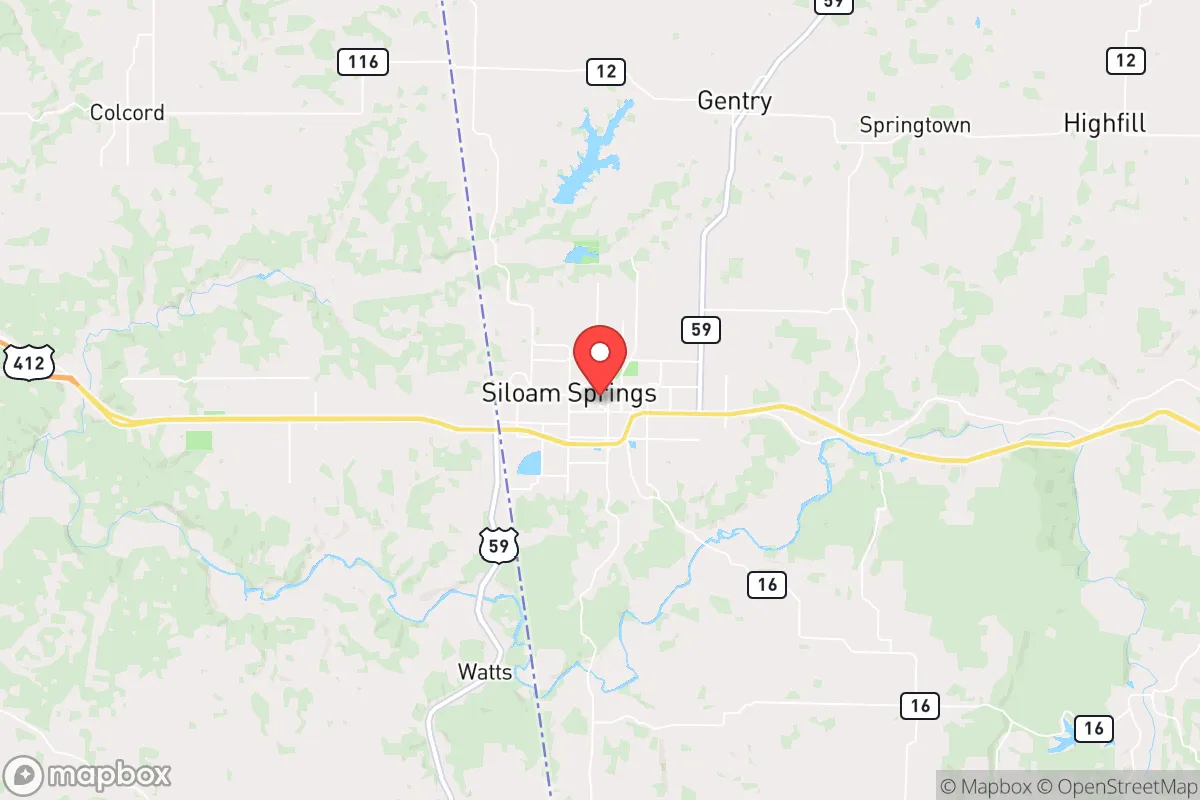
Drive 20 minutes south to Fayetteville, and you might as well be in a different country. That's where the University of Arkansas campus dominates, and the politics lean noticeably left—think progressive city council votes, bike lanes, and a lot of talk about equity. Siloam Springs, by contrast, feels like a holdout of common sense. Neighboring towns like Gentry and Gravette share a similar conservative bent, but Bentonville—just 15 miles east—has gotten more purple over the last decade, thanks to Walmart's corporate transplants. Siloam Springs has managed to stay more grounded, with local elections often decided by a candidate's stance on property rights, gun laws, and keeping taxes low. The contrast is stark: while Fayetteville debates renaming streets, Siloam Springs is more concerned with keeping the city council from overstepping on zoning or business regulations.
What this means for residents
For the average person living here, the political climate translates into a pretty hands-off approach from local government. You don't see a lot of nanny-state ordinances—no bans on plastic bags, no overbearing noise restrictions, and the city generally stays out of your business. That's a big deal for folks who value personal freedom. The school board and county commission are dominated by conservatives, which means curriculum decisions and budget priorities tend to reflect traditional values. But there's a growing concern among long-time residents: as the population swells, there's pressure to adopt more progressive policies, like higher impact fees on new construction or stricter environmental rules. If you're the type who gets uneasy when the government starts telling you what you can do with your own property, that's worth keeping an eye on.
Culturally, Siloam Springs still feels like a place where neighbors look out for each other, and the local churches play a big role in community life. You won't find a lot of political protests or heated town hall fights—most folks here just want to be left alone to work, raise their families, and enjoy the outdoors. The city's policy on things like Second Amendment rights is straightforward: no unnecessary restrictions, and the sheriff's office is known for being pro-owner. If you're moving here from a blue state, you'll notice the difference immediately—less red tape, more trust in individuals to make their own choices. That's the Siloam Springs way, and as long as the newcomers don't tip the scales too far, it's likely to stay that way for the foreseeable future.

State Political ClimatePolitical Climate in Arkansas
State Political AnalysisPolitical Environment in the State
Arkansas has been a reliably red state for decades, but it’s not the same Arkansas it was 20 years ago. The state leans solidly Republican at the presidential level — Donald Trump won it by 27 points in 2024 — but the real story is how the GOP has tightened its grip on every level of government, from the statehouse to county courthouses. The shift started in earnest around 2010, when the legislature flipped, and it’s only accelerated since, with the state now sporting a supermajority in both chambers and a governor’s mansion that hasn’t seen a Democrat since 2015. For a conservative looking to relocate, the political climate here is about as friendly as it gets, but there are nuances — especially in the northwest corner and a few stubborn blue pockets — that are worth understanding before you pack the truck.
Urban vs. rural divide
The political map of Arkansas is a study in contrasts, but not the kind you see in a place like Texas or Georgia. The state’s two major metros — Little Rock and Northwest Arkansas — pull in opposite directions. Little Rock, the capital and largest city, is a Democratic stronghold in Pulaski County, which voted for Joe Biden in 2020 by about 12 points. That’s largely driven by the city’s Black population (roughly 40% of the county) and a concentration of government workers and university faculty. But drive 20 minutes outside the city limits into Saline or Faulkner County, and you’re in deep red territory — places like Benton and Conway that vote 65-70% Republican. Northwest Arkansas, anchored by Fayetteville, Bentonville, and Springdale, is a different beast. It’s the fastest-growing region in the state, fueled by the Walmart, Tyson Foods, and J.B. Hunt corporate ecosystem. Fayetteville itself is a blue dot — home to the University of Arkansas, it voted for Biden by 8 points — but the surrounding suburbs like Rogers and Centerton are reliably red. The rural areas — the Delta in the east, the Ozarks in the north, and the timber country in the south — are overwhelmingly Republican, often pushing 80% or more for GOP candidates. The one notable exception is the Mississippi River Delta, where counties like Phillips and Lee still vote Democratic due to high Black populations, but those are shrinking fast as young people leave for jobs elsewhere.
Policy environment
Arkansas’s policy environment is a conservative’s dream, with a few asterisks. The state has a flat income tax of 4.4% as of 2025, down from 7% a decade ago, and the legislature is on track to phase it out entirely by 2030. Property taxes are low — about 0.6% of assessed value on average — and there’s no inheritance tax. The regulatory posture is light-touch; the state is a right-to-work state, and permitting for businesses is streamlined. On education, Arkansas passed the LEARNS Act in 2023, which created a universal school voucher program — one of the most expansive in the country — and banned critical race theory and “divisive concepts” in K-12 classrooms. Parents have real leverage here. Healthcare is a mixed bag: the state expanded Medicaid under the private option in 2013, which was a pragmatic conservative compromise, but there’s no state-level abortion ban beyond the trigger law that took effect after Dobbs — it’s a near-total ban with exceptions only for the life of the mother. Election laws are solid: voter ID is required, early voting runs for 15 days, and the state purges inactive voters regularly. No mail-in ballot drop boxes, no same-day registration. It’s not Texas-level strict, but it’s secure.
Trajectory & freedom
Arkansas is moving in the direction of more personal freedom, not less, and the last five years have been a legislative firehose. In 2021, the state passed a constitutional carry law — no permit needed to carry a concealed handgun — and in 2023, it expanded that to allow firearms in churches and on college campuses. Parental rights got a boost with the 2023 “Parental Bill of Rights,” which requires schools to get written consent before teaching about sexuality or gender identity and bans transgender athletes from women’s sports. Medical autonomy is a mixed bag: the state banned gender-affirming care for minors in 2021 (Act 626), which is a win for those who see it as government overreach into childhood, but it also has a restrictive medical marijuana program — only 38 dispensaries for a state of 3 million, and no home grow. On property rights, Arkansas is a “Dillon’s Rule” state, meaning local governments only have powers explicitly granted by the state, which keeps zoning and land-use restrictions minimal in rural areas. The biggest freedom expansion in recent memory was the 2024 tax cut package, which accelerated the income tax phase-out and eliminated the corporate income tax for small businesses. The trajectory is clear: less government, more local control, and a legislature that’s not afraid to preempt city ordinances on everything from plastic bags to rental regulations.
Civil unrest & political movements
Arkansas doesn’t have the protest culture of Portland or Austin, but it’s had its flashpoints. The most visible was the 2020 Black Lives Matter protests in Little Rock, which saw several nights of demonstrations downtown and a few smashed windows, but nothing like the destruction in larger cities. The state’s response was swift: the legislature passed a “back the blue” bill in 2021 that increased penalties for rioting and blocking highways. On the right, the most organized movement is the “Arkansas Sovereignty” crowd, which has pushed nullification bills — in 2021, the legislature passed a law (Act 1011) that prohibits state agencies from enforcing federal gun laws, a direct challenge to the ATF. Immigration politics are quiet; Arkansas has a small foreign-born population (about 5%), and there are no sanctuary cities. The only notable sanctuary-adjacent policy was in Fayetteville, which in 2017 declared itself a “welcoming city” for immigrants — the state legislature responded in 2019 with a law banning sanctuary policies statewide. Election integrity controversies have been minimal; the 2020 and 2022 elections ran smoothly, and the state’s voter ID law has been in place since 2013 with no major challenges. The biggest political movement you’ll notice as a new resident is the grassroots school choice activism — groups like “Arkansas Families for School Choice” are highly visible at the capitol and in local school board meetings, especially in Bentonville and Rogers, where the LEARNS Act has been a rallying point.
Projection
Over the next 5-10 years, Arkansas is going to get redder, but it’s also going to get more suburban and more diverse in the northwest. The in-migration pattern is clear: people are moving to Northwest Arkansas from California, Illinois, and Colorado — drawn by low taxes, good schools, and the corporate job base. That’s going to shift the political center of gravity away from Little Rock and toward Benton County, which is already the most populous county in the state and growing at 2% a year. The risk for conservatives is that some of those newcomers bring blue-state habits — they’re not all MAGA; many are moderate Republicans or even libertarian-leaning independents who want low taxes but also bike lanes and craft breweries. The state GOP is aware of this and has been preemptively passing preemption laws to lock in conservative policies before the demographics shift too far. Expect more tax cuts, more school choice expansion, and more preemption of local ordinances on housing and zoning. The Delta will continue to shrink and lose political clout, while the Ozarks and the River Valley will hold steady. The wildcard is the 2030 census and redistricting — if Northwest Arkansas gains a second congressional seat, it could dilute the rural conservative vote slightly, but the state’s overall partisan lean is unlikely to budge more than a point or two. For a new resident, the Arkansas of 2035 will look a lot like the Arkansas of 2025, just with lower taxes, more school options, and a slightly more suburban flavor.
Bottom line for someone moving here: Arkansas is a state where your personal freedoms — from gun rights to school choice to low taxes — are protected and expanding. You won’t find the culture war intensity of a place like Florida or Texas, but you also won’t find the government overreach of a blue state. The key is picking the right spot: if you want the most conservative environment, stick to the rural counties or the outer suburbs of Bentonville and Rogers. If you want a bit more diversity and amenities, Fayetteville is a purple oasis that’s still very safe. Just avoid Little Rock proper unless you’re comfortable with a Democratic city government and the crime that comes with it. Arkansas is a place where you can live your life without the state getting in your way — and that’s getting rarer by the year.
* Values derived from national, state, county, city and local statistics and may differ in a specific area. Last updated: 2026-04-23T03:42:02.000Z
Narrative content on this page is AI-generated and may contain mistakes. Verify any details that matter before acting on them.
ReloMaps may earn a commission from affiliate links at no extra cost to you.

