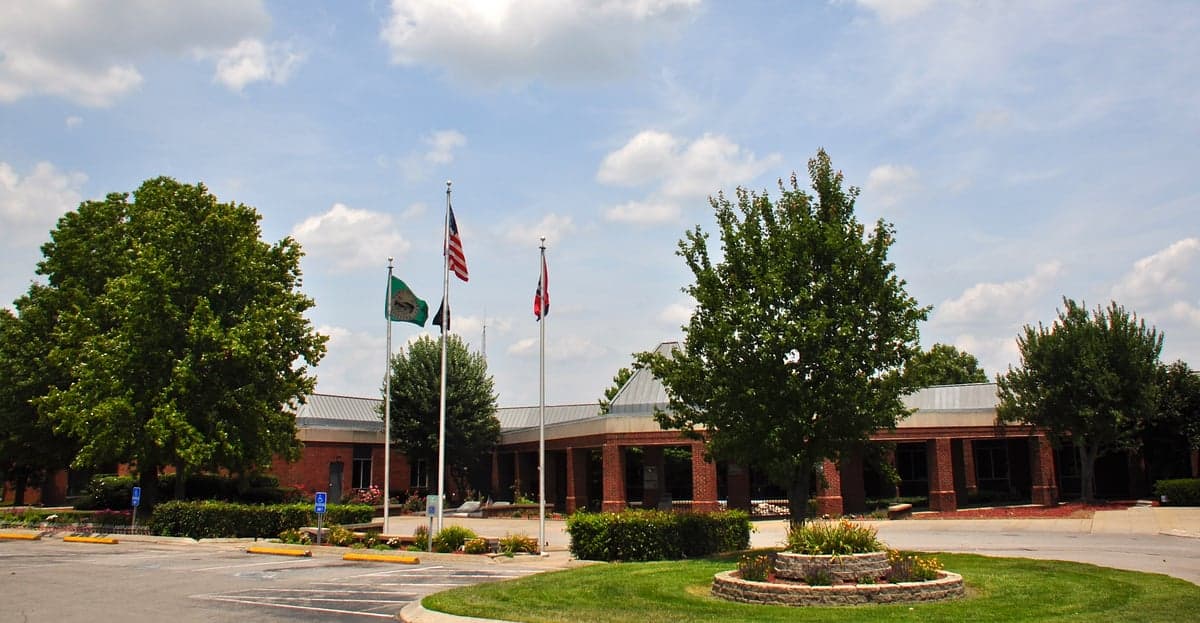
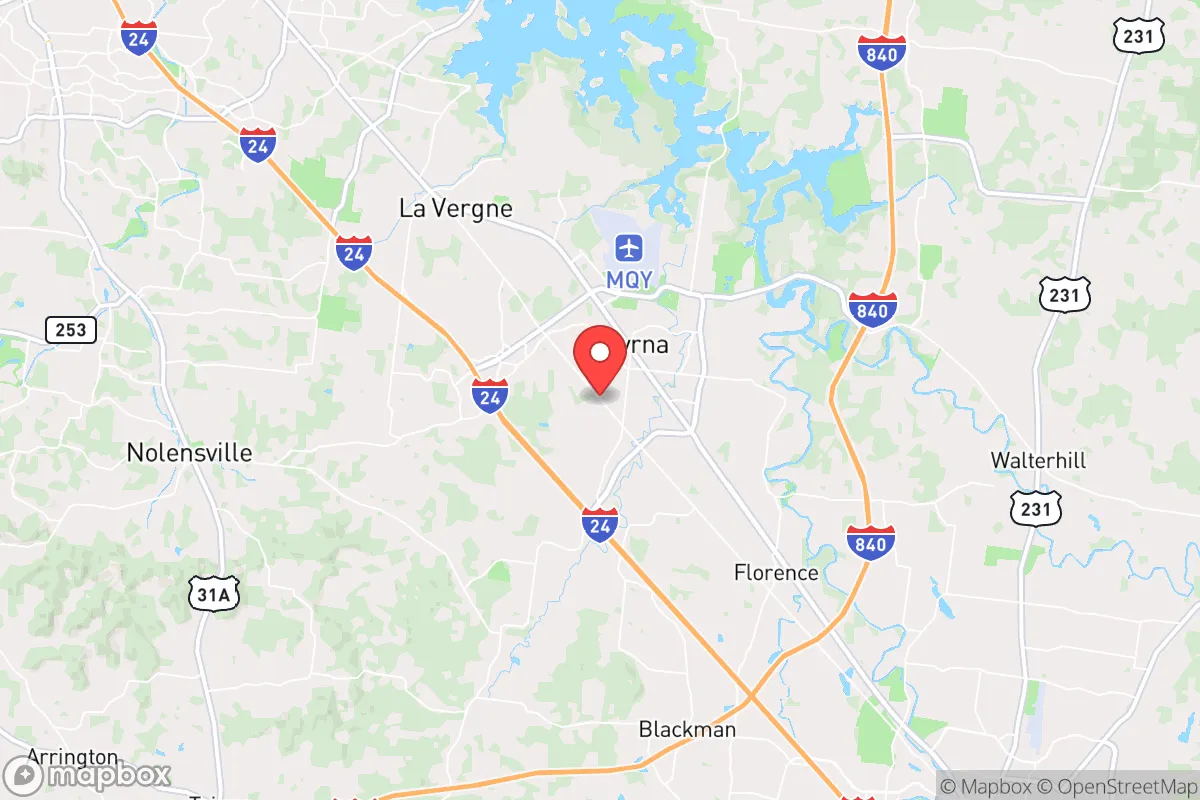
Photo: Wikipedia
Personal Sovereignty in Smyrna, TN
Moderate friction. Expect trade-offs in some aspect of personal liberty and independence.
What does Personal Sovereignty tell us?
Personal Sovereignty measures your capacity for self-reliance and independence with minimal government friction. Higher scores mean fewer barriers between you and the way you want to live... but it assumes you have the space you need and good neighbors.
What does this tell us?
Personal Sovereignty measures your capacity for self-reliance and independence with minimal government friction. Higher scores mean fewer barriers between you and the way you want to live... but it assumes you have the space you need and good neighbors.
State Policy
Energy independence: Importer (25% of energy produced in-state)
Personal Liberty
Homesteading

Personal Liberty Analysis
Smyrna, Tennessee, offers a notably high degree of personal sovereignty compared to many other rapidly growing suburbs in the Southeast, largely because it sits within a state that has aggressively pushed back against federal overreach and maintained a light regulatory touch. For the survivalist or prepper-minded individual, this translates into a legal environment where your ability to keep what you earn, defend your home, and raise your family according to your own values is still largely intact. While no location is a fortress against the national trends of inflation and cultural drift, Smyrna’s combination of zero state income tax, strong gun rights, and relatively permissive land-use rules makes it a serious contender for those prioritizing autonomy.
Tax burden and regulatory posture in Rutherford County
The most immediate win for personal sovereignty in Smyrna is the financial one. Tennessee has no state income tax on wages, meaning every dollar you earn stays in your pocket—a critical advantage when the federal government’s purchasing power is eroding. The state sales tax is high at 7%, but groceries are exempt, and local sales tax in Smyrna adds about 2.25%, bringing the total to roughly 9.25%. Property taxes are the real story: Rutherford County’s rate is around $2.50 per $100 of assessed value, which is moderate for the region. More importantly, Tennessee has no state property tax, and there are no intrusive personal property taxes on vehicles or business equipment. From a regulatory standpoint, Tennessee is a right-to-work state with minimal business licensing hurdles, and the state legislature has consistently preempted local ordinances that would restrict property use—meaning Smyrna cannot easily impose the kind of zoning or rental controls seen in blue states. For the prepper, this means less government interference in how you use your land or run a side business.
Self-defense and gun law specifics in Smyrna
Tennessee is a constitutional carry state, and Smyrna fully reflects that. As of 2021, any law-abiding adult 21 or older can carry a handgun openly or concealed without a permit. This is a bedrock sovereignty issue: the state does not require you to ask permission to exercise a fundamental right. There is no state-level red flag law, no magazine capacity restrictions, and no firearm registration. The Castle Doctrine is strong—Tennessee law presumes that a person using force against an unlawful intruder in their home, vehicle, or place of business had a reasonable fear of death or serious injury, and there is no duty to retreat. Stand Your Ground protections extend to any place you are lawfully present. For the survivalist, this means your defensive options are not hamstrung by bureaucratic delays or arbitrary limits. Smyrna itself is a relatively safe town, but the legal framework ensures that if the worst happens, the law is on your side, not the aggressor’s. The only notable restriction is that carrying on private property with posted signage is a misdemeanor, so know your local businesses.
Self-reliance and homesteading viability in Smyrna
For those looking to reduce dependence on fragile supply chains, Smyrna’s zoning and lot sizes offer mixed but workable options. Within the town limits, most residential lots are standard subdivision sizes—quarter-acre to half-acre—which limits large-scale gardening or livestock. However, the surrounding unincorporated areas of Rutherford County, particularly toward the eastern and southern edges, offer parcels of 1 to 5 acres that are still affordable relative to national averages. Zoning in the county allows for backyard chickens, beekeeping, and small-scale agriculture without the onerous permitting seen in more urbanized counties. Off-grid feasibility is limited: the town requires connection to municipal water and sewer in most subdivisions, but rural parcels often have well and septic options. Solar panels are allowed, though homeowners’ associations (HOAs) in some subdivisions may restrict their visibility—so if off-grid independence is a priority, avoid HOA-controlled neighborhoods. Rainwater collection is legal and even encouraged in Tennessee. For the prepper, the key is to buy outside city limits but within the county’s fire district to maintain insurance rates. The local soil is decent for vegetable gardens, and the growing season is long enough for two planting cycles.
Personal liberties in Smyrna: parental rights, medical autonomy, and property
Tennessee has been a national leader in asserting parental rights. State law explicitly affirms that parents have the fundamental right to direct the upbringing, education, and healthcare of their children. This means no mask mandates in schools without parental opt-out, no vaccine mandates for school attendance beyond standard requirements, and a strong presumption against government interference in family medical decisions. The state passed the “Tennessee Moms” law, which requires schools to notify parents of any changes in a child’s mental, emotional, or physical health. On medical autonomy, Tennessee has banned nearly all abortions after six weeks and has a conscience clause protecting medical providers who refuse to participate in procedures they find objectionable. For the prepper, this legal environment means you can stockpile medications, practice alternative medicine, and refuse unwanted medical interventions without fear of state coercion. Property rights are also robust: Tennessee has strong eminent domain protections, and the state’s “Private Property Protection Act” requires the government to prove a taking is for a public use and to pay just compensation. There is no state-level rent control, and short-term rentals are generally allowed in unincorporated areas. Free speech is protected by the state constitution, and Smyrna has no local ordinances that chill political expression or assembly.
Overall, Smyrna ranks highly for personal sovereignty when compared to other mid-sized Southern suburbs. It lacks the extreme libertarian bent of a place like rural Idaho or New Hampshire, but it offers a practical balance: you get the job access of a Nashville exurb with the legal protections of a red state that has actively resisted federal overreach. The tax burden is low, the gun laws are among the best in the country, and the regulatory environment respects your right to live as you see fit. For the survivalist who needs to be near infrastructure but wants to maintain independence, Smyrna is a solid, defensible choice—just be prepared to navigate HOAs if you buy inside the town limits, and prioritize acreage outside city boundaries if self-sufficiency is the long-term goal.

* Values derived from national, state, county, city and local statistics and may differ in a specific area. Last updated: 2026-05-01T11:26:58.000Z
Narrative content on this page is AI-generated and may contain mistakes. Verify any details that matter before acting on them.
ReloMaps may earn a commission from affiliate links at no extra cost to you.

