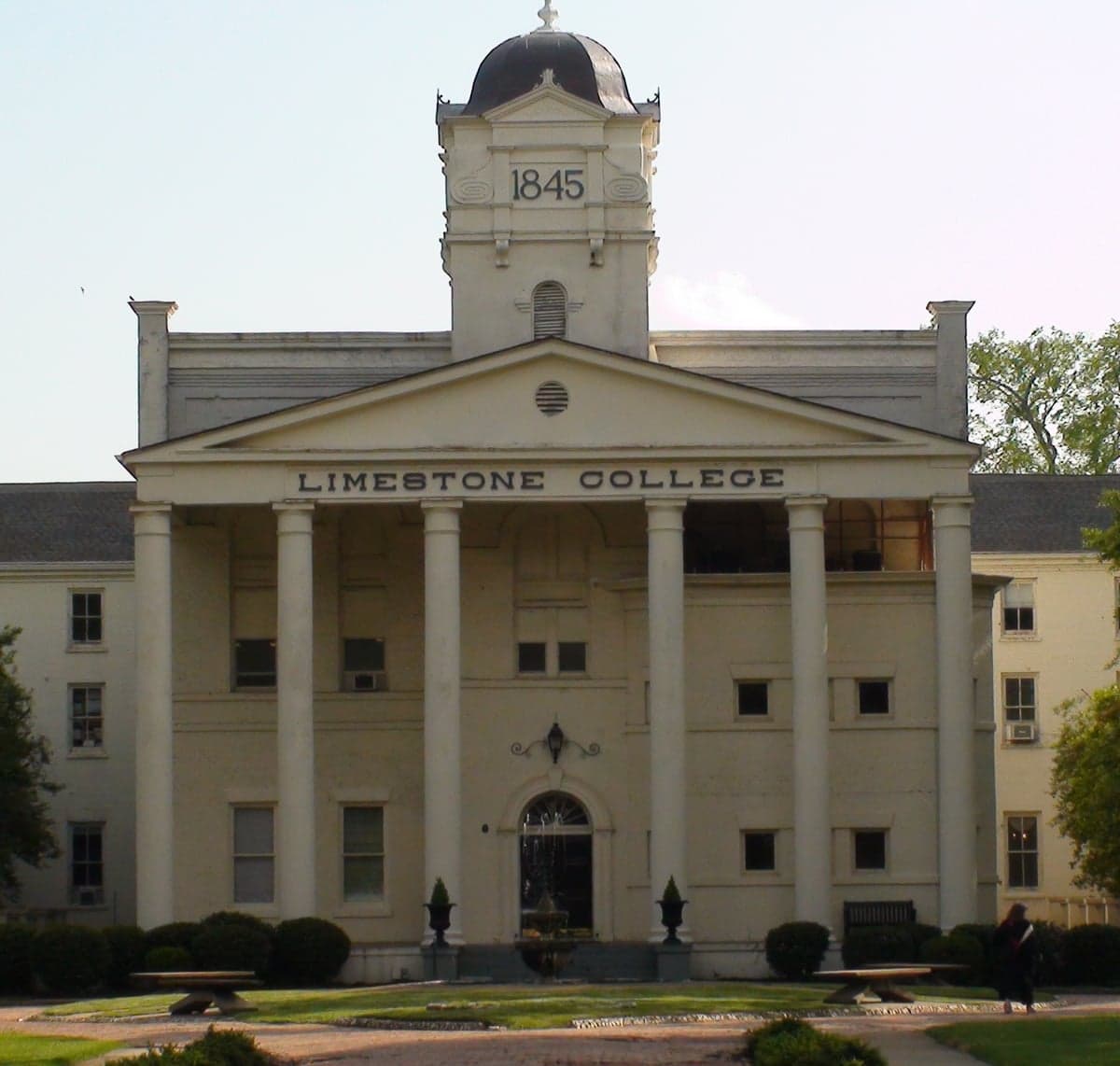
Photo: Wikipedia
Demographics of Cherokee County
Affluence Level in Cherokee County
A below-average socioeconomic profile. Incomes, home values, and educational attainment trail the U.S., with higher poverty and unemployment.
People of Cherokee County
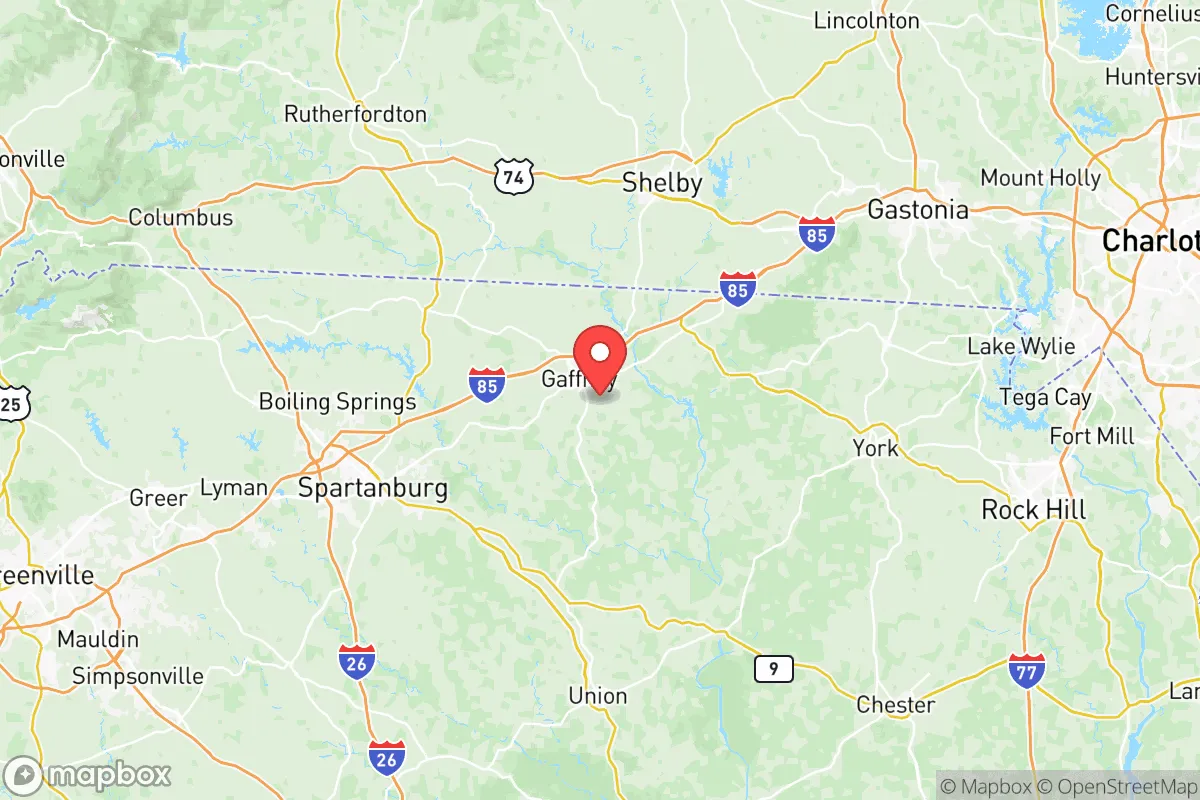
The people of Cherokee County, South Carolina today number 56,299, forming a community that is predominantly white (70.0%) with a significant Black minority (18.8%) and a small but growing Hispanic presence (5.2%). The county is characterized by its rural-to-suburban character, anchored by the city of Gaffney, and retains a distinctly Southern, working-class identity shaped by its textile and manufacturing heritage. With only 2.1% foreign-born residents and a college attainment rate of 18.4%, Cherokee County remains one of South Carolina's more ethnically homogeneous and less-educated areas, though recent in-migration from other parts of the Southeast is slowly diversifying its population.
Settlement & growth (pre-1960)
Before European settlement, the area now known as Cherokee County was part of the traditional homeland of the Cherokee Nation, who used the region for hunting and established seasonal settlements along the Broad River and its tributaries. The Cherokee were forcibly removed through treaties and land cessions in the late 18th and early 19th centuries, with most displaced by the 1777 Treaty of DeWitt's Corner and subsequent agreements. The county's name itself memorializes this original population, though few Cherokee remain in the area today.
European-American settlement began in earnest after the American Revolution, with Scots-Irish and English migrants moving south from Pennsylvania, Virginia, and North Carolina along the Great Wagon Road. These early settlers were primarily small farmers seeking fertile bottomland along the Broad River and its creeks. The town of Gaffney, founded in 1804 as a trading post, became the county's commercial and political center after Cherokee County was formed in 1897 from parts of Union, Spartanburg, and York counties. The nearby community of Blacksburg developed as a railroad stop in the 1880s, attracting a mix of farmers and merchants.
The defining economic force shaping Cherokee County's population was the textile industry. Beginning in the 1880s and accelerating through the early 20th century, cotton mills sprang up along the Broad River and its tributaries, drawing thousands of rural white families off farms and into mill villages. Towns like Mayo, Pacolet (part of which lies in Cherokee County), and East Gaffney grew around these mills, with company-owned housing creating tight-knit, insular communities. This mill culture—predominantly white, Protestant, and union-resistant—defined the county's social character for generations.
African Americans in Cherokee County have a distinct history rooted in slavery and its aftermath. By 1860, enslaved people made up roughly one-third of the area's population, working primarily on cotton plantations in the fertile river valleys. After emancipation, many Black families remained as sharecroppers or tenant farmers, with communities forming in areas like Grassy Pond and the Draytonville section of Gaffney. The Great Migration (1910-1970) drew many Black residents north to industrial cities like Detroit and Philadelphia, reducing the county's Black population share from over 30% in 1900 to around 18% today.
The early 20th century also saw a small influx of European immigrants, primarily from Italy and Eastern Europe, who came to work in the textile mills and railroads. However, these groups were never large enough to form distinct ethnic enclaves, and most assimilated into the white population within a generation. The county's foreign-born population peaked at around 3% in 1910 and then declined steadily through the mid-20th century.
Modern era (post-1965)
The 1965 Hart-Cellar Act had minimal direct impact on Cherokee County, as the area attracted very few of the new immigrant waves that transformed larger Southern cities. The county's foreign-born population remains at just 2.1%, far below the national average of 13.7%. The small Hispanic population (5.2%) began growing in the 1990s and 2000s, driven primarily by Mexican and Central American immigrants recruited to work in the poultry processing plants and construction industries. These families have concentrated in and around Gaffney, particularly in the West Gaffney area, where a small but visible Hispanic commercial corridor has emerged along Cherokee Avenue.
Domestic migration has been the more significant demographic force since 1965. The decline of the textile industry in the 1970s and 1980s triggered a population exodus, with the county losing residents to Charlotte, Greenville, and Spartanburg. However, the completion of Interstate 85 in the 1960s and the subsequent development of the Gaffney Outlet Marketplace (now one of the largest outlet centers in the Southeast) helped stabilize the economy. The county's location on the I-85 corridor between Charlotte and Atlanta has made it a bedroom community for commuters working in Spartanburg County and Greenville County, where manufacturing and distribution centers have boomed.
The Black population has remained relatively stable at around 18-19% since 1990, with most African Americans living in Gaffney's historic Black neighborhoods, including the Limestone Street and Frederick Street areas. There has been some out-migration of younger Black residents to larger cities, offset by natural increase. The Asian population (0.3%) and Indian population (0.2%) are negligible, consisting mostly of professionals working at the county's hospitals and educational institutions, with no distinct ethnic enclaves.
The future
Cherokee County's population is projected to grow modestly over the next decade, reaching approximately 60,000 by 2035, driven primarily by domestic migration from more expensive areas in the Northeast and along the East Coast. The county's relatively low housing costs and proximity to the Charlotte and Greenville-Spartanburg job markets make it attractive to families and retirees seeking a lower cost of living. However, the population is likely to remain predominantly white and native-born, as the county lacks the economic diversity and urban amenities that attract international immigrants.
The Hispanic population is expected to continue growing slowly, potentially reaching 8-10% of the total by 2040, as families already in the area sponsor relatives and as agricultural and construction industries continue to recruit Latino workers. This growth will likely remain concentrated in Gaffney, with some spread to Blacksburg and Mayo as housing costs push families outward. The Black population share is projected to remain stable or decline slightly, as younger African Americans continue to leave for educational and economic opportunities in larger cities.
Culturally, Cherokee County is likely to remain a conservative, religiously traditional area, with new in-migrants being absorbed into existing social structures rather than transforming them. The county's political leanings—it voted +38 points for Donald Trump in 2024—reflect a population that values stability, low taxes, and limited government. The main demographic tension will be between long-time residents who remember the textile-era economy and newcomers who work in distribution, healthcare, or commute to white-collar jobs in Spartanburg and Greenville.
For someone moving to Cherokee County today, the area offers a stable, affordable, and culturally homogeneous environment where community ties remain strong and the pace of life is slower than in the booming Upstate cities. The population is aging slightly (median age 40.5), but the county retains a family-oriented character with good schools in the Gaffney and Blacksburg areas. The key challenge will be economic diversification: without a broader job base, the county may struggle to retain its younger residents, who increasingly leave for college and do not return.

* Values derived from national, state, county, city and local statistics and may differ in a specific area. Last updated: 2026-05-21T02:28:19.000Z
Narrative content on this page is AI-generated and may contain mistakes. Verify any details that matter before acting on them.
ReloMaps may earn a commission from affiliate links at no extra cost to you.

