
Photo: Wikipedia
Political ClimatePolitical Climate in Cherokee County
Showing district-level results — no local-only data available.
Local Political AnalysisPolitical Analysis of Cherokee County
Cherokee County, South Carolina, has long been a reliably conservative stronghold, and that hasn't changed much. With a Cook Partisan Voting Index (PVI) of R+11, it's a solid three points redder than the state of South Carolina as a whole, which sits at R+8. That might not sound like a huge gap, but in practical terms, it means this county isn't just Republican—it's deeply, consistently Republican, and the trajectory has been holding steady, not drifting toward the center. If you're looking for a place where traditional values and limited government are still the norm, this is it.
How it compares
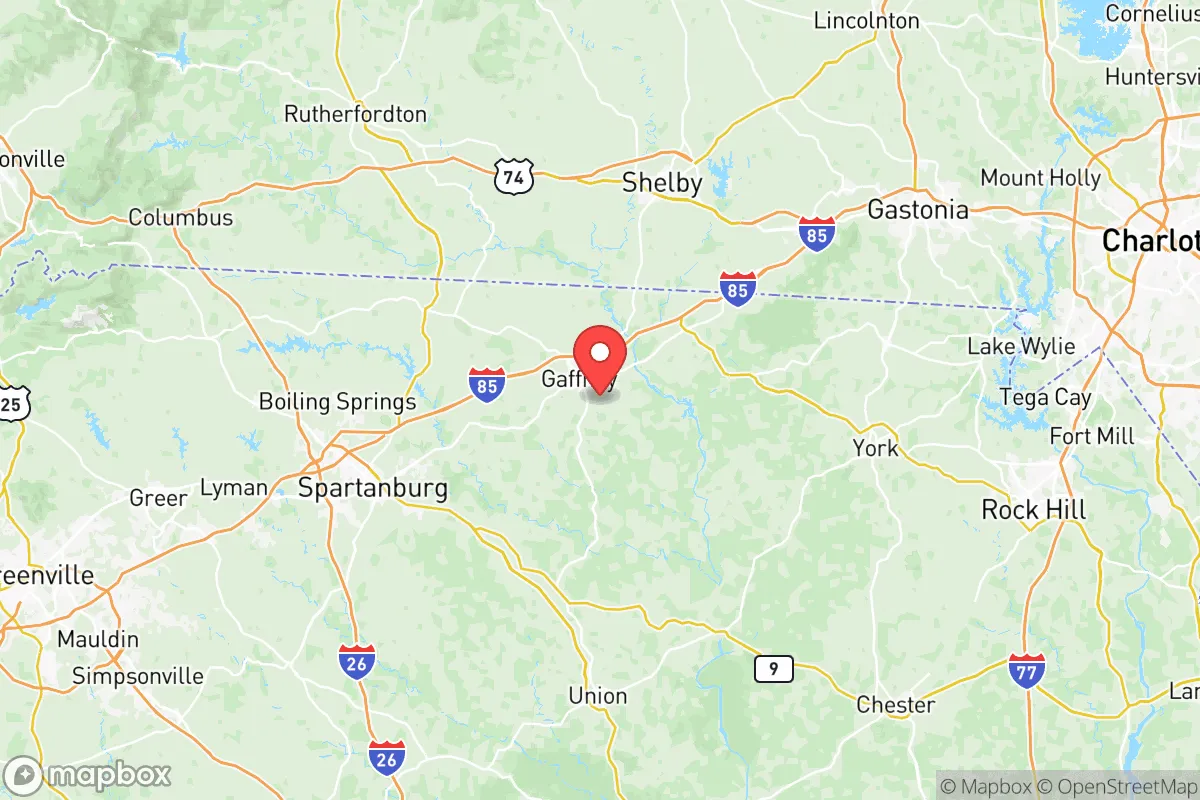
When you stack Cherokee County against the rest of South Carolina, the difference is real but not extreme. The state's R+8 PVI already puts it in reliably red territory, but Cherokee County's R+11 shows a community that leans even harder into conservative politics. That extra margin comes from the rural and small-town character of places like Gaffney, the county seat, and Blacksburg, where you'll find strong support for gun rights, low taxes, and a general skepticism of government overreach. There's some variation within the county, though—Gaffney's downtown precincts and areas near Limestone University can swing a bit more moderate, sometimes even showing a slight blue tint in local races, but those are outliers. The rural precincts around Cowpens and Macedonia are where the red runs deepest. The bottom line: Cherokee County is a bit more resistant to the progressive shifts you see in places like Charleston or Columbia, and that's a comfort for folks who value personal freedoms and don't want the government poking into their lives.
What this means for residents
For the people living here, the political climate translates into a daily life that's less about bureaucracy and more about common sense. You won't see the kind of overreaching regulations or tax hikes that plague more liberal areas. The county commission and local school boards tend to prioritize fiscal responsibility and local control, which means fewer mandates from Columbia or Washington telling you how to run your business or raise your kids. That's a big deal if you're concerned about government overreach—here, the attitude is still "leave us alone, we know what we're doing." Property taxes stay reasonable, and there's a strong push to keep the Second Amendment intact without the kind of restrictions you'd find in other parts of the state. The downside? If you're hoping for a more progressive shift, you'll be waiting a long time. The county's demographics and culture are stable, and the voting patterns show no sign of flipping anytime soon.
One thing that sets Cherokee County apart from the rest of South Carolina is its cultural identity. It's a place where church, family, and hard work are still the backbone of the community, and that shows up in everything from local ordinances to the way people treat each other. There's a real sense of independence here—people don't like being told what to do, whether it's about mask mandates, land use, or school curriculum. Compared to the state's coastal or urban areas, Cherokee County feels like a holdout for the kind of old-school Southern conservatism that values personal responsibility over government programs. If you're looking for a place where the political climate matches a live-and-let-live philosophy with a conservative twist, this is it. Just don't expect it to change much—the locals like it the way it is.

State Political ClimatePolitical Climate in South Carolina
State Political AnalysisPolitical Environment in the State
South Carolina is a solidly Republican state, carrying a Cook PVI of R+8, but that number only tells part of the story. The real political climate is a battle between a rapidly growing, transplant-heavy Lowcountry and a deeply conservative Upstate and Midlands, with the rural black belt counties acting as a Democratic anchor that keeps the state from shifting further right. Over the last 20 years, the state has moved from a competitive purple-ish swing state (voting for George W. Bush by single digits) to a reliable red stronghold, driven by an influx of retirees and families from the Northeast and Midwest who are fleeing high taxes and progressive policies in places like New York and California.
Urban vs. rural divide
The political map is starkly divided. The Upstate — anchored by Greenville, Spartanburg, and Anderson — is the engine of the state's conservatism. Greenville County itself is the largest county in the state and votes reliably Republican, with the city proper trending slightly more moderate as it attracts corporate transplants, but the surrounding suburbs like Simpsonville and Greer are deep red. The Midlands around Columbia are a mixed bag: Richland County (Columbia proper) is a Democratic stronghold thanks to the University of South Carolina and a large state government workforce, while Lexington County across the river is one of the most reliably Republican suburbs in the Southeast. The Lowcountry is where the real tension lives. Charleston County has been trending left for a decade, driven by an influx of out-of-state professionals and a booming tourism economy, but the surrounding counties — Berkeley and Dorchester — remain solidly red. The Pee Dee region around Florence and Myrtle Beach is a mix: Myrtle Beach's Horry County is reliably Republican, but the rural black belt counties like Williamsburg and Marlboro vote overwhelmingly Democratic, keeping the state from being as red as its neighbors Georgia or Alabama.
Policy environment
South Carolina's policy environment is broadly conservative, but with some notable wrinkles. The state has a flat income tax rate of 6.4%, which is being phased down to 6.0% by 2027, and no tax on Social Security benefits — a major draw for retirees. Property taxes are among the lowest in the country, with a 4% assessment ratio for owner-occupied homes. The regulatory posture is business-friendly, with a right-to-work law and a strong tort reform environment. On education, the state has a robust school choice program, including the Education Scholarship Trust Fund (a voucher program for low-income students) and a growing charter school sector. However, the state's public schools remain underfunded relative to the national average, and teacher pay is a perennial issue. Healthcare policy is a mixed bag: the state did not expand Medicaid under the ACA, which keeps costs down for taxpayers but leaves a coverage gap for low-income adults. Election laws are strict: voter ID is required, and the state has a 30-day residency requirement to register. There is no early voting by mail without an excuse, though in-person early voting was expanded in 2022. The state legislature is firmly Republican, with a supermajority in both chambers, meaning conservative policy priorities generally pass without much drama.
Trajectory & freedom
The trajectory over the last five years has been toward more personal freedom, particularly on gun rights and parental rights. In 2023, the state passed constitutional carry (permitless carry of a concealed handgun), making it the 26th state to do so. On parental rights, the Parents' Bill of Rights (H. 4104) was signed into law in 2023, requiring schools to notify parents of any changes in a child's mental, emotional, or physical health and prohibiting instruction on sexual orientation or gender identity in K-5 classrooms. The state also passed a fetal heartbeat law (banning abortion at roughly six weeks) in 2023, which was upheld by the state supreme court. On the taxation front, the state is moving in the right direction with the income tax phase-down, but property tax relief has been slower. The biggest concern for freedom-minded residents is the growth of local government overreach in the Charleston area, where zoning and land-use regulations have become more restrictive as the city tries to manage rapid growth. There is also a brewing fight over medical freedom: the state did not impose broad vaccine mandates during COVID, but there is ongoing legislative effort to ban vaccine passports and employer mandates permanently.
Civil unrest & political movements
South Carolina has not seen the kind of large-scale civil unrest seen in Portland or Seattle, but there have been flashpoints. The Confederate flag removal from the Statehouse grounds in 2015 after the Charleston church shooting was a major cultural moment, and it still simmers as a political issue in rural areas. The Black Lives Matter protests in 2020 were relatively small compared to other states, with the largest gathering in Columbia drawing a few thousand people. The state has a strong Second Amendment sanctuary movement, with dozens of counties passing resolutions declaring themselves "sanctuary counties" for gun rights. Immigration politics are less heated than in border states, but there is a growing concern about the influx of migrants through the southeastern corridor, and the state legislature has considered bills to require local law enforcement to cooperate with ICE. The election integrity debate is active: the state's voter ID law is among the strictest in the country, and there were no major controversies in 2020 or 2022, but the legislature is considering further restrictions on ballot harvesting and mail-in voting. The most visible political movement is the Moms for Liberty chapter activity in the suburbs of Greenville and Charleston, which has been highly effective in school board elections and pushing back on critical race theory and LGBTQ curriculum.
Projection
Over the next 5-10 years, South Carolina is likely to become more Republican at the state level but more polarized at the local level. The in-migration from blue states is accelerating, particularly to the Charleston and Greenville metros, and while many of these transplants are conservative-leaning (fleeing high taxes and crime), a significant minority are moderate Democrats who will make Charleston County and Richland County more reliably blue. The rural black belt counties will continue to shrink in population, reducing the Democratic base. The state's Republican supermajority is likely to hold, but the internal dynamics will shift: the Upstate faction (more socially conservative) will clash with the Lowcountry faction (more economically conservative but socially moderate). Expect continued movement on school choice expansion, further income tax cuts, and tighter election laws. The biggest wildcard is the growth of the coastal population: if Charleston and Myrtle Beach continue to attract high-income transplants, the state may see a push for more environmental regulations and land-use controls that could frustrate property rights advocates.
Bottom line for a new resident: If you are moving to South Carolina for freedom, you will find it in the Upstate and Midlands suburbs — places like Simpsonville, Lexington, or Fort Mill. If you move to Charleston proper or the coastal islands, you will encounter a more progressive local government that is increasingly at odds with the state's conservative direction. The state is trending in the right direction on taxes, guns, and parental rights, but the battle over local control is just beginning. Keep an eye on the school board races and the county council meetings — that is where the real fights over your freedom will happen.
* Values derived from national, state, county, city and local statistics and may differ in a specific area. Last updated: 2026-05-21T02:28:19.000Z
Narrative content on this page is AI-generated and may contain mistakes. Verify any details that matter before acting on them.
ReloMaps may earn a commission from affiliate links at no extra cost to you.

