
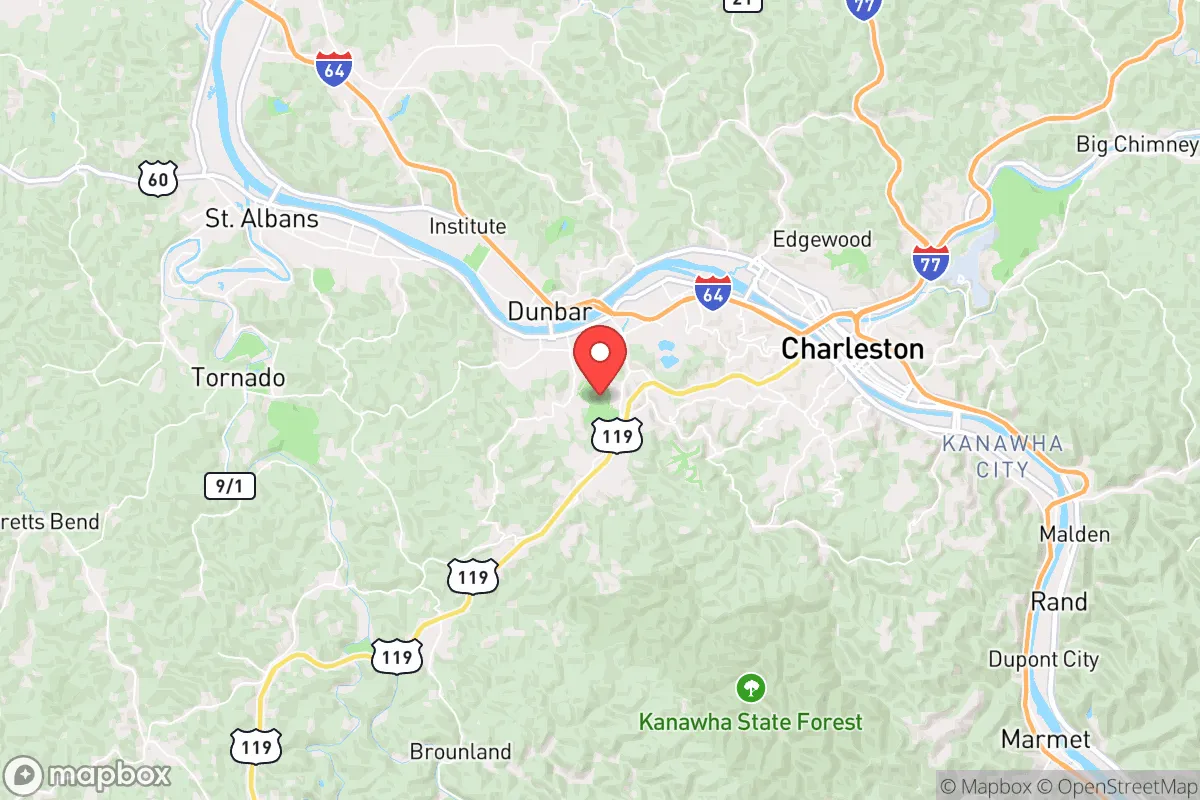
Photo: Wikipedia
Personal Sovereignty in South Charleston, WV
Strong independent fundamentals that actively favor personal liberty and low regulation.
What does Personal Sovereignty tell us?
Personal Sovereignty measures your capacity for self-reliance and independence with minimal government friction. Higher scores mean fewer barriers between you and the way you want to live... but it assumes you have the space you need and good neighbors.
What does this tell us?
Personal Sovereignty measures your capacity for self-reliance and independence with minimal government friction. Higher scores mean fewer barriers between you and the way you want to live... but it assumes you have the space you need and good neighbors.
State Policy
Energy independence: Net exporter (200% of energy produced in-state)
Personal Liberty
Homesteading

Personal Liberty Analysis
South Charleston, West Virginia, offers a personal sovereignty environment that stands in stark contrast to the restrictive policies found in many mid-Atlantic and coastal states, making it a serious consideration for those prioritizing autonomy. The city sits within a state that has actively pushed back against federal overreach, particularly in the realms of gun rights, medical freedom, and parental authority. While no location is a perfect libertarian haven, the legal and cultural framework here leans heavily toward individual decision-making, with a notably low tax burden and a regulatory climate that still permits a degree of self-reliance uncommon in more urbanized regions. For a single individual or a family looking to minimize government intrusion into daily life, South Charleston represents a viable, if not exceptional, option within the Appalachian corridor.
Tax burden and regulatory posture for individuals and families
West Virginia's tax structure is one of the most favorable in the nation for those seeking to keep more of their earnings and reduce the state's footprint in their finances. The state has no gross receipts tax, no estate or inheritance tax, and a flat personal income tax rate of 3.99% as of 2026, following a series of rate reductions. Property taxes are notoriously low, with the effective rate on owner-occupied homes typically falling between 0.5% and 0.7% of assessed value, a fraction of what you'd pay in Ohio, Pennsylvania, or Maryland. The regulatory posture in South Charleston and Kanawha County is generally permissive for small-scale enterprise, with no county-level business licensing fees that strangle side hustles or home-based operations. The state's right-to-work law and absence of prevailing wage mandates on private construction further reduce the cost and bureaucratic friction of building or renovating property. For a prepper or survivalist, this means less of your income is siphoned away by the state, and fewer regulatory hurdles exist when establishing a workshop, a food preservation setup, or a small-scale agricultural operation on your own land.
Self-defense and gun law specifics in South Charleston
West Virginia is a constitutional carry state, meaning no permit is required to carry a concealed firearm for anyone legally allowed to possess one, and South Charleston fully operates under this framework. The state preempts all local gun ordinances, so the city council cannot impose its own magazine bans, waiting periods, or registration schemes—a critical protection against the patchwork of restrictions seen in places like Colorado or Washington. Stand-your-ground laws are in effect, with no duty to retreat in any place where a person has a legal right to be, and the castle doctrine explicitly covers vehicles and occupied structures. Private firearm sales between individuals require no background check or paperwork, and there is no state-level database of gun owners. For those concerned with government overreach, the state's Second Amendment Preservation Act prohibits state resources from being used to enforce any federal gun laws deemed unconstitutional, including potential future bans on certain firearm types. In practical terms, this means a resident of South Charleston can legally own suppressors, short-barreled rifles, and full-auto firearms (with federal tax stamps), and can carry them openly or concealed without asking the government for permission.
Self-reliance and homesteading viability: lot sizes, zoning, off-grid feasibility
South Charleston's residential landscape includes a mix of older suburban neighborhoods and more rural pockets within the city limits, offering genuine opportunities for self-sufficiency that are rare in similarly sized towns. Many single-family lots in the outlying areas of the city range from 0.25 to 1 acre, with some larger parcels available in the unincorporated parts of Kanawha County just minutes from downtown. Zoning in the city proper is relatively light, with no prohibitions on backyard chickens, small livestock like goats or rabbits, or vegetable gardens covering the majority of a lot. Off-grid feasibility is moderate: the region receives ample rainfall (around 45 inches annually), making rainwater catchment a practical supplement, and the hilly terrain provides numerous sites for solar panel installation with good southern exposure. However, the city does require connection to municipal water and sewer in most developed areas, and building codes for new structures are enforced, so a fully off-grid cabin within city limits would face hurdles. The real advantage lies in the county's lax attitude toward unpermitted accessory structures like sheds, greenhouses, and root cellars, as long as they don't create a public nuisance. For a family wanting to raise a significant portion of its own food, store bulk supplies, and reduce dependence on the grid, the combination of affordable land, lenient zoning, and a climate that supports year-round growing makes this area a strong contender.
Personal liberties: parental rights, medical autonomy, speech, and property
West Virginia has been a battleground for parental rights in education, and the current legal climate strongly favors family authority over state mandates. The state's Parental Bill of Rights, enacted in 2023, requires schools to obtain written consent before administering any medical or mental health survey to a student, and it prohibits school personnel from encouraging a child to withhold information from their parents regarding gender identity or sexual orientation. Medical autonomy is similarly robust: the state has banned vaccine passports and prohibits employers from mandating COVID-19 vaccines as a condition of employment, and it maintains a broad religious and philosophical exemption to all school immunization requirements. Free speech protections are reinforced by a state law that prohibits public universities from creating "free speech zones" that restrict expression to designated areas, and the state's common law tradition strongly defends property rights, including the right to exclude others and to use land for lawful purposes without nuisance lawsuits from neighbors. The eminent domain climate is less aggressive than in many states, with the West Virginia Supreme Court historically requiring strict public use justification for takings. For those wary of government overreach into family decisions, medical choices, or the use of their own land, the legal framework here provides a meaningful buffer against the trends seen in more progressive jurisdictions.
Overall, South Charleston offers a level of personal sovereignty that ranks among the highest in the eastern United States, particularly when weighed against the regulatory density of the Northeast or the West Coast. The combination of constitutional carry, low taxes, parental rights protections, and a regulatory environment that still permits genuine self-reliance creates a strategic advantage for individuals and families who prioritize autonomy. It is not a libertarian utopia—property taxes still exist, building codes are enforced, and the state retains a sales tax of 6%—but relative to the trajectory of many other states, West Virginia's posture is one of restraint. For a single person or a parent looking to secure a base of operations where the government is more ally than adversary in the pursuit of independence, this area warrants serious, boots-on-the-ground consideration.

* Values derived from national, state, county, city and local statistics and may differ in a specific area. Last updated: 2026-04-23T06:05:34.000Z
Narrative content on this page is AI-generated and may contain mistakes. Verify any details that matter before acting on them.
ReloMaps may earn a commission from affiliate links at no extra cost to you.

