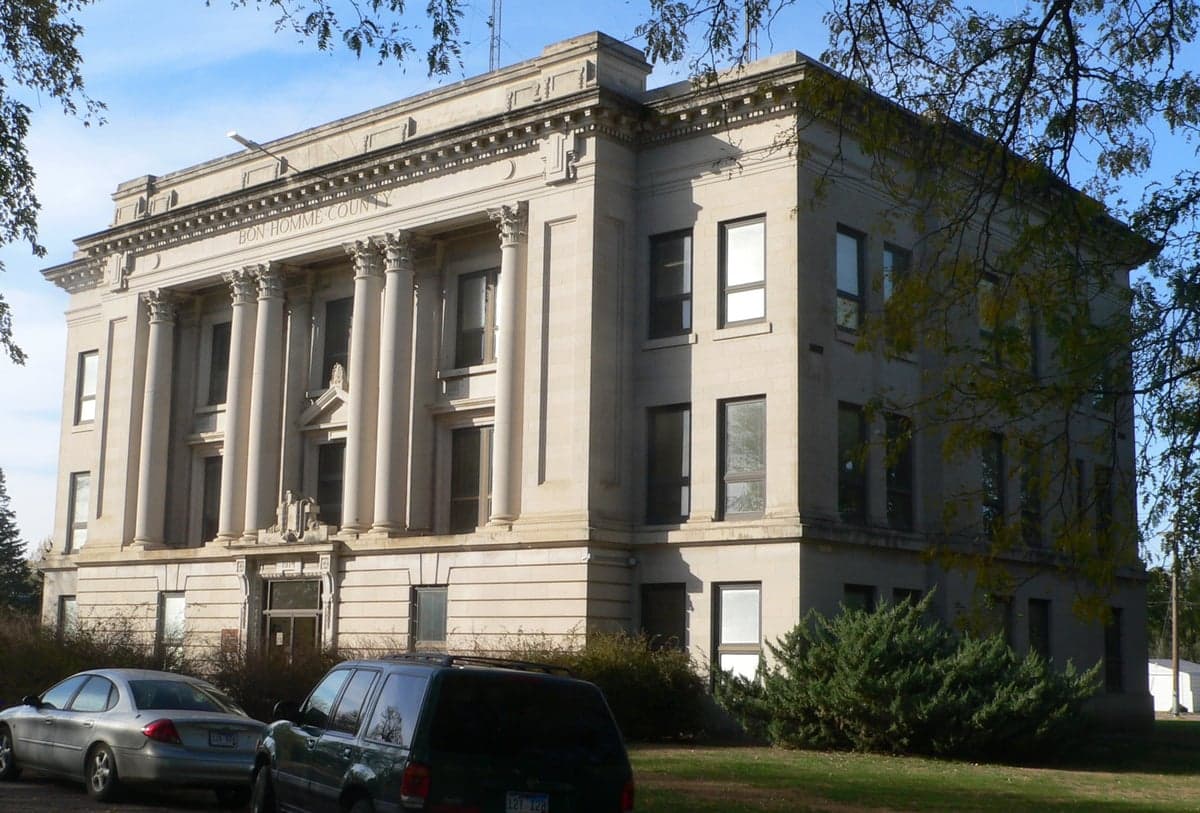
Photo: Wikipedia
Personal Sovereignty in Bon Homme County
Strong independent fundamentals that actively favor personal liberty and low regulation.
What does Personal Sovereignty tell us?
Personal Sovereignty measures your capacity for self-reliance and independence with minimal government friction. Higher scores mean fewer barriers between you and the way you want to live... but it assumes you have the space you need and good neighbors.
What does this tell us?
Personal Sovereignty measures your capacity for self-reliance and independence with minimal government friction. Higher scores mean fewer barriers between you and the way you want to live... but it assumes you have the space you need and good neighbors.
State Policy
Energy independence: Importer (35% of energy produced in-state)
Personal Liberty
Homesteading

Personal Liberty Analysis
Bon Homme County, South Dakota, offers one of the strongest personal sovereignty environments in the Upper Midwest, largely because state-level preemption laws and a deeply rooted rural culture keep government overreach at arm’s length. Unlike counties in coastal states where zoning boards and health departments dictate land use, Bon Homme County’s roughly 7,000 residents enjoy a regulatory posture that prioritizes individual decision-making over bureaucratic control. For those evaluating relocation from high-tax, high-regulation states like California, Illinois, or New York, this county represents a strategic foothold where personal autonomy—from firearm ownership to off-grid living—remains largely unencumbered by local or state interference.
Tax burden and regulatory posture: How Bon Homme County compares to surrounding areas
South Dakota’s lack of a state income tax is the headline advantage, but Bon Homme County’s specific property tax rates and minimal local regulations make it a standout even within the state. The county’s effective property tax rate hovers around 1.1% of assessed value, which is competitive with neighboring counties like Yankton (1.2%) but notably lower than Hutchinson County (1.4%). There is no county-level sales tax beyond the state’s 4.5% rate, meaning everyday purchases are cheaper than in nearby towns like Tyndall or Avon, which sit in counties with slightly higher levies. Regulatory posture is equally favorable: Bon Homme County has no county-wide building codes outside of the small towns of Scotland and Springfield, where municipal ordinances apply only within city limits. For rural parcels—especially those near the Missouri River in the western part of the county—landowners can construct dwellings, workshops, or storage structures without permit delays or inspection fees. This stands in stark contrast to states like Colorado or Washington, where even a backyard shed requires a permit. The county’s zoning is minimal, limited to agricultural and residential designations that do not restrict livestock, vehicle storage, or home-based businesses. For a prepper or homesteader, this means no county official will question a root cellar, a rainwater catchment system, or a workshop for reloading ammunition.
Self-defense and gun law specifics: What the Second Sanctuary status means for residents
Bon Homme County is a Second Amendment Sanctuary, a designation passed by the county commission in 2021 that formally prohibits local funds from being used to enforce any federal gun control measures deemed unconstitutional. This is not symbolic—it carries legal weight in South Dakota, where state law preempts local firearm ordinances entirely. Residents of Tabor and Lesterville, the county’s smaller unincorporated communities, can carry concealed without a permit under the state’s constitutional carry law, which has been in effect since 2019. There is no waiting period, no firearm registration, and no magazine capacity restrictions. The nearest federally licensed firearms dealer is in Yankton, about 20 miles north, but private sales between individuals require no background check, a feature that appeals to those who value privacy in transactions. For those concerned about federal overreach, the county’s sanctuary resolution means local sheriff’s deputies—who are elected, not appointed—will not assist federal agents in confiscation efforts. The sheriff’s office in Tyndall, the county seat, has publicly stated that its primary duty is to uphold the state constitution, not federal executive orders. This creates a de facto buffer against any future national gun bans, making Bon Homme County a reliable location for those who view firearm ownership as a non-negotiable right.
Self-reliance and homesteading viability: Lot sizes, zoning, and off-grid feasibility
For those serious about self-reliance, Bon Homme County offers some of the most permissive land-use policies in the region. Rural parcels outside of incorporated towns typically have minimum lot sizes of 1 to 5 acres, but many tracts along the James River valley and near the Missouri River bluffs are available in 10- to 40-acre increments, ideal for a homestead with livestock, orchards, or solar arrays. Off-grid living is entirely feasible: there are no county regulations requiring connection to municipal water or power grids. Residents near Kaylor and Utica commonly use private wells, septic systems, and solar panels with battery storage. The county’s building department does not inspect alternative energy installations, and there are no restrictions on rainwater collection—a critical advantage over states like Colorado or Utah where such practices are regulated. Zoning is agricultural by default on most rural land, meaning chickens, goats, cattle, and even pigs are allowed without special permits. The only limitation comes within the town limits of Avon, where a 2019 ordinance restricts livestock to parcels over 2 acres, but this is a minor constraint compared to the near-total freedom on unincorporated land. For those seeking to build a retreat or a permanent off-grid residence, the county’s lack of building codes for rural structures means you can construct a timber-frame cabin, a shipping container home, or an earth-sheltered dwelling without plan review or inspection fees. This is a stark contrast to counties in the Pacific Northwest or Northeast, where even remote cabins require engineered plans and multiple permits.
Personal liberties: Parental rights, medical autonomy, speech, and property protections
Bon Homme County’s culture of personal sovereignty extends beyond taxes and guns into the realms of family and medical decisions. South Dakota law grants parents broad authority over their children’s education, including the right to homeschool without state curriculum mandates or teacher certification requirements. In Scotland and Springfield, homeschool co-ops are active, and the local school districts are accommodating of part-time enrollment for extracurricular activities. Medical autonomy is similarly robust: South Dakota does not mandate COVID-19 vaccines for children or adults, and the state legislature passed a 2023 law prohibiting employers from requiring vaccines as a condition of employment. The county’s healthcare system, centered at the Bon Homme County Memorial Hospital in Tyndall, respects patient choice and does not enforce federal vaccine mandates for non-employees. On speech and property, the county’s small-town ethos means that local government rarely interferes with signage, political expression, or land use. There are no county-level noise ordinances, no restrictions on political yard signs, and no limitations on the number of vehicles or equipment stored on private property. For those who value the right to speak freely, store supplies, or build without permission, Bon Homme County offers a level of personal liberty that is increasingly rare in the United States.
In the broader context of the Great Plains, Bon Homme County ranks among the top 10% of U.S. counties for personal sovereignty, rivaling areas like Harding County in western South Dakota or Perkins County in Nebraska. Its combination of no income tax, minimal zoning, constitutional carry, and a Second Amendment Sanctuary designation creates a legal environment where government overreach is the exception, not the rule. For a prepper, a homesteader, or a family seeking to escape the encroaching regulatory state, this county provides a strategic base where individual rights are still the default—and where the local government sees its role as protecting those rights, not restricting them.

* Values derived from national, state, county, city and local statistics and may differ in a specific area. Last updated: 2026-05-28T04:16:40.000Z
Narrative content on this page is AI-generated and may contain mistakes. Verify any details that matter before acting on them.
ReloMaps may earn a commission from affiliate links at no extra cost to you.

