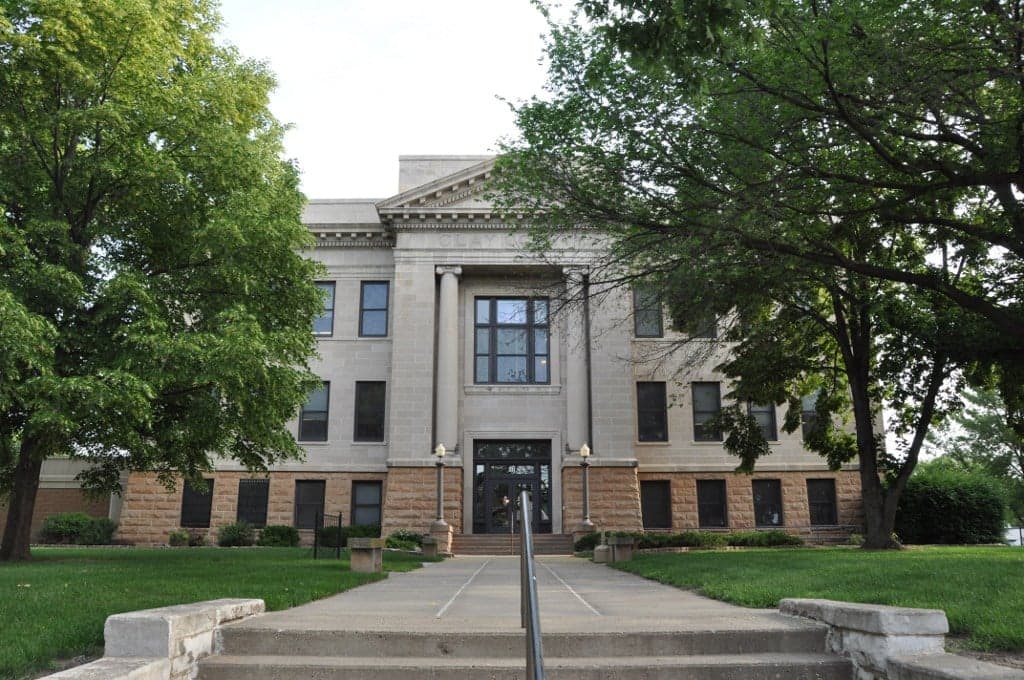
Photo: Wikipedia
Political ClimatePolitical Climate in Clay County
Showing state-level results — no local-only data available.
Local Political AnalysisPolitical Analysis of Clay County
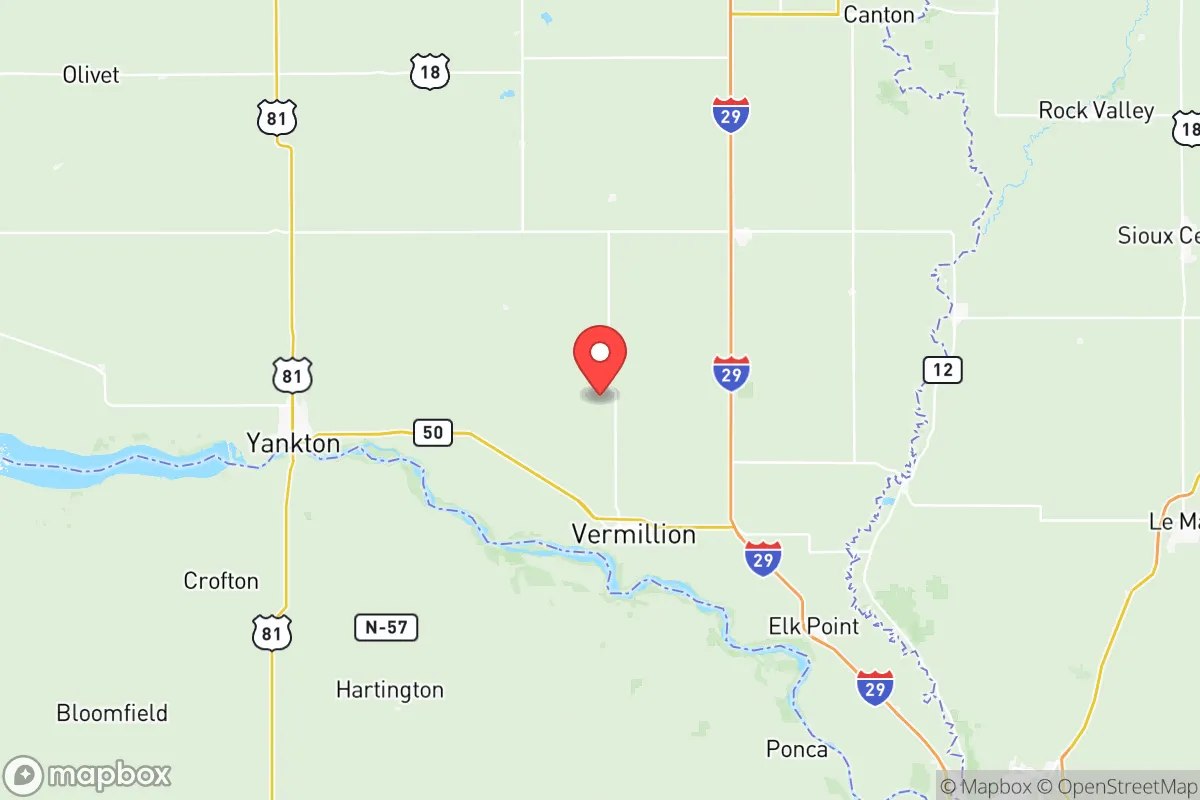
Clay County, South Dakota, is a political outlier in an otherwise deeply red state, leaning Republican with a Cook PVI of R+15 but showing a distinctly more moderate-to-liberal streak than the surrounding region, largely driven by the college town of Vermillion. The county has been trending slightly bluer in recent presidential cycles, a shift that contrasts with the state's solidly conservative trajectory. While the county as a whole still votes Republican, the margin has narrowed, and local races often see competitive Democratic performances, especially in precincts around the University of South Dakota.
How it compares
Compared to the rest of South Dakota, Clay County is a blue dot in a red sea. The state as a whole has a Cook PVI of R+16, making Clay County's R+15 rating nearly identical in partisan lean, but the county's internal dynamics are far more divided. Vermillion, home to the University of South Dakota, consistently votes Democratic in national and state elections, with precincts near campus often breaking 60-40 for Democratic candidates. In contrast, the rural areas outside Vermillion—like the towns of Burbank and Wakonda—vote heavily Republican, sometimes by margins of 70% or more. The swing precincts are in the more suburban parts of Vermillion and the unincorporated areas along the Missouri River, where independent voters decide close races. Statewide, South Dakota has not voted for a Democratic presidential candidate since 1964, but Clay County came within 5 points of doing so in 2020, a sign of its growing divergence from the state's norm.
What this means for residents
For conservative residents, Clay County offers a comfortable environment where Republican values still dominate countywide, especially in local government and school board elections. The county commission and most township boards are reliably Republican, and gun rights, agricultural policy, and low taxes are widely supported. For liberal residents, the county provides a rare pocket of progressive influence in South Dakota, particularly in Vermillion, where city council races and university-related issues often see strong Democratic turnout. The presence of the university also means that issues like LGBTQ+ rights, climate policy, and public education funding get more airtime here than in neighboring counties like Yankton or Union. However, both sides must navigate a community where political divides are real but rarely hostile—most residents know each other, and local politics tends to focus on practical issues like road maintenance, school funding, and economic development rather than national culture wars.
Culturally, Clay County stands apart from much of South Dakota due to the university's influence. Vermillion hosts a vibrant arts scene, a public radio station, and a more diverse population than the surrounding rural areas, which can feel like a different world from the conservative farming communities just a few miles away. Policy-wise, the county has been a battleground over issues like mask mandates during the pandemic and land use regulations, with the university often pushing for more progressive stances while the county commission holds the line. Looking ahead, the trajectory suggests Clay County will continue to moderate, especially as Vermillion grows and attracts younger, more diverse residents, while the rural parts of the county remain staunchly Republican. For anyone moving here, the key takeaway is that you'll find your people—whether you're a conservative farmer or a liberal professor—but you'll also have to get used to living in a place where your neighbors might vote very differently than you do.

State Political ClimatePolitical Climate in South Dakota
State Political AnalysisPolitical Environment in the State
South Dakota has been a reliably Republican state for decades, but the depth of that lean has intensified significantly since 2016, with the state now ranking as one of the most conservative in the nation. The dominant coalition is a mix of rural agricultural interests, evangelical Christians, and a growing influx of liberty-minded transplants, all of whom have pushed the state’s politics further right. Over the past 20 years, the GOP has moved from holding a comfortable majority to a supermajority in both legislative chambers, and no Democrat has won a statewide election since 2008. The shift is most visible in the rapid growth of Sioux Falls, which now drives much of the state’s economic and political energy, while the western half of the state, anchored by Rapid City, remains even more conservative.
Urban vs. rural divide
The political map of South Dakota is defined by a stark urban-rural split, but unlike many states, the urban areas are also conservative. Sioux Falls, home to nearly 20% of the state’s population, leans Republican but is the most moderate part of the state—it’s where you’ll find the few Democratic-leaning precincts, particularly around downtown and the university neighborhoods. Rapid City is more reliably red, with the Black Hills region voting heavily Republican. The rural counties—especially in the central and western parts of the state, like Jones County and Harding County—routinely deliver 80-90% of their votes to GOP candidates. The only notable exception is Minnehaha County (Sioux Falls), which occasionally flips in local races but still votes Republican by double digits in presidential elections. The Native American reservations, such as Pine Ridge and Rosebud, are overwhelmingly Democratic, but their populations are small and turnout is low, so they have little impact on statewide outcomes.
Policy environment
The state’s policy environment is built around low taxes, minimal regulation, and a hands-off approach to social issues. South Dakota has no state income tax, a low sales tax (4.5% state rate, with local options adding up to 2%), and some of the lowest property taxes in the region. The regulatory climate is business-friendly, with no statewide zoning laws and a right-to-work law that limits union power. Education policy is decentralized: school funding is tied to local property taxes, and there is a robust school choice movement, including a growing number of charter schools and a new education savings account program passed in 2024. Healthcare is a mixed bag—the state did not expand Medicaid until 2023, and while it now covers about 50,000 additional residents, the system remains strained in rural areas. Election laws are among the most accessible in the country: same-day voter registration is available, no-excuse absentee voting is permitted, and voter ID requirements are minimal (a student ID or utility bill works).
Recent policy direction
Since 2020, South Dakota has moved aggressively on several fronts, often positioning itself as a national test case for conservative governance. On gun and self-defense law, the state enacted permitless carry in 2019 and in 2023 passed a law allowing teachers to carry firearms in schools with minimal training. Parental and education rights saw a major win with the 2024 Education Savings Account Act, which gives families up to $3,000 per child for private school or homeschooling expenses. Speech and privacy have been protected by a 2023 law that prohibits social media platforms from censoring users based on political viewpoints, though it’s currently tied up in court. On medical and bodily autonomy, South Dakota has one of the strictest abortion bans in the nation—triggered in 2022 with no exceptions for rape or incest—and a 2024 law that restricts gender-affirming care for minors. Property rights were strengthened by a 2022 law that limits eminent domain for carbon pipelines, a direct response to the controversial Summit Carbon Solutions project. Taxation has been cut repeatedly: the state sales tax on groceries was eliminated in 2023, and the overall sales tax rate was reduced from 4.5% to 4.2% in 2024. Voting and ballot access remain broad, but a 2024 law requiring all absentee ballots to be notarized (or signed by two witnesses) has been criticized as a restriction.
Civil unrest & political movements
South Dakota has seen relatively little civil unrest compared to other states, but there have been notable flashpoints. The Dakota Access Pipeline protests in 2016-2017 drew national attention, with thousands of activists converging on the Standing Rock Reservation, though the pipeline was ultimately completed. More recently, the Summit Carbon Solutions pipeline has sparked a grassroots property rights movement, with landowners in counties like Brown County and Spink County organizing against eminent domain for CO2 sequestration. On the left, the South Dakota Democratic Party has been largely dormant, but there is a small but active progressive network in Sioux Falls focused on Medicaid expansion and abortion rights. On the right, the South Dakota Freedom Caucus has become a powerful force in the legislature, pushing for further tax cuts, school choice, and restrictions on immigration. Immigration politics are relatively quiet—the state has a small immigrant population, and there are no sanctuary cities. Election integrity controversies have been minimal, though a 2022 audit of the 2020 election found no significant issues, which was widely accepted by both parties.
Projection
Over the next 5-10 years, South Dakota’s political trajectory points further right, driven by two key factors: in-migration and demographic shifts. The state is attracting a steady stream of newcomers from California, Colorado, and the Midwest, many of whom are drawn by the low taxes and libertarian-leaning policies. These transplants tend to be even more conservative than native South Dakotans, particularly on fiscal issues. The growth of Sioux Falls will continue to moderate the state’s politics slightly, but the city’s suburbs—places like Harrisburg and Tea—are among the fastest-growing and most conservative areas in the state. The rural population will continue to shrink, but the rural vote will remain disproportionately powerful due to the state’s legislative map. Expect further tax cuts, expanded school choice, and continued resistance to federal mandates on environmental and healthcare policy. The biggest wildcard is the Native American vote—if turnout increases, it could shift the balance in a few legislative districts, but it’s unlikely to change the statewide dynamic.
For a new resident, the bottom line is this: South Dakota offers a stable, predictable political environment that strongly favors conservative values, but it’s not a monolith. If you’re a conservative, you’ll find a government that actively supports your priorities on taxes, guns, and education. If you’re a liberal, you’ll find a small but resilient community in Sioux Falls and on the reservations, but you’ll be in a clear minority. The state is unlikely to swing blue in any foreseeable future, so anyone moving here should be comfortable with a political landscape that is deeply red and getting redder.
* Values derived from national, state, county, city and local statistics and may differ in a specific area. Last updated: 2026-07-30T03:34:58.000Z
Narrative content on this page is AI-generated and may contain mistakes. Verify any details that matter before acting on them.
ReloMaps may earn a commission from affiliate links at no extra cost to you.

