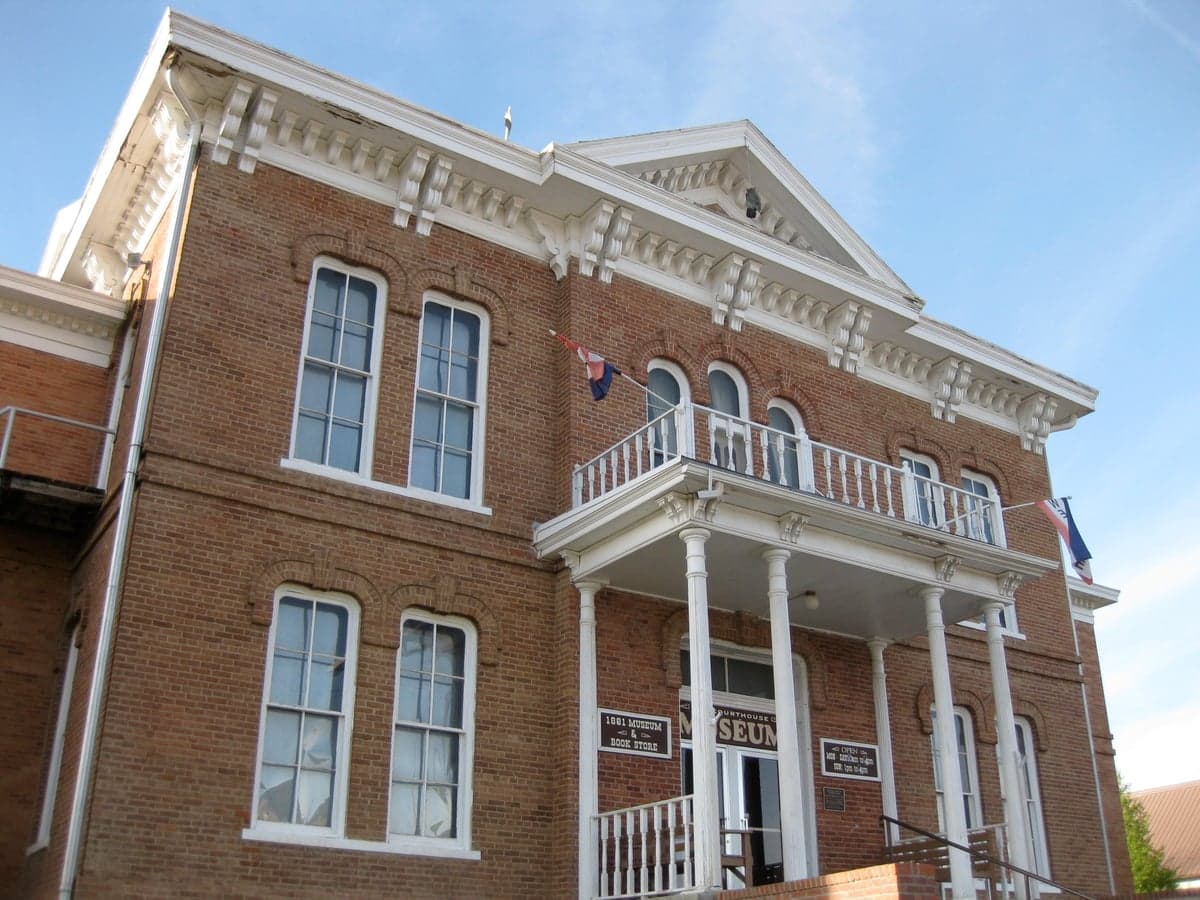
Photo: Wikipedia
Demographics of Custer County
Affluence Level in Custer County
An upper-middle-class area. Household wealth, education levels, and homeownership run ahead of national benchmarks.
People of Custer County
The people of Custer County, South Dakota, today number just 8,686, making it one of the state’s least densely populated counties, yet its character is defined by a distinct blend of frontier independence and outdoor recreation. The population is overwhelmingly white (89.9%), with a tiny foreign-born share of 0.6%, and a college education rate of 32.1% that slightly exceeds the national average. This is a county where the legacy of gold rushes, homesteading, and a deep-rooted ranching culture still shapes daily life, set against the dramatic backdrop of the Black Hills.
Settlement & growth (pre-1960)
Long before European settlement, the area now known as Custer County was part of the ancestral homeland of the Lakota Sioux, particularly the Oglala and Miniconjou bands, who used the Black Hills for hunting, spiritual ceremonies, and seasonal camps. The 1868 Treaty of Fort Laramie guaranteed the Lakota exclusive rights to the region, but that guarantee collapsed with the 1874 Custer Expedition, which confirmed gold in the hills. The ensuing gold rush brought the first major wave of American settlers—mostly white prospectors, miners, and entrepreneurs from the eastern U.S. and Europe—who founded the county’s first town, Custer City, in 1875. By 1876, the town had swelled to an estimated 10,000 people, though most were transient fortune-seekers who left when surface gold played out.
The permanent population took root after the 1880s, driven by the Homestead Act and the expansion of the railroad. German, Scandinavian, and Irish immigrants arrived to work the remaining hard-rock mines, such as the Golden Reward Mine near Pringle, and to establish ranches on the surrounding grasslands. The county’s second town, Hermosa, grew as a railroad stop and agricultural hub, while Fairburn and Buffalo Gap became service centers for cattle and sheep operations. By 1900, the population had stabilized around 4,000, with a mix of native-born Americans of British Isles descent and a smaller number of German and Scandinavian immigrants. The Dust Bowl of the 1930s hit the county’s eastern ranches hard, but the Black Hills’ higher elevation and tourism potential—spurred by the 1927 carving of Mount Rushmore—began drawing a new kind of resident: retirees, small-business owners, and seasonal workers. The 1950s saw a modest boom tied to the construction of Pactola Dam and the expansion of the U.S. Forest Service, which brought government employees and conservation workers to Custer City and Hill City (the latter technically in adjacent Pennington County but closely tied to Custer County’s economy).
Modern era (post-1965)
The 1965 Hart-Cellar Act had almost no direct effect on Custer County’s demographics, as the foreign-born population remains negligible at 0.6%. Instead, the county’s modern growth has been driven by domestic migration—specifically, a steady influx of retirees, second-home buyers, and remote workers drawn to the Black Hills’ natural amenities and lower cost of living. Between 1970 and 2020, the county’s population grew from roughly 4,700 to 8,686, a 85% increase, but still far below the explosive growth seen in the nearby Rapid City metro area. The Hispanic share (2.9%) and East/Southeast Asian share (0.4%) are small and largely tied to seasonal tourism and service-industry jobs in Custer City and Hermosa, rather than forming distinct ethnic enclaves. The Black population (0.4%) and Indian subcontinent population (0.0%) are statistically negligible.
The most significant demographic shift has been the aging of the population. The median age in Custer County is 52.3 years, well above the national median of 38.8, reflecting the county’s appeal to retirees and the out-migration of younger adults seeking employment in larger cities. Suburbanization has been minimal; the county has no incorporated suburbs, and new housing development is concentrated in unincorporated subdivisions around Custer City and along the U.S. Highway 16 corridor leading to Mount Rushmore. The county’s cultural identity remains firmly rooted in its ranching and mining heritage, with annual events like the Custer County Fair and the Gold Discovery Days in Custer City reinforcing a conservative, self-reliant ethos. Political registration data shows the county leans heavily Republican, with 72% of voters registered as Republican in 2024.
The future
The population of Custer County is projected to grow slowly, reaching roughly 9,500 by 2040, according to state demographers, driven primarily by continued in-migration of retirees and remote workers from the Midwest and West Coast. The county is not homogenizing or tribalizing into distinct enclaves; rather, it is becoming slightly more diverse in age and occupation, with a growing share of residents employed in tourism, healthcare, and professional services. The Hispanic and East/Southeast Asian communities are expected to remain small but may grow modestly as the tourism industry expands, particularly in Custer City and Hermosa, where service-sector jobs are concentrated. The out-migration of young adults is a persistent challenge, as the county lacks the high-paying tech or manufacturing jobs that attract families. The cultural identity is likely to remain stable, with new arrivals being absorbed into the existing ranching and outdoor-recreation lifestyle rather than reshaping it. The next 10-20 years will see a continued emphasis on preserving open space, managing tourism pressure, and attracting younger families through affordable housing initiatives and expanded broadband infrastructure.
For someone moving in now, Custer County offers a place where the population is stable, politically conservative, and deeply connected to the land. The low crime rate, strong sense of community, and access to the Black Hills’ outdoor amenities are the primary draws, but the limited job market and aging demographic mean that newcomers should be prepared for a slower pace of life and a smaller social circle. This is not a county of rapid change or cultural friction; it is a place where the past—gold, cattle, and homesteads—still echoes in the present, and where the future looks much like the present, only a little older and a little more connected.

* Values derived from national, state, county, city and local statistics and may differ in a specific area. Last updated: 2026-05-28T12:05:13.000Z
Narrative content on this page is AI-generated and may contain mistakes. Verify any details that matter before acting on them.
ReloMaps may earn a commission from affiliate links at no extra cost to you.

