
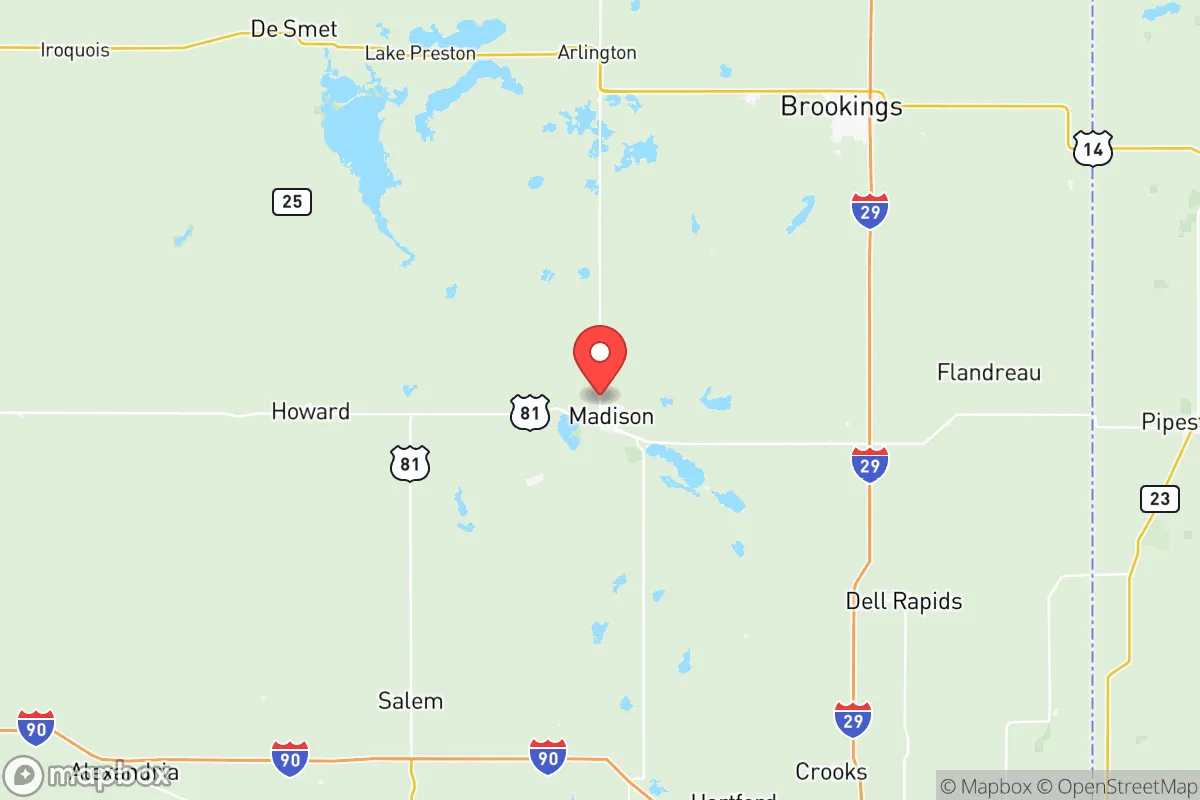
Photo: Wikipedia
Personal Sovereignty in Lake County
Viable for self-reliance. Generally workable, though some barriers may limit total independence.
What does Personal Sovereignty tell us?
Personal Sovereignty measures your capacity for self-reliance and independence with minimal government friction. Higher scores mean fewer barriers between you and the way you want to live... but it assumes you have the space you need and good neighbors.
What does this tell us?
Personal Sovereignty measures your capacity for self-reliance and independence with minimal government friction. Higher scores mean fewer barriers between you and the way you want to live... but it assumes you have the space you need and good neighbors.
State Policy
Energy independence: Importer (35% of energy produced in-state)
Personal Liberty
Homesteading

Personal Liberty Analysis
Lake County, South Dakota, offers a notably high degree of personal sovereignty compared to much of the nation, particularly for those seeking to minimize government overreach in daily life. The county’s small-town character, combined with South Dakota’s consistently conservative state-level policies, creates an environment where individual autonomy is the default rather than the exception. For single individuals and parents evaluating relocation from high-regulation states, the key question is not whether freedoms exist here, but how deeply they are embedded in the local culture and legal framework—and the answer is that they run deep, especially in communities like Madison, Wentworth, and Chester.
Tax burden and regulatory posture: how South Dakota’s policies protect your wallet and choices
South Dakota’s tax structure is among the most favorable in the country for those prioritizing financial sovereignty. There is no state income tax, no personal property tax on vehicles or business assets, and no inheritance or estate tax. For a family or individual relocating from a high-tax state like California or Illinois, this alone can represent a five-figure annual savings. Lake County’s property tax rates are moderate, with the effective rate hovering around 1.2% of assessed value, and the county assessor’s office is known for straightforward valuations rather than aggressive reassessments. Regulatory posture at the state level is equally restrained: South Dakota has no statewide building code for single-family homes outside of incorporated cities, meaning that in unincorporated Lake County areas like rural sections near Nunda or Ramona, you can build a home, shop, or workshop without layers of permit bureaucracy. Occupational licensing is minimal compared to coastal states, and the state legislature consistently rejects efforts to expand environmental or land-use regulations that would hamper individual property rights. For the prepper-minded, this means fewer legal hurdles to constructing a root cellar, installing a backup generator, or keeping livestock for subsistence.
Self-defense and gun law specifics: constitutional carry and no red-flag statutes
Lake County sits in a state that treats the Second Amendment as a fundamental, uninfringed right. South Dakota is a constitutional carry state, meaning no permit is required to carry a concealed firearm for anyone legally allowed to possess one. There are no red-flag laws, no firearm registration requirements, and no waiting periods for purchase. The state preempts all local gun ordinances, so Madison or Chester cannot enact their own bans or restrictions—what’s legal in Pierre is legal in Lake County. Stand-your-ground laws are on the books, with no duty to retreat in any place where you have a legal right to be. For parents, this extends to school safety: South Dakota law allows school boards to authorize staff to carry firearms on campus, and several rural districts have done so. The local sheriff’s office in Madison is known for a pro-2A stance, and gun ranges and private shooting clubs are common in the area. If your relocation checklist includes the ability to defend your home and family without government permission slips, Lake County delivers without compromise.
Self-reliance and homesteading viability: lot sizes, zoning, and off-grid feasibility
For those serious about self-reliance, Lake County’s rural character is a major asset. Unincorporated areas have no county-wide zoning, meaning you can purchase a 5- to 40-acre parcel near Wentworth or rural Madison and build a homestead with minimal interference. Chickens, goats, and even larger livestock are standard in these areas, and there are no nuisance ordinances that would prevent you from keeping a garden, composting, or installing a rainwater catchment system. Off-grid living is legally feasible: South Dakota has no state mandate to connect to the electrical grid, and solar panels with battery storage are increasingly common. Well water and septic systems are permitted through straightforward county health department processes, not byzantine environmental review boards. In the town of Madison itself, zoning is more structured, but even there, lots in the outskirts allow for substantial gardening and small livestock. The city of Chester, with its population under 300, offers a middle ground—small-town water and sewer services but with large lots and a hands-off attitude toward what you do on your property. For the prepper, the key takeaway is that Lake County does not treat self-sufficiency as a problem to be regulated; it treats it as a normal way of life.
Personal liberties: parental rights, medical autonomy, speech, and property
South Dakota has been a national leader in protecting parental rights, with state law affirming that parents have the fundamental right to direct the upbringing, education, and healthcare of their children. School boards in Lake County, particularly in Madison Central School District and Chester Area School District, are locally elected and responsive to conservative values; curriculum transparency laws require that instructional materials be available for parent review. Medical autonomy is similarly respected: the state does not mandate COVID-19 or other vaccines for school attendance, and there are no state-level mask or business closure mandates on the books. Freedom of speech and assembly are robust, with no hate-speech laws or social-media content restrictions that would chill political expression. Property rights are protected by South Dakota’s strong eminent domain laws, which require a public purpose and just compensation, and the state has no statewide rent control or landlord-tenant regulations that would interfere with private property use. For the survivalist-minded, this legal environment means you can stockpile supplies, homeschool your children, decline medical interventions you disagree with, and speak your mind without fear of government retaliation—all without needing to fight city hall.
In the broader national context, Lake County stands out as a place where personal sovereignty is not just tolerated but actively protected by state law and local culture. Compared to the regulatory density of the Pacific Northwest, the Northeast, or even parts of the Front Range, this area offers a level of freedom that feels increasingly rare. For single individuals and parents who view government overreach as a growing threat to their way of life, Lake County—and specifically its rural stretches near Nunda, Ramona, and Wentworth—represents a viable, low-friction destination where you can live by your own rules, defend your own home, and raise your family without constant bureaucratic interference.

* Values derived from national, state, county, city and local statistics and may differ in a specific area. Last updated: 2026-05-28T01:10:31.000Z
Narrative content on this page is AI-generated and may contain mistakes. Verify any details that matter before acting on them.
ReloMaps may earn a commission from affiliate links at no extra cost to you.

