
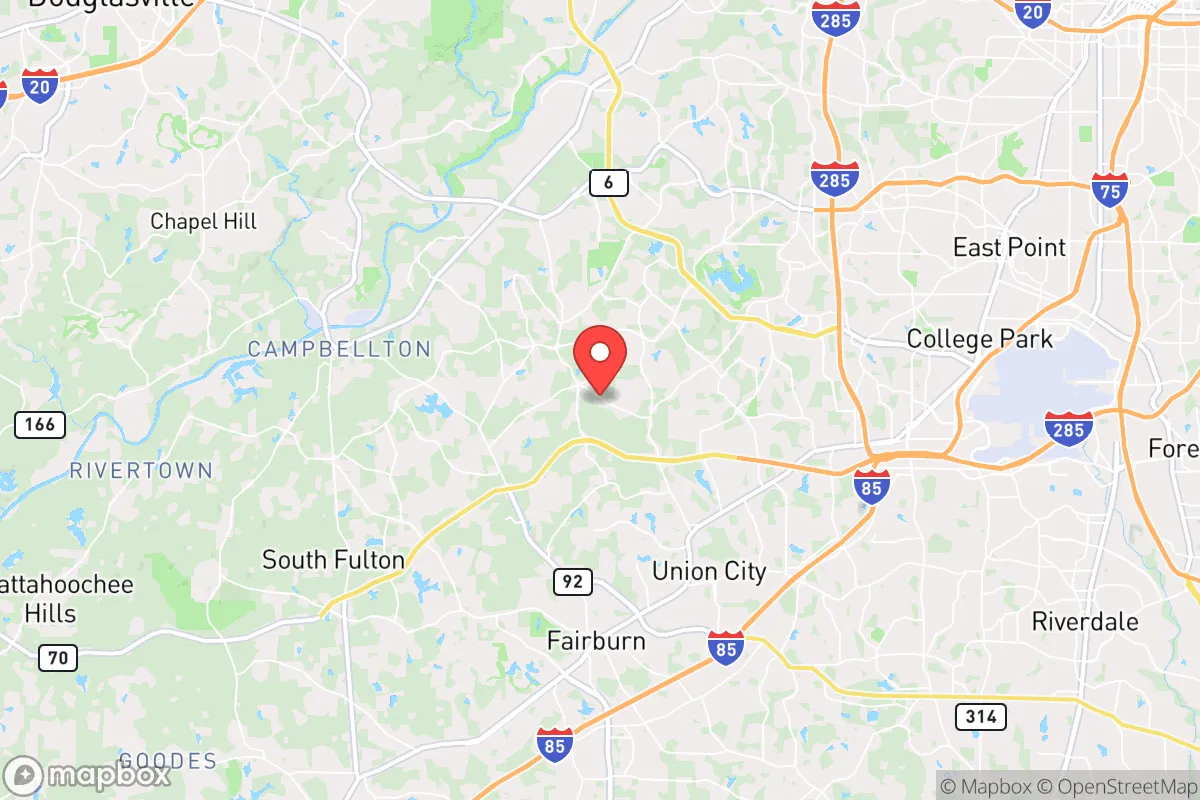
Photo: Wikipedia
Political ClimatePolitical Climate in South Fulton, GA
District shown is the primary district for this city’s centroid. Cities may span multiple districts.
Local Political AnalysisPolitical Analysis of South Fulton, GA
South Fulton, Georgia, leans heavily Democratic, with a Cook PVI of D+25, meaning it votes about 25 points more Democratic than the national average. This wasn’t always the case—back in the 1990s, this area was more of a mixed bag, with plenty of independent and even conservative-leaning folks who valued low taxes and personal responsibility. Over the last decade, though, the political shift has been dramatic, driven by rapid suburbanization from Atlanta and an influx of younger, more progressive residents. The trajectory is clear: the local government has moved further left with each election cycle, and that’s brought some real changes to how things run around here.
How it compares
If you drive 15 miles north to places like Peachtree City or Tyrone, you’ll find a completely different political vibe—those areas still lean conservative, with lower taxes and a “keep the government out of my backyard” attitude. South Fulton, by contrast, has become a stronghold for progressive policies, especially compared to its neighbors like Union City or Fairburn, which are more moderate. The contrast is stark: while nearby Fayette County has a Republican-leaning commission that keeps zoning and business regulations light, South Fulton’s city council has embraced higher property taxes and stricter land-use rules. It’s like two different worlds separated by a 20-minute drive, and the gap is widening every election.
What this means for residents
For folks living here, the political climate translates directly into daily life. Property taxes have crept up faster than in surrounding areas, partly to fund expanded city services and social programs that some residents feel are unnecessary. There’s also been a push for more regulations on short-term rentals and home-based businesses, which can feel like government overreach if you’re trying to run a side gig or rent out a spare room. The school board has adopted progressive curriculum changes that prioritize social-emotional learning over traditional academics, which has some parents worried about their kids’ foundational skills. On the plus side, the city has invested in new parks and public safety initiatives, but the trade-off is a heavier hand in personal freedoms—like stricter noise ordinances and limits on property modifications—that wouldn’t fly in more conservative towns nearby.
Culturally, South Fulton has developed a distinct identity as a progressive enclave, with a focus on equity and inclusion that shows up in everything from city council meetings to local festivals. The long-term trend suggests this will only intensify, as younger families continue to move in from Atlanta proper, bringing their values with them. If you’re someone who values low taxes, minimal government interference, and the freedom to do what you want with your property, you might find yourself butting heads with the local leadership more often than not. It’s a trade-off: you get a diverse, active community, but you also get a government that’s increasingly comfortable telling you how to live your life. For now, the best advice is to keep an eye on city council elections—they’re where the real power lies, and they’re the only way to push back if things go too far.

State Political ClimatePolitical Climate in Georgia
State Political AnalysisPolitical Environment in the State
Georgia has shifted from a reliably Republican stronghold to a true battleground state over the past two decades, with its 2020 presidential vote flipping blue for the first time since 1992. The state’s current political climate is defined by a razor-thin partisan divide, driven by explosive growth in the Atlanta metro area, while the rest of the state remains deeply conservative. For a conservative considering relocation, Georgia offers a mixed bag: low taxes and business-friendly policies in a state that still leans right overall, but with a rapidly growing progressive coalition in its urban core that has already reshaped statewide elections and policy debates.
Urban vs. rural divide
The political map of Georgia is a study in stark contrasts. The Atlanta metropolitan area, home to roughly 60% of the state’s population, is the engine of Democratic growth. Counties like Fulton (Atlanta), DeKalb, Cobb, and Gwinnett have swung hard left over the past decade, fueled by an influx of younger, more diverse, and college-educated residents. Gwinnett County, once a Republican suburban stronghold, voted for Joe Biden by 18 points in 2020. Meanwhile, the rest of the state—from the rural southwest to the north Georgia mountains—remains overwhelmingly Republican. Counties like Murray (northwest) and Bacon (southeast) routinely deliver 80%+ margins for GOP candidates. The divide isn’t just urban vs. rural; it’s also suburban vs. exurban. Places like Forsyth County (north of Atlanta) have become conservative redoubts, with Forsyth voting +30 R in 2024, while Henry County (south of Atlanta) has flipped blue. The political future of Georgia hinges on whether the Atlanta suburbs continue to trend left or if the exurban and rural vote can keep pace with the state’s rapid population growth.
Policy environment
Georgia’s policy environment is a study in conservative governance with notable exceptions. The state has a flat income tax rate of 5.49% (down from 5.75% in 2024), with a path to 4.99% by 2029, and no state-level estate or inheritance tax. Property taxes are relatively low, with a median effective rate of 0.87% of home value. The regulatory climate is business-friendly, with a right-to-work law and a low corporate tax rate of 5.75%. On education, Georgia has a robust school choice program, including the Georgia Promise Scholarship Act (2024), which provides $6,500 per student for private school tuition or homeschooling expenses. However, the state’s healthcare landscape is more mixed: it did not expand Medicaid under the Affordable Care Act, but the Georgia Pathways to Coverage program (2023) imposes work requirements for limited coverage, a conservative approach that has seen low enrollment. Election laws have been a flashpoint: the Election Integrity Act of 2021 (SB 202) tightened voter ID requirements, limited drop boxes, and restricted absentee ballot applications, drawing national criticism but defended by supporters as necessary for security. Gun laws are permissive: constitutional carry (permitless carry) was signed into law in 2022, allowing most adults to carry a concealed firearm without a license. Abortion is banned after six weeks under the Living Infants Fairness and Equality (LIFE) Act (2019), which took effect after the Dobbs decision in 2022. For a conservative, Georgia’s policy environment is largely favorable, though the ongoing battle over election laws and the potential for future Medicaid expansion remain points of tension.
Trajectory & freedom
Georgia’s trajectory on personal freedom is a mixed bag, with clear gains in some areas and worrying encroachments in others. On the positive side, the state has expanded gun rights significantly with the 2022 constitutional carry law, and the 2024 school choice expansion gives parents more control over their children’s education. Property rights are generally strong, with no statewide rent control and a relatively straightforward eminent domain process. However, there are concerning trends. The Georgia Hate Crimes Act (2020) expanded criminal penalties for bias-motivated offenses, which some conservatives view as a slippery slope toward thought policing. More alarmingly, the state’s response to COVID-19 included a patchwork of local mask mandates and business closures, particularly in Atlanta, where Mayor Keisha Lance Bottoms imposed some of the strictest restrictions in the South. The Georgia Emergency Management Agency retains broad powers that could be used to curtail personal liberties during future crises. On medical freedom, the state has not enacted any broad vaccine mandate bans, though a 2023 law (SB 1) prohibits COVID-19 vaccine mandates for state employees and contractors. The biggest freedom concern for conservatives is the growing influence of progressive prosecutors in metro Atlanta, such as Fulton County DA Fani Willis, whose policies on bail reform and sentencing have been criticized as soft on crime. Overall, Georgia is becoming more free in some areas (guns, school choice) but less free in others (local government overreach, prosecutorial discretion), and the trend line depends heavily on which party controls the governor’s mansion and legislature after 2026.
Civil unrest & political movements
Georgia has been a focal point for political activism and civil unrest, particularly in the Atlanta area. The 2020 protests following the murder of George Floyd saw significant property damage and clashes with police in downtown Atlanta, including the burning of a Wendy’s and the declaration of a state of emergency. The Stop Cop City movement, opposing the construction of a police training facility in Atlanta’s South River Forest, has led to ongoing protests, arrests, and a controversial state law (SB 44) that expands penalties for protest-related offenses. On the right, the Georgia Republican Party has seen internal divisions between establishment figures like Governor Brian Kemp and more populist, Trump-aligned factions, with the 2022 primary featuring a bitter challenge from David Perdue. Immigration politics are a hot-button issue: while Georgia is not a sanctuary state, the Atlanta area has a large undocumented population, and local governments like Clarkston (a DeKalb County city) have been labeled a “sanctuary city” by critics for its welcoming policies toward refugees. Election integrity remains a live controversy, with the 2020 results still contested by many conservatives and ongoing litigation over the 2021 election law. A new resident would notice the political polarization in everyday life, from yard signs to local news coverage, but the state has not seen the kind of sustained, large-scale unrest seen in some other battleground states.
Projection
Over the next 5-10 years, Georgia is likely to become more competitive at the statewide level, with a real possibility of becoming a lean-Democratic state by 2032 if current demographic trends continue. The Atlanta metro area is projected to add another 1.5 million residents by 2030, most of whom will be younger, more diverse, and more liberal. The exurban counties like Forsyth and Cherokee will remain conservative, but they cannot outvote the growing urban and suburban population. The state legislature is likely to remain under Republican control through at least 2030 due to gerrymandering, but the governor’s race in 2026 and 2030 will be toss-ups. On policy, expect continued battles over education (school choice expansion vs. public school funding), election laws (further restrictions vs. expanded access), and healthcare (potential Medicaid expansion if a Democrat wins the governorship). The biggest wild card is the 2026 gubernatorial election, which will set the tone for the next decade. If a conservative wins, expect continued tax cuts and school choice expansion; if a progressive wins, look for Medicaid expansion, gun control measures, and a more aggressive regulatory posture. For a conservative moving in now, the state offers a favorable policy environment today, but the long-term trend is concerning, and the political climate will only become more contentious.
For a conservative considering relocation, Georgia offers a strong economy, low taxes, and a largely conservative policy framework outside of Atlanta. The key trade-off is that you’ll be living in a state where your vote matters less and less at the statewide level, and where the cultural and political influence of the Atlanta metro will continue to grow. If you’re looking for a place where conservative values are deeply entrenched and likely to stay that way, the exurbs of Atlanta or the rural areas of north and south Georgia are your best bet. But if you want a state that is reliably red and trending redder, you may want to look further south or west. Georgia is a battleground, and it’s only going to get more contested.
* Values derived from national, state, county, city and local statistics and may differ in a specific area. Last updated: 2026-04-29T19:32:21.000Z
Narrative content on this page is AI-generated and may contain mistakes. Verify any details that matter before acting on them.
ReloMaps may earn a commission from affiliate links at no extra cost to you.

