
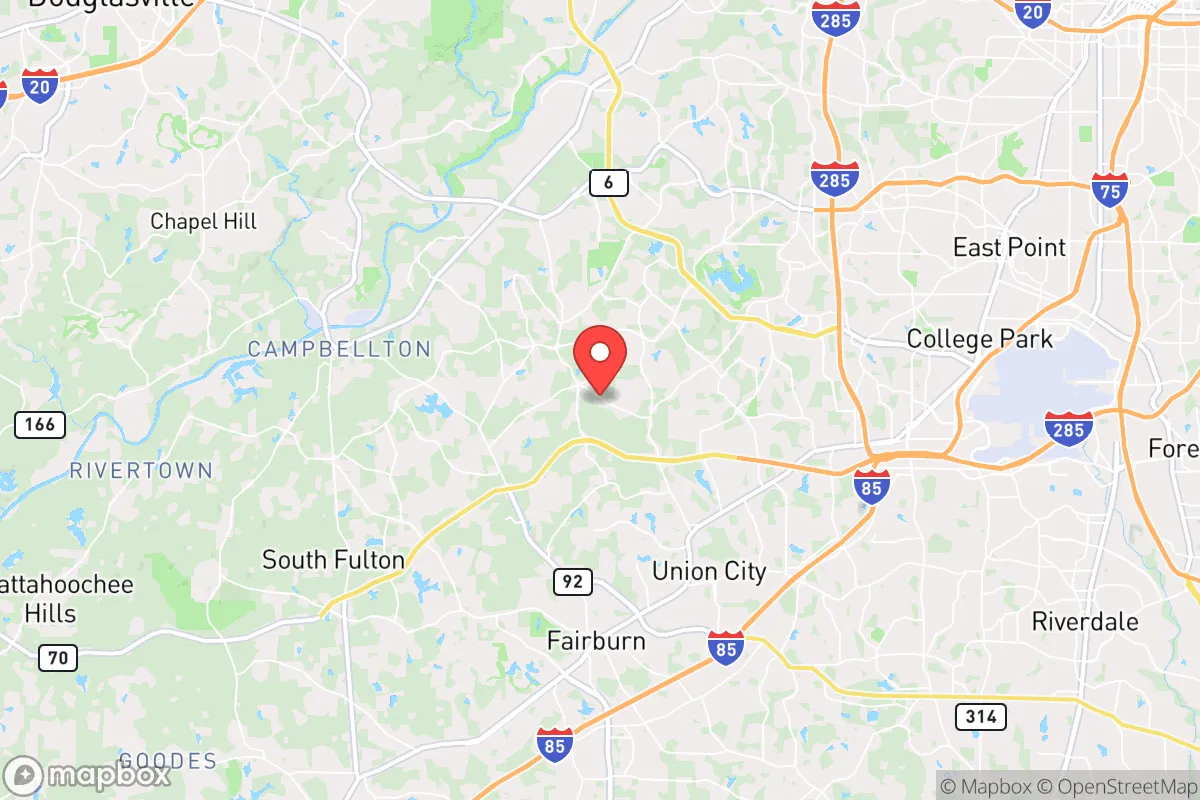
Photo: Wikipedia
Personal Sovereignty in South Fulton, GA
Viable for self-reliance. Generally workable, though some barriers may limit total independence.
What does Personal Sovereignty tell us?
Personal Sovereignty measures your capacity for self-reliance and independence with minimal government friction. Higher scores mean fewer barriers between you and the way you want to live... but it assumes you have the space you need and good neighbors.
What does this tell us?
Personal Sovereignty measures your capacity for self-reliance and independence with minimal government friction. Higher scores mean fewer barriers between you and the way you want to live... but it assumes you have the space you need and good neighbors.
State Policy
Energy independence: Importer (12% of energy produced in-state)
Personal Liberty
Homesteading

Personal Liberty Analysis
South Fulton, Georgia, presents a complex landscape for personal sovereignty that demands careful scrutiny from anyone prioritizing autonomy, self-reliance, and minimal government overreach. While the city itself is a relatively new municipality (incorporated in 2017) within a deep-blue county (Fulton County), its location on the southern edge of the Atlanta metro area offers a unique blend of suburban space and proximity to rural escape routes. The reality is that personal sovereignty here is a mixed bag: you get the benefits of Georgia’s generally pro-liberty state-level framework, but you must contend with a local government that has shown increasing appetite for regulation and taxation. For the survivalist or prepper, South Fulton is not a haven, but it is a place where strategic positioning—choosing the right neighborhood and understanding the local political dynamics—can preserve a meaningful degree of freedom.
Tax burden and regulatory posture: How much of your income and property stays yours
Georgia’s state-level tax environment is relatively friendly to individual sovereignty. The state has a flat income tax rate of 5.49% as of 2026, with ongoing legislative pressure to reduce it further. There is no state-level estate or inheritance tax, which matters for those looking to pass property and assets to the next generation without the government taking a cut. However, Fulton County is where the friction begins. The combined sales tax rate in South Fulton is 8.9% (state 4%, county 3.9%, and local 1%), which is among the highest in the state. Property taxes are also a significant consideration: Fulton County’s millage rate hovers around 10.5 to 11 mills for unincorporated areas, and South Fulton adds its own city levy. For a $350,000 home, you’re looking at roughly $3,800 to $4,200 annually in property taxes—substantially higher than in neighboring Coweta or Fayette counties. The regulatory posture at the city level is concerning for those who value low-touch governance. South Fulton has actively pursued code enforcement on issues like grass height, vehicle parking on lawns, and even the number of chickens you can keep. The city council has also shown willingness to impose moratoriums on new construction and to tighten zoning rules, which signals a preference for control over organic growth. For the prepper, this means you cannot assume you’ll be left alone to manage your property as you see fit.
Self-defense and gun law specifics: What you can carry and where you can carry it
On firearms and self-defense, Georgia law provides a strong baseline that South Fulton cannot easily override—but you must know the local nuances. Georgia is a constitutional carry state, meaning you can carry a handgun openly or concealed without a permit if you are at least 21 and legally allowed to possess a firearm. No state-level permit is required to purchase a rifle, shotgun, or handgun from a private seller. The state also has a Stand Your Ground law, which removes any duty to retreat before using deadly force if you are lawfully present and reasonably believe force is necessary to prevent death or great bodily harm. These are solid protections. However, South Fulton has its own municipal code that restricts carrying firearms in city-owned parks and recreation facilities, and the city council has debated further restrictions on carrying in government buildings. While state preemption law generally prevents cities from enacting stricter gun laws than the state, South Fulton has tested those boundaries. The practical reality is that you can legally carry almost everywhere in the city, but you should avoid city parks and be cautious around municipal buildings. Also note that Fulton County’s law enforcement culture is not uniformly pro-2A; the county police and sheriff’s office have been known to take aggressive stances on firearm-related stops. For the survivalist, this means your right to self-defense is legally robust but may be challenged by local enforcement attitudes.
Self-reliance and homesteading viability: Lot sizes, zoning, and off-grid feasibility
South Fulton offers more room for self-reliance than most of metro Atlanta, but it is not a free-for-all. The city is largely suburban and exurban, with many residential lots ranging from half an acre to two acres, particularly in neighborhoods like Red Oak, Campbellton, and parts of the Cascade area. There are still pockets of larger parcels—five to ten acres—especially along the southern edge near the Fulton-Coweta county line. Zoning is primarily R-1 (single-family residential), which allows for gardens, small livestock like chickens, and even beekeeping with a permit. However, the city has strict limits: no more than six hens (no roosters) on lots under one acre, and you must keep them 50 feet from any neighbor’s dwelling. Larger livestock like goats or pigs require a special use permit and a minimum of two acres. Off-grid feasibility is limited. The city requires connection to municipal water and sewer in most developed areas, and there are building codes that effectively prohibit composting toilets or rainwater-only systems for primary residences. Solar panels are allowed but must comply with HOA covenants if you’re in a subdivision. For the serious prepper, the best strategy is to buy on the southern fringe—closer to Coweta County—where zoning is looser and enforcement is less aggressive. Even then, you will not be able to disappear entirely from the grid. South Fulton is a place where you can have a substantial garden, keep some chickens, and store supplies, but you will still be visible to local code enforcement.
Personal liberties: Parental rights, medical autonomy, speech, and property
Georgia’s state-level protections for parental rights are strong. The state has a Parents’ Bill of Rights that affirms parents’ authority to direct the upbringing, education, and healthcare of their children. This means you can opt your child out of certain school curricula, and you have the right to be notified of any medical or mental health services provided at school. South Fulton’s school system (Fulton County Schools) has generally respected these rights, though there have been local controversies over library book content and gender-related policies. On medical autonomy, Georgia law does not mandate COVID-19 or other adult vaccines, and there is no state-level vaccine passport system. However, Fulton County’s health department has been proactive in promoting mandates in the past, and local hospitals may require vaccinations for certain procedures. The city itself has not enacted any broad medical mandates, but the political climate is such that future overreach is possible. Free speech is protected under the First Amendment, and South Fulton has not been a hotspot for censorship, though the city council has occasionally moved to restrict public comment periods. Property rights are where you feel the most friction. The city has an active code enforcement division that issues citations for tall grass, inoperable vehicles, and unpermitted structures. There is also a rental registration program that requires landlords to register units and pass inspections—a clear expansion of government oversight into private property. For the individualist, this is the most intrusive aspect of life in South Fulton.
Overall, South Fulton offers a moderate level of personal sovereignty that requires active defense. You get the benefit of Georgia’s state-level protections on guns, taxes, and parental rights, but you must navigate a local government that is more inclined to regulate than to leave you alone. Compared to areas like North Georgia’s mountain counties or rural South Georgia, South Fulton falls short on homesteading freedom and regulatory burden. Compared to deep-blue cities like Atlanta or Decatur, it is significantly better. For the strategic relocator with a survivalist mindset, South Fulton is a compromise: you can live near the economic opportunities of Atlanta while maintaining a reasonable degree of autonomy, but you must be prepared to engage with local politics, know your rights, and choose your specific neighborhood carefully. It is not a retreat, but it is a viable forward operating base.

* Values derived from national, state, county, city and local statistics and may differ in a specific area. Last updated: 2026-04-29T19:32:21.000Z
Narrative content on this page is AI-generated and may contain mistakes. Verify any details that matter before acting on them.
ReloMaps may earn a commission from affiliate links at no extra cost to you.

