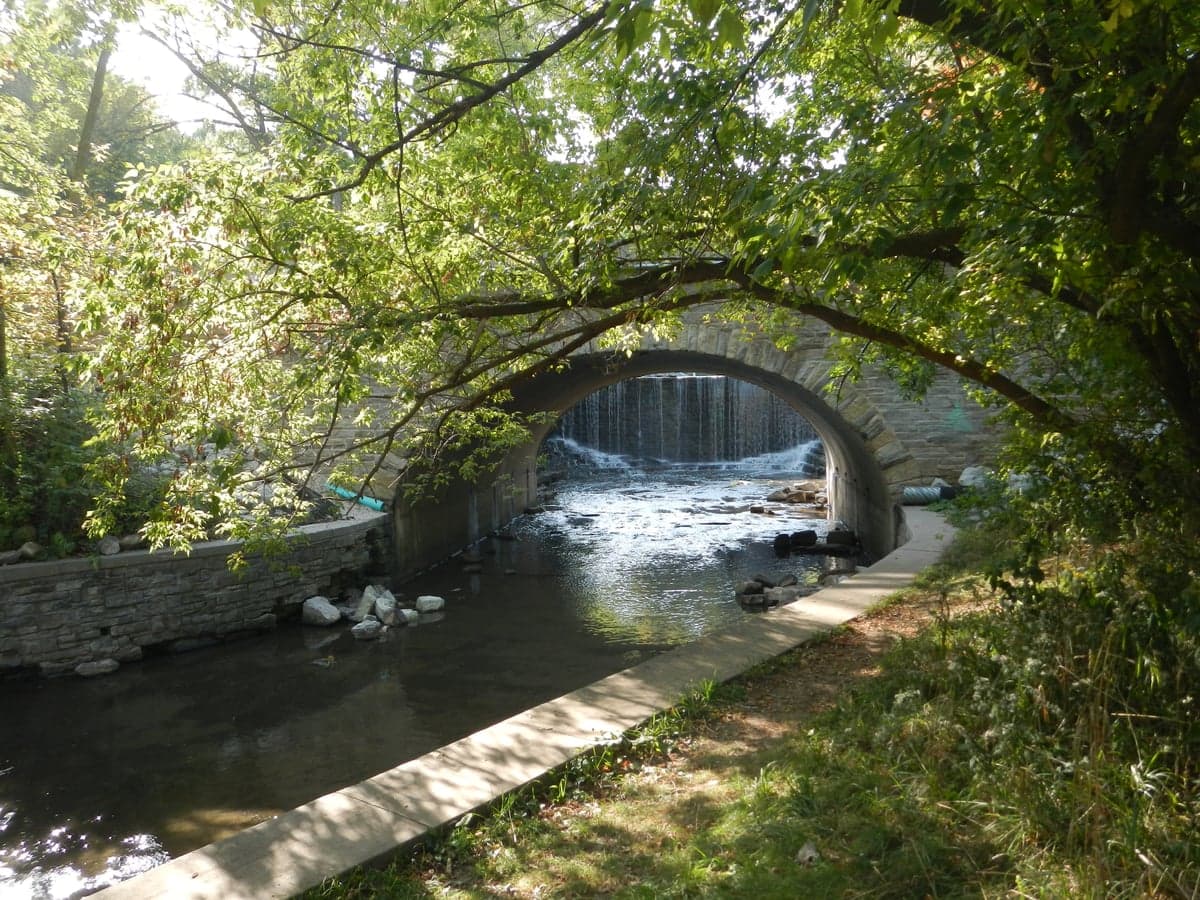
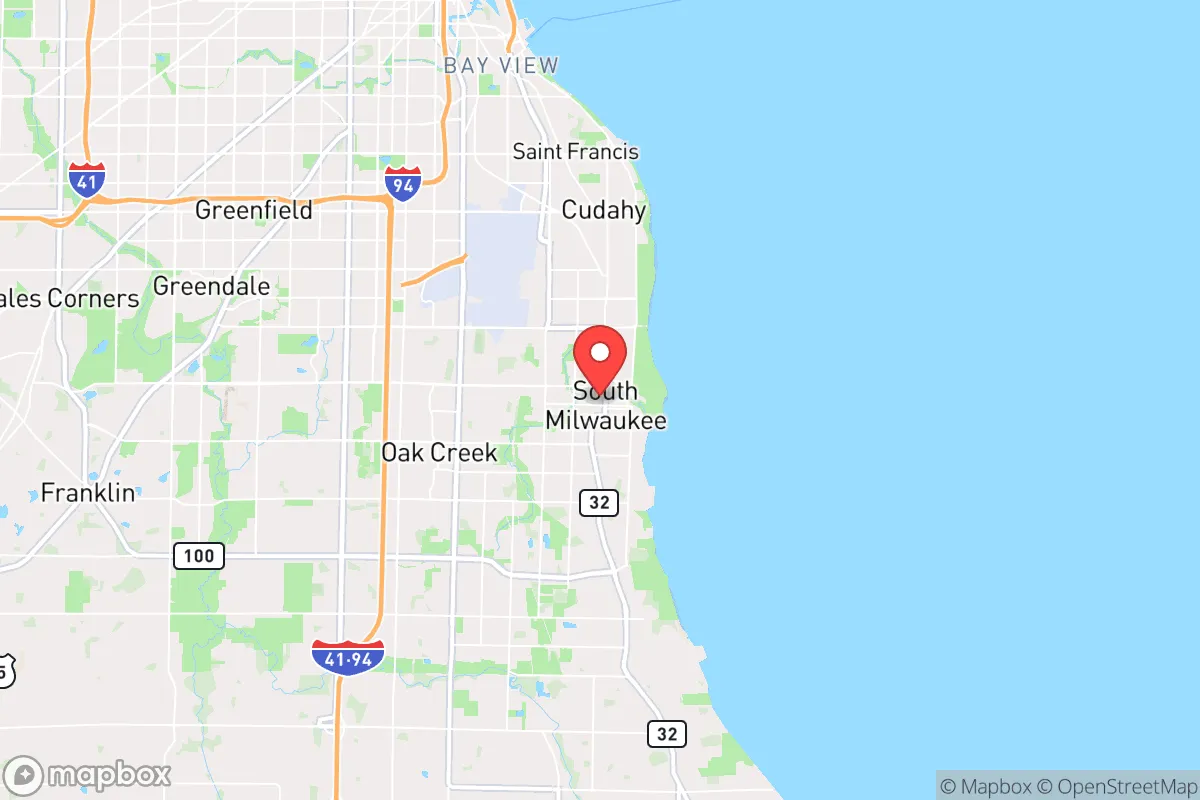
Photo: Wikipedia
Demographics of South Milwaukee, WI
Affluence Level in South Milwaukee, WI
A middle-class area roughly in line with national averages across income, home values, education, and employment.
People of South Milwaukee, WI
The people of South Milwaukee, Wisconsin, today number 20,547, forming a dense, historically rooted community that is 78.4% white and notably more Hispanic (13.1%) than the surrounding Milwaukee County suburbs. The city retains a strong blue-collar identity, shaped by generations of industrial workers, with a foreign-born population of just 1.8% and a college attainment rate of 27.7%. Distinct from its larger neighbor to the north, South Milwaukee feels like a self-contained small city where family ties to the local manufacturing base run deep.
How the city was settled and grew
South Milwaukee was platted in 1892 as a company town for the Bucyrus-Erie Company, a heavy machinery manufacturer that became the city's economic anchor. The original population was overwhelmingly German and Polish immigrants drawn by jobs in the foundry and machine shops. These groups settled in the Lake Drive corridor and the blocks around Milwaukee Avenue, building the city's first Catholic parishes and social halls. A second wave of Eastern European immigrants—primarily Czechs and Slovaks—arrived between 1900 and 1920, clustering in the North Milwaukee Avenue district near the rail yards. By 1930, the city was nearly 95% white, almost entirely of European descent, with a population that had swelled past 10,000. The Bucyrus Park neighborhood, with its modest bungalows and duplexes, became the heart of the working-class German-Polish community that dominated local politics and civic life for decades.
Modern era (post-1965)
After the 1965 Hart-Cellar Act, South Milwaukee saw only modest immigration compared to the city of Milwaukee. The foreign-born share peaked at around 3% in the 1980s and has since declined to 1.8%. The most significant demographic shift has been the growth of the Hispanic population, which rose from 2.4% in 1990 to 13.1% today. This growth is largely Mexican-American, drawn by affordable housing and entry-level manufacturing jobs at remaining industrial sites like the Bucyrus-Erie plant (now part of Caterpillar). These families have concentrated in the southwest quadrant near Rawson Avenue and 10th Avenue, where older single-family homes and duplexes offer lower entry prices. The Black population remains small at 2.4%, concentrated in scattered rental units along Milwaukee Avenue south of College Avenue. East/Southeast Asian residents (0.4%) and Indian-subcontinent residents (0.1%) are present in negligible numbers, mostly professionals commuting to Milwaukee or Racine. The white population, while still dominant, has aged and shrunk from 92% in 1990 to 78.4% today, as younger families have moved to newer suburbs like Oak Creek or Franklin.
The future
The population is slowly homogenizing around a white and Hispanic axis, with the Hispanic share projected to reach 18-20% by 2040 based on current birth rates and continued in-migration from nearby Milwaukee neighborhoods. The city is not tribalizing into distinct enclaves; rather, Hispanic families are dispersing across the Lake Drive and Rawson Avenue corridors, integrating into the existing housing stock. The Black and Asian populations are expected to remain flat, as South Milwaukee lacks the rental density and transit connections that attract newer immigrant groups to the central city. The biggest risk to population stability is the continued decline of manufacturing employment; if the Caterpillar plant downsizes further, the city could see net out-migration of younger white families. The college-educated share (27.7%) is below the county average, suggesting limited in-migration of knowledge workers.
For a conservative-leaning mover today, South Milwaukee offers a stable, family-oriented community where the population is becoming more Hispanic but remains predominantly white and working-class. The city is not diversifying rapidly; it is slowly shifting from a nearly all-white industrial town to a white-majority community with a significant Mexican-American minority. New arrivals will find a place where neighborhood identity still matters—particularly in the Bucyrus Park and Rawson Avenue areas—and where the pace of demographic change is measured in decades, not years.

* Values derived from national, state, county, city and local statistics and may differ in a specific area. Last updated: 2026-04-21T10:36:34.000Z
Narrative content on this page is AI-generated and may contain mistakes. Verify any details that matter before acting on them.
ReloMaps may earn a commission from affiliate links at no extra cost to you.

