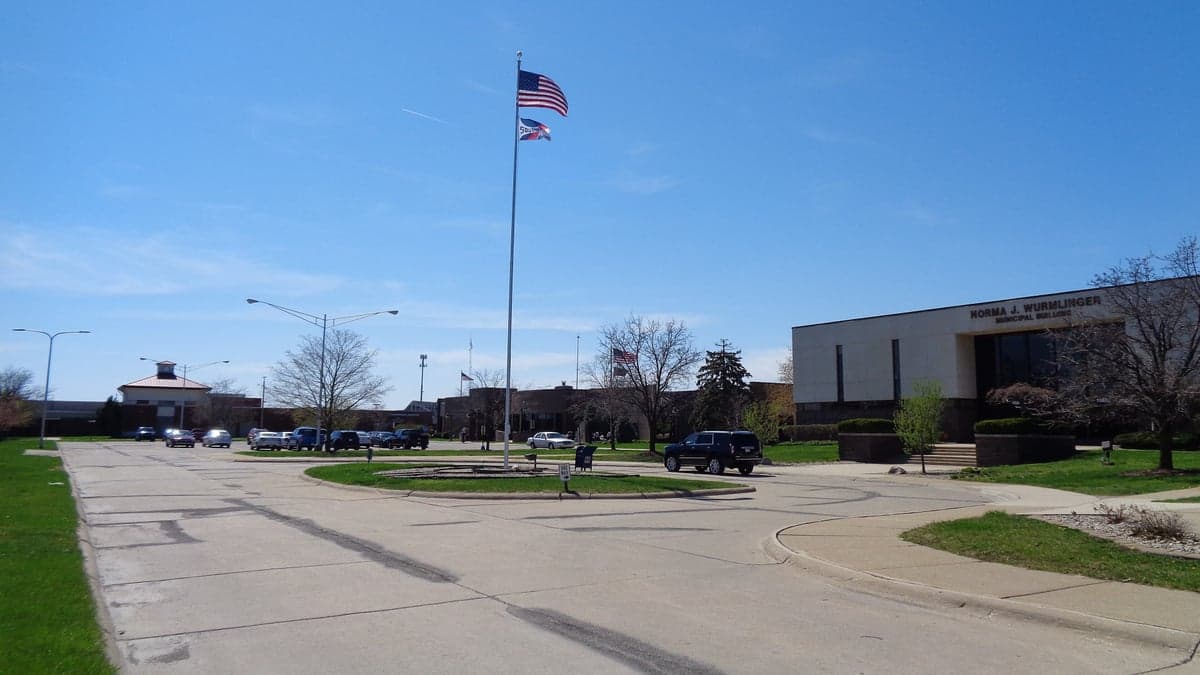
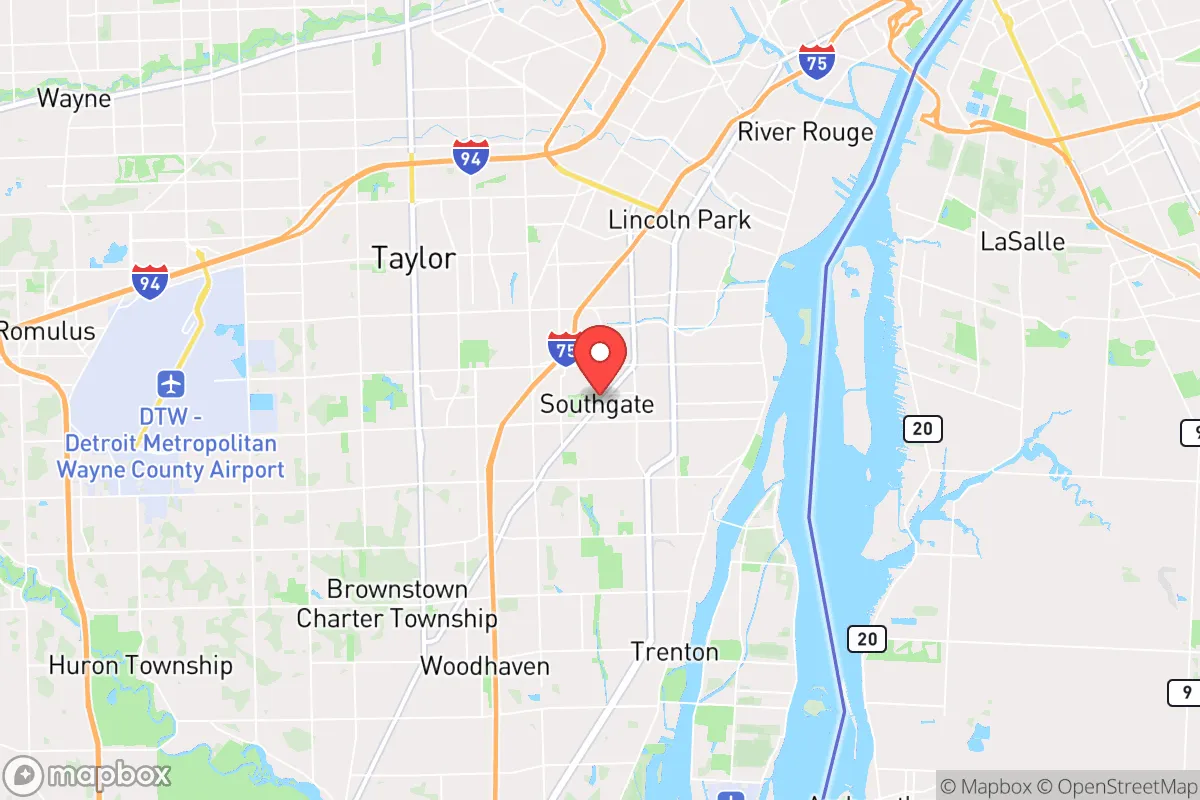
Photo: Wikipedia
Demographics of Southgate, MI
Affluence Level in Southgate, MI
A middle-class area roughly in line with national averages across income, home values, education, and employment.
People of Southgate, MI
Southgate, Michigan, is a predominantly white, working- and middle-class city of 29,551 residents, with a notably low foreign-born share of 2.8% and a college attainment rate of 21.4%. The city is characterized by its dense, older suburban housing stock, a strong sense of local identity tied to its Downriver Detroit location, and a population that is slowly diversifying, with Hispanic residents now comprising 10.7% and Black residents 8.2%. Southgate feels like a stable, family-oriented community where generational roots run deep, but where the demographic profile is beginning to shift away from its historically homogeneous European-American base.
How the city was settled and grew
Southgate’s population history is a classic story of 20th-century suburbanization, not pioneer settlement. The area was originally part of Ecorse Township, a sparsely populated farming and riverfront community. The city’s true founding population arrived in two distinct waves tied to the auto industry. The first wave, from roughly 1910 to 1930, consisted of European immigrants—primarily Polish, German, and Italian families—who moved south from Detroit’s overcrowded east side to work in the massive Ford Rouge Complex in nearby Dearborn and the Wyandotte shipyards. These families built modest bungalows and colonials in what is now the Southgate Historic District, a core neighborhood of tree-lined streets near the city’s original commercial spine on Fort Street. The second and larger wave came during the post-World War II boom, from 1945 to 1965, when returning GIs and their young families, almost entirely white and of European descent, flooded into newly built subdivisions. This era created the city’s dominant housing stock—ranches and Cape Cods in neighborhoods like Allen Park Estates (the southwest quadrant) and Beverly Hills (the northeast section near the Allen Park border). These areas were built out rapidly to house the expanding auto-worker middle class, cementing Southgate’s identity as a solidly blue-collar, union-voting suburb.
Modern era (post-1965)
After the 1965 Hart-Cellar Act and the subsequent white flight from Detroit in the 1970s and 1980s, Southgate experienced a period of demographic stabilization rather than dramatic change. The city did not see the rapid racial turnover that occurred in some inner-ring suburbs. Instead, it remained overwhelmingly white (still 75.1% today), but began a slow, gradual diversification. The most notable post-1965 shift has been the growth of the Hispanic population, now at 10.7%, concentrated in the city’s older, more affordable housing stock near the Fort Street corridor and in the Southgate Manor neighborhood, a mid-century apartment and small-home district south of Eureka Road. This growth has come primarily from Mexican-American families moving from Southwest Detroit and from direct migration from Texas and the Southwest. The Black population (8.2%) is more dispersed but has a visible presence in the Parkwood area, a collection of 1950s ranches near the city’s southern edge. The East/Southeast Asian community remains very small at 0.6%, while the Indian-subcontinent population (2.2%) is a newer, more affluent group, often drawn by professional jobs in the auto and healthcare sectors, and tends to settle in the newer, larger homes in the Beverly Hills section. The foreign-born share (2.8%) is low, indicating that most of Southgate’s diversity comes from domestic migration and natural growth, not international immigration.
The future
Southgate’s population is likely to continue its slow diversification, but the city is not on a trajectory toward becoming a majority-minority suburb. The white population, while still dominant, is aging, and younger families—both white and non-white—are being drawn by the city’s relatively affordable housing (median home values well below the Detroit metro average) and its safe, established neighborhoods. The Hispanic share is the fastest-growing segment and will likely approach 15-18% within a decade, solidifying the Fort Street corridor as a bicultural commercial and residential zone. The Black population is stable but not rapidly increasing, as many Black families in the region prefer more diverse suburbs like Southfield or Oak Park. The Indian-subcontinent community, though small, is a high-income, highly educated cohort that may grow modestly as professionals seek good school districts (Southgate Community Schools are rated average for the region) and larger lots. The city is not tribalizing into distinct enclaves; rather, it is experiencing a gradual, organic blending, with most neighborhoods becoming slightly more diverse over time. The biggest risk to population growth is the low college attainment rate (21.4%), which may limit the city’s ability to attract the knowledge-economy workers driving growth in other parts of metro Detroit.
For a conservative-leaning individual or family moving in now, Southgate represents a stable, affordable, and still predominantly traditional community. It is not a rapidly changing or culturally fragmented place, but it is becoming more Hispanic and slightly more diverse in a measured, neighborly way. The city’s future is one of modest demographic evolution within a framework of enduring working-class identity—a place where the old Polish and German names on mailboxes are gradually joined by new ones, but the character of the community remains recognizably Southgate.

* Values derived from national, state, county, city and local statistics and may differ in a specific area. Last updated: 2026-04-30T02:53:12.000Z
Narrative content on this page is AI-generated and may contain mistakes. Verify any details that matter before acting on them.
ReloMaps may earn a commission from affiliate links at no extra cost to you.

