Photo: Wikipedia
Demographics of Sparks, NV
Affluence Level in Sparks, NV
A middle-class area roughly in line with national averages across income, home values, education, and employment.
People of Sparks, NV
The people of Sparks, Nevada, today form a working- and middle-class community of 109,106 that is notably younger and more ethnically diverse than the national average. The city’s character is shaped by a strong Hispanic plurality (32.6%), a white majority that has shrunk to 54.4%, and small but established East/Southeast Asian (4.6%) and Black (2.0%) populations. With a foreign-born share of just 7.8%—well below Nevada’s 19%—Sparks is a predominantly native-born city where family roots often trace back to the railroad, warehousing, and casino-service economy of the greater Reno-Sparks area.
How the city was settled and grew
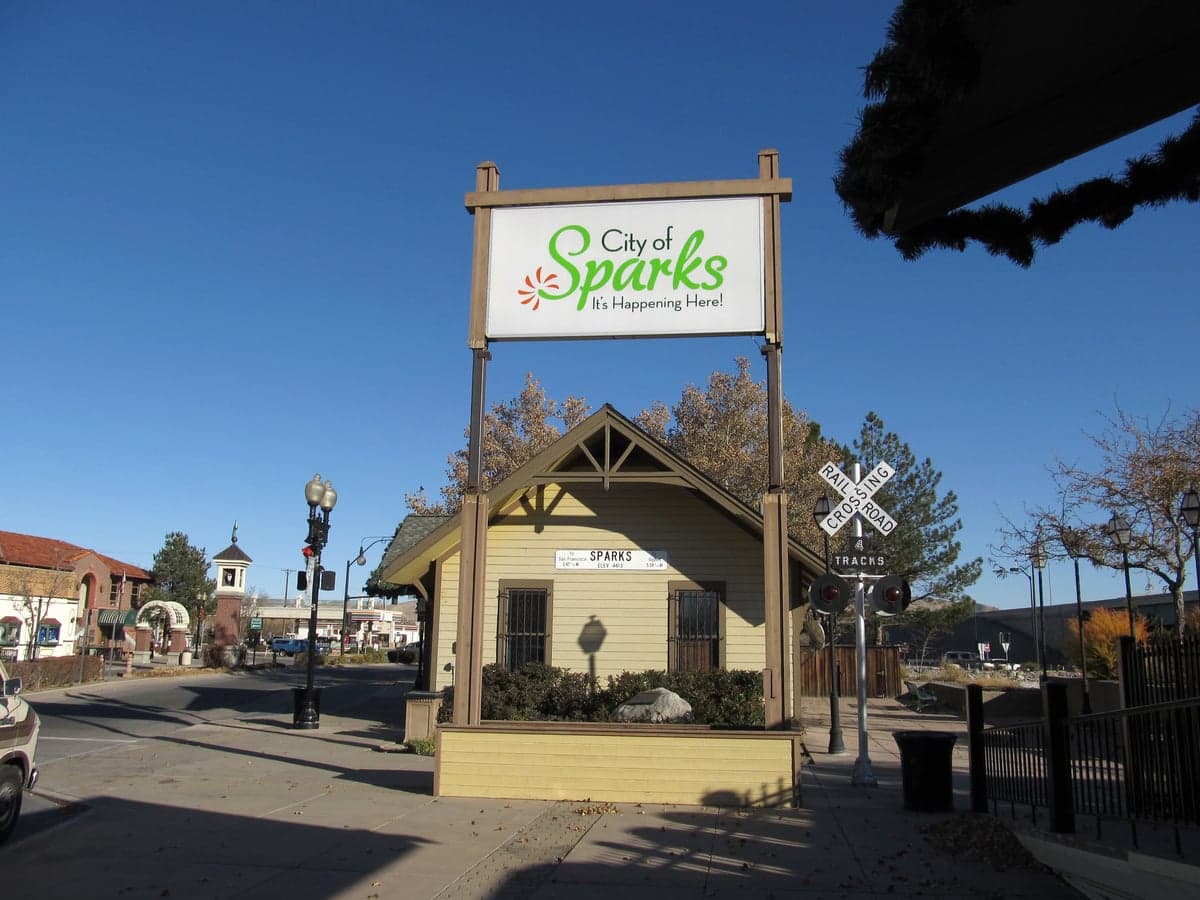
Sparks was born not from a pioneer trail but from a railroad junction. In 1904, the Southern Pacific Railroad moved its locomotive repair shops from Wadsworth to a new site east of Reno, laying out a company town named after Nevada governor John Sparks. The original population was overwhelmingly white, native-born, and male—railroad mechanics, boilermakers, and their families who lived in company-built housing near the tracks in what is now the Historic Downtown Sparks district. By the 1910s, a small Chinese community that had worked on the transcontinental railroad settled in the Glendale Avenue corridor, forming the city’s first non-white enclave. The 1920s and 1930s brought Dust Bowl migrants from Oklahoma and Arkansas, who built modest homes in the Veterans’ Park neighborhood and found work at the rail yards or the new warehouses along the Truckee River. Sparks remained a compact, blue-collar railroad town of roughly 8,000 people through World War II.
Modern era (post-1965)
The 1965 Hart-Cellar Act had a modest direct effect on Sparks—the city’s foreign-born share never exceeded 10%—but the broader suburbanization of the Reno-Sparks metro area reshaped the population. From the 1970s through the 1990s, white middle-class families moved into master-planned subdivisions like Spanish Springs in the north, while Hispanic families—many from California’s Central Valley and rural Mexico—settled in the older, more affordable Oddie Boulevard corridor and the Rock Boulevard area near the industrial parks. The East/Southeast Asian population, primarily Filipino and Vietnamese, grew during the 1980s and 1990s as casino and hospitality jobs expanded; these families concentrated in the Prater Way district and the newer Golden Valley subdivision. By 2000, Sparks had reached 66,000 residents, with Hispanics making up 22% of the population. The 2010s saw a wave of domestic in-migration from California—families and remote workers seeking lower housing costs—who pushed into the Lakeridge and Kiley Ranch neighborhoods, accelerating the white share’s decline from 68% in 2000 to 54% today.
The future
Demographic projections suggest Sparks is slowly homogenizing into a majority-minority city rather than tribalizing into distinct ethnic enclaves. The Hispanic share is expected to rise past 40% by 2035, driven by natural increase and continued domestic migration from California, while the white share will likely fall below 50% within a decade. The East/Southeast Asian and Black populations are growing at a slower pace—roughly 0.3% annually—and are assimilating into mixed-income neighborhoods like Spanish Springs rather than forming new ethnic clusters. The Indian-subcontinent population (0.5%) remains tiny and is concentrated among tech and healthcare professionals commuting to Reno’s midtown. The foreign-born share is projected to stay below 10% as most growth comes from U.S.-born children of existing residents. Sparks is not becoming a gateway city for new immigrants; it is becoming a more Hispanic, more native-born, and slightly more educated city (college attainment is 26.3% and rising).
For someone moving to Sparks now, the city offers a stable, family-oriented environment where the old railroad-town identity is giving way to a younger, bilingual, working-class character. The population is not fragmenting into isolated enclaves but is gradually blending into a Hispanic-plurality community with a strong native-born core. New residents—especially families—will find a city where the cost of living is still below California’s, the schools are improving, and the demographic trend points toward a more integrated, less segregated future than many Western suburbs.

* Values derived from national, state, county, city and local statistics and may differ in a specific area. Last updated: 2026-04-23T04:11:06.000Z
Narrative content on this page is AI-generated and may contain mistakes. Verify any details that matter before acting on them.
ReloMaps may earn a commission from affiliate links at no extra cost to you.

