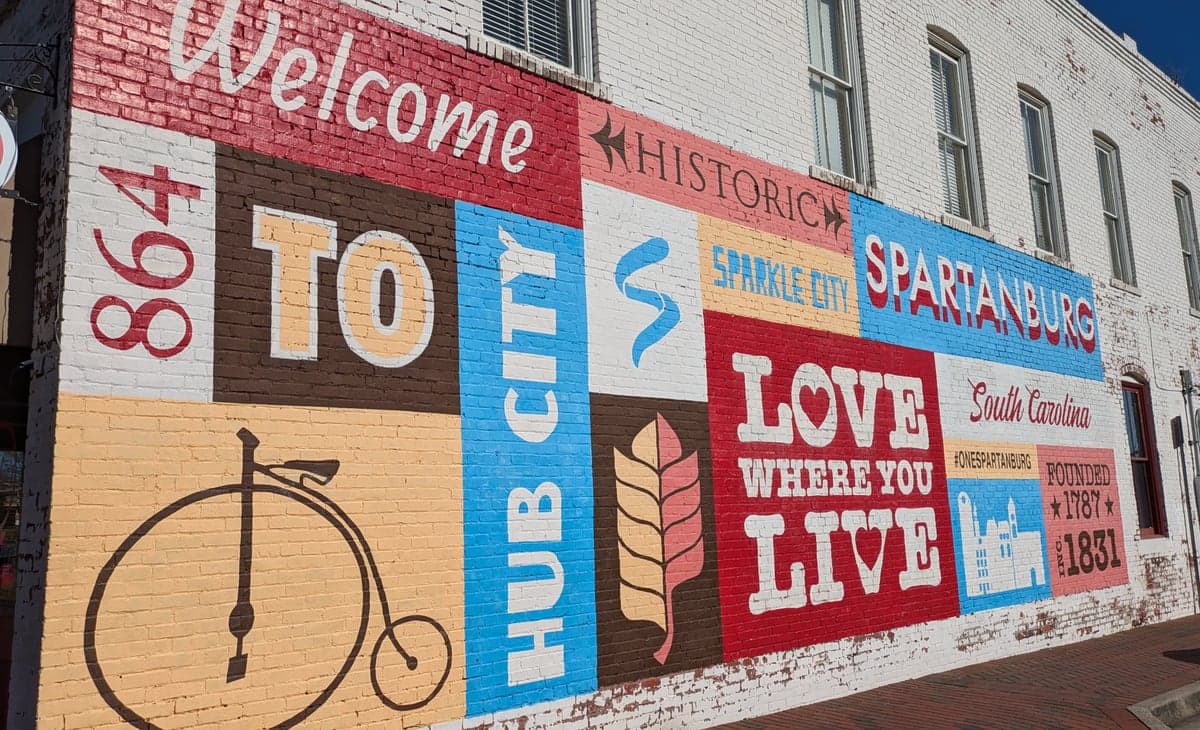
Photo: Wikipedia
Demographics of Spartanburg, SC
Affluence Level in Spartanburg, SC
A below-average socioeconomic profile. Incomes, home values, and educational attainment trail the U.S., with higher poverty and unemployment.
People of Spartanburg, SC
The people of Spartanburg, South Carolina today form a nearly evenly split Black and White city of 38,578 residents, with a small but growing Hispanic population (6.6%) and a notably low foreign-born share of just 2.6%. The city is denser and more diverse than its surrounding county, yet retains a distinctly Southern character shaped by textile mills, railroad expansion, and the post-industrial transition to healthcare and manufacturing. A third of adults hold a college degree, reflecting the pull of the University of South Carolina Upstate and the medical sector, while the city's historic neighborhoods still trace the settlement patterns of the 19th and 20th centuries.
How the city was settled and grew
Spartanburg's population history begins with European settlers moving into the Piedmont after the Cherokee were forced out in the 1770s. The city itself was founded in 1787 as a courthouse town, but its real growth came with the railroad in the 1850s and the subsequent textile boom. The original white settlers—mostly Scots-Irish and English farmers—established the Converse Heights and Hampton Heights neighborhoods, the latter being the city's first planned suburb, built for mill owners and merchants in the late 1800s. The textile mills that drove Spartanburg's economy from the 1880s through the 1920s drew a second wave: rural white families from the surrounding Upstate who moved into mill villages like Beaumont and Glendale, company-owned housing clusters that still exist as distinct neighborhoods. Black residents, who had been present since the city's founding as enslaved laborers, began forming their own communities after the Civil War, most notably in the Southside and Highland neighborhoods, where churches, schools, and small businesses anchored a separate but parallel civic life. By 1950, Spartanburg was roughly 70% White and 30% Black, with virtually no other groups present.
Modern era (post-1965)
The post-1965 period reshaped Spartanburg's demographics through two main forces: suburbanization and the decline of textiles. White families began moving to newer subdivisions in the western and northern edges of the city and into unincorporated areas like Roebuck and Boiling Springs, leaving older neighborhoods like Hampton Heights and the Northside to become predominantly Black. The 1970s and 1980s saw the mill closures that devastated the white working-class mill villages, while Black residents in the Southside and Highland faced disinvestment and redlining. The city's Black population share rose from about 30% in 1960 to 42% by 2020, not because of new Black in-migration but because of White flight to the suburbs. The Hispanic population, now 6.6%, began arriving in the 1990s, drawn by construction and service jobs; they settled mainly in the Northside and along the Asheville Highway corridor, though no single Hispanic-majority neighborhood has formed. The East/Southeast Asian community (1.0%) and Indian-subcontinent community (0.9%) are small and dispersed, with no ethnic enclave, largely tied to professional jobs at BMW (which opened its first U.S. plant in Spartanburg County in 1994) and the medical sector. The foreign-born share remains very low at 2.6%, far below the national average of 13.7%, meaning Spartanburg is not a traditional immigrant gateway.
The future
Spartanburg's population is heading toward a slow, modest diversification rather than rapid change. The White share has stabilized after decades of decline, while the Hispanic share is growing steadily from a small base—likely reaching 10-12% by 2040 if current trends hold. The Black share is plateauing near 42%, as younger Black residents increasingly move to the suburbs or to larger metros like Charlotte and Atlanta. The city is not tribalizing into distinct ethnic enclaves; instead, it is experiencing a mild homogenization of its older neighborhoods as new development targets the downtown core and the Northside redevelopment area, which is drawing a mix of young professionals and retirees regardless of race. The Indian and East/Southeast Asian communities are likely to grow slowly, tied to BMW's supply chain and the expanding health system, but will remain small. The biggest demographic risk is not fragmentation but stagnation: Spartanburg's population has grown only 3% since 2010, and without stronger immigration or domestic in-migration, the city could see its share of young adults shrink as the college-educated leave for larger job markets.
For someone moving to Spartanburg now, the city offers a racially balanced, moderately educated population in a region that is slowly diversifying but remains overwhelmingly native-born and Southern in character. The neighborhoods that defined the city's past—Converse Heights, Hampton Heights, the Southside, the Northside—still shape its present, but the future belongs to the downtown core and the redeveloping Northside, where the city's next demographic chapter will be written.

* Values derived from national, state, county, city and local statistics and may differ in a specific area. Last updated: 2026-04-30T02:03:59.000Z
Narrative content on this page is AI-generated and may contain mistakes. Verify any details that matter before acting on them.
ReloMaps may earn a commission from affiliate links at no extra cost to you.

