
Photo: Wikipedia
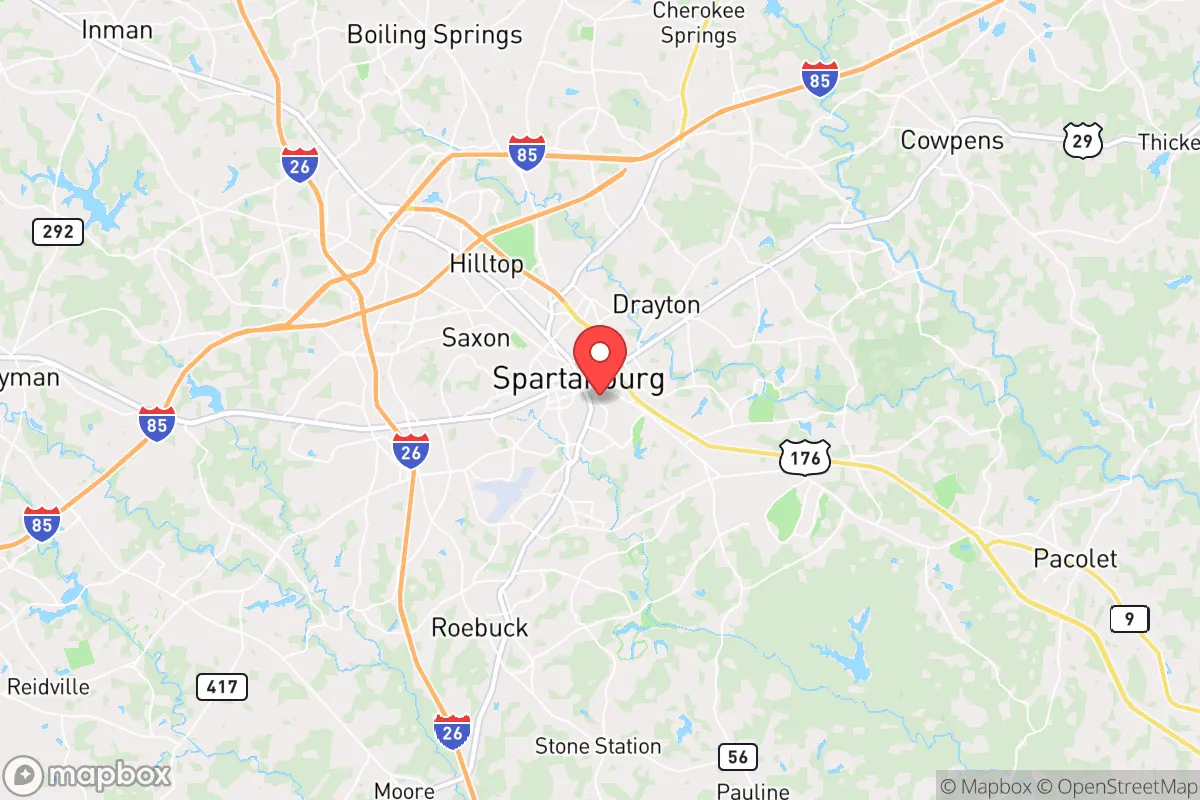
Strategic Assessment of Spartanburg, SC
Meaningful friction. Expect exposure to either population pressure, blast zones, or natural disaster risk. Consider buying a retreat property.
What does the Strategic Assessment tell us?
Our Strategic Assessment grades tactical survivability of an area. Major population centers, military targets, fallout zones, natural disasters, and border exposure all drive risk — lower exposure means a more defensible position in a crisis.
This is heavily inspired by Joel Skousen's Strategic Relocation book. Highly recommended you checkout the book ($)What does this tell us?
Our Strategic Assessment grades tactical survivability of an area. Major population centers, military targets, fallout zones, natural disasters, and border exposure all drive risk — lower exposure means a more defensible position in a crisis.
This is heavily inspired by Joel Skousen's Strategic Relocation book. Highly recommended you checkout the book ($)Strategic Pillars

Key Distances
Regional Safe Places
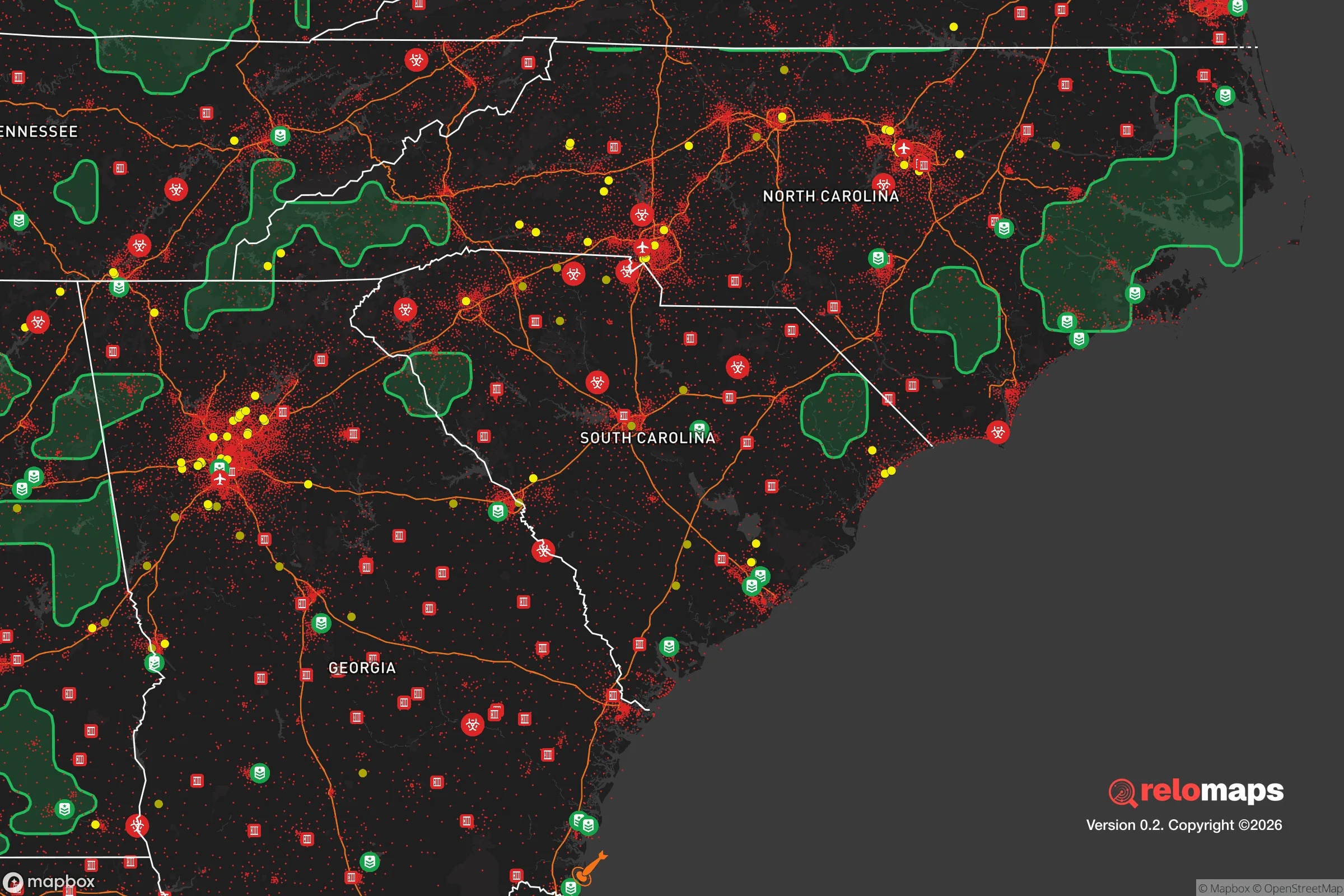
Below is our recommended "safe zones" in South Carolina and the surrounding area based on our strategic heuristics. For most people, it's unrealistic to live in a “safe zone” full-time due to work, family or other personal reasons. They tend to be more rural. However, many of these areas are perfect for second homes and retreat properties that double as a vacation home or even a short-term rental.
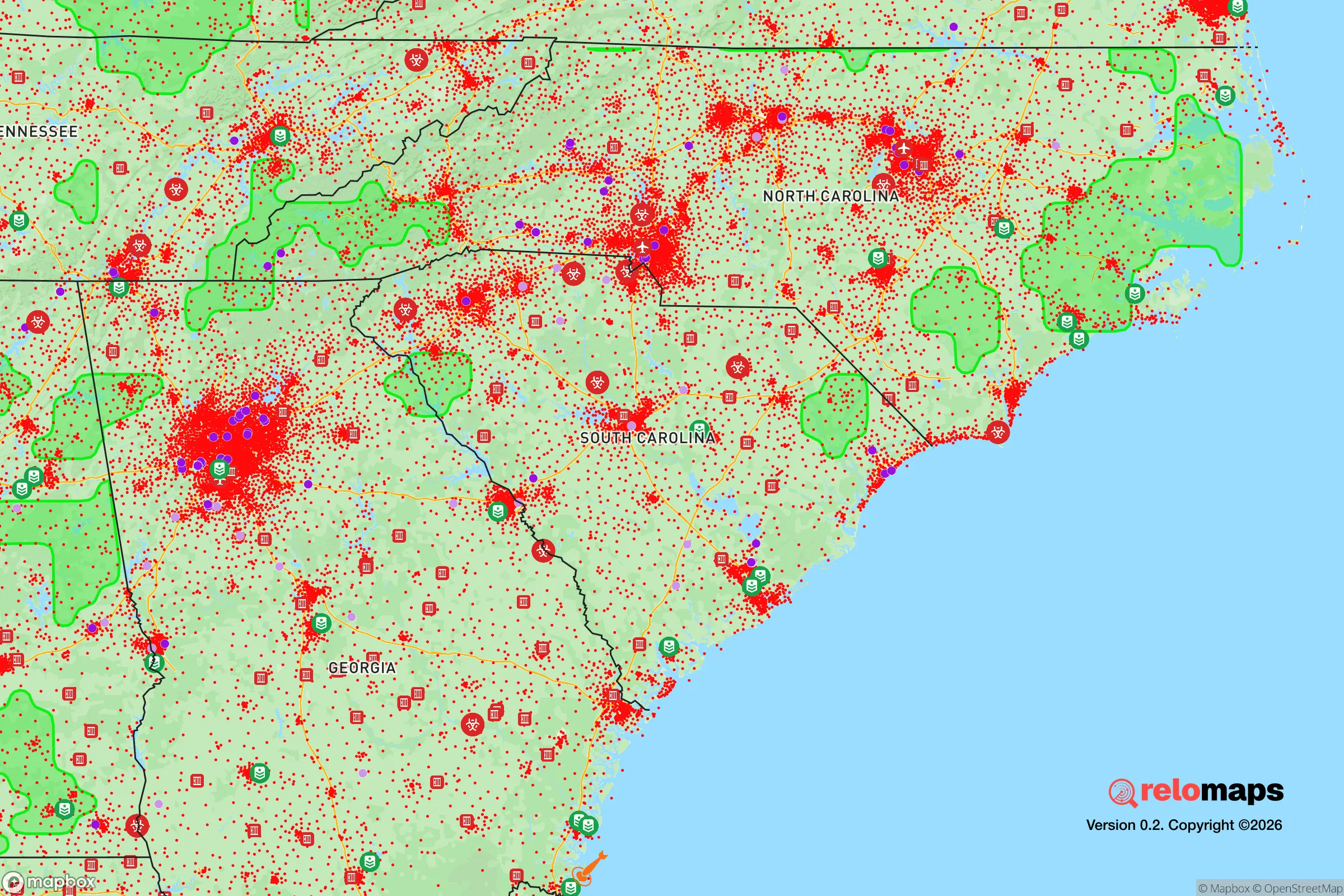


Important Note: For informational purposes only. This does not mean nothing bad ever happens in the green zones. Please use common sense. This is based on public data and modeled with AI. We tried to take a conservative approach but mistakes happen. We update this regularly as new information becomes available.
Solar Generator Recommendations
Backup power matters more here than in safer locations. We've picked three solar generators across budgets and capacity tiers — start with the budget unit if you only need a few essentials, or step up if you want to run a fridge and HVAC for days at a time.

Jackery Portable Power Station Explorer 300
Budget OptionPower on the Go: Weighing only 11 lbs, it's convenient to set up and store with book-sized foldable solar panels

BLUETTI Portable Power Station AC180
Designed for both indoor and outdoor scenarios, AC180 is highly capable as it has a robost capacity and continuous output power.

EF ECOFLOW DELTA Pro Ultra Power Station
Upgraded PickEcoFlow DELTA Pro Ultra is a whole-home energy system designed to grow with your family. Integrated with the Smart Home Panel 2, it scales to meet your evolving energy needs — keeping your home powered, intelligent, and secure through every stage of life.
We earn a commission, at no additional cost to you.
Strategic Assessment Analysis
Spartanburg, South Carolina, presents a mixed strategic picture for the conservative prepper or survivalist. Its core resilience stems from a robust manufacturing and logistics base, a growing population, and a location that balances access to resources with a buffer from the most immediate fallout zones. However, its proximity to major interstate corridors and the sprawling Charlotte-Atlanta axis introduces significant risks that must be weighed carefully. For a relocator prioritizing long-term stability, self-sufficiency, and a lower profile, Spartanburg offers genuine advantages but demands a clear-eyed assessment of its vulnerabilities.
Geographic position and natural advantages for long-term stability
Spartanburg sits in the Piedmont region of the Upstate, a geographic sweet spot that provides several natural advantages. The area is inland enough to be largely immune to hurricane storm surge and the worst coastal flooding, yet it is not so far inland that it suffers from extreme temperature swings or water scarcity. The region receives ample rainfall—averaging around 50 inches annually—which supports reliable well water and local agriculture. The terrain is rolling hills, not mountains, which offers decent defensibility without the isolation that can complicate supply runs or community building. The proximity to the Blue Ridge Mountains, about an hour to the northwest, provides a potential retreat zone if conditions deteriorate further. The area’s geology is stable, with no significant earthquake risk, and the climate is temperate enough to avoid the deep freezes that can cripple northern grids. For a prepper, this means a lower baseline risk of natural disasters and a more predictable environment for off-grid systems like solar, rainwater catchment, and food production.
Risks, exposures, and proximity to fallout-relevant landmarks
The most significant strategic downside of Spartanburg is its position along the I-85 corridor, a major artery connecting Charlotte, North Carolina, and Atlanta, Georgia. This highway is a primary evacuation route and a likely target for disruption during any large-scale crisis. In the event of a major economic collapse, civil unrest, or a mass casualty event, this corridor could become a chokepoint or a vector for displaced populations. Spartanburg itself is roughly 75 miles from Charlotte and 150 miles from Atlanta—close enough to feel the ripple effects of any major event in those cities, including potential fallout from a terrorist attack, grid failure, or social breakdown. The city is also within 200 miles of the Savannah River Site, a nuclear weapons facility, and the Port of Charleston, a high-value target. While not in the immediate blast zone, the risk of secondary effects—refugee flows, supply chain disruptions, and martial law checkpoints—is real. The presence of large manufacturing plants (BMW, Michelin, and others) also makes the area a potential target for sabotage or labor unrest, though these same facilities provide a strong economic anchor that could stabilize the region in a prolonged crisis.
Practical resilience for a relocator: food, water, energy, and defensibility
For a relocator focused on practical resilience, Spartanburg offers a mixed bag. Water is a strong point: the area sits over the Piedmont aquifer, and many rural properties can drill a well at reasonable depth. The numerous creeks and rivers, including the Tyger and Pacolet Rivers, provide surface water sources, though they require proper filtration. Food production is viable—the growing season is long (roughly 7 months), and the soil, while clay-heavy, can be amended for gardens. Local farmers' markets and a growing network of small farms mean that even without full self-sufficiency, a prepper can source fresh food locally. Energy resilience is more challenging. The grid in the Upstate is aging and has experienced rolling blackouts during winter storms (like the 2022 ice storm). Solar is viable, but the region’s frequent cloud cover reduces efficiency compared to the Southwest. A backup generator with a propane or diesel supply is a near-necessity for any serious prepper. Defensibility is moderate. The rolling hills and wooded lots offer some natural cover, and the area is not so densely populated that a rural property feels exposed. However, the lack of natural barriers (mountains, rivers, or swamps) means that a determined group could approach from multiple directions. The best strategy is to choose a property on a dead-end road or in a small, tight-knit community where neighbors know each other. The local gun culture is strong, and South Carolina has favorable laws for concealed carry and stand-your-ground, which is a plus for those concerned with self-defense during unrest.
The overall strategic picture for a conservative relocator
Overall, Spartanburg is a solid B-tier relocation target for the conservative prepper. It is not a remote bunker location, nor is it a high-risk urban center. Its strengths lie in its economic stability, water availability, and moderate climate, which reduce the likelihood of a total collapse scenario. Its weaknesses are its position along a major evacuation corridor and its proximity to large population centers that could become sources of instability. For a single individual or a family willing to invest in a well, solar backup, and a defensible rural property on the outskirts of town, Spartanburg offers a realistic balance of access to jobs, healthcare, and community with a reasonable buffer from the worst-case scenarios. The key is to avoid the suburban sprawl near I-85 and instead look toward the northern or western parts of the county, closer to the mountains and further from the interstate. If you are looking for a place that is not a target, not a disaster zone, and not a ghost town, Spartanburg deserves a serious look—but only if you are prepared to be your own first responder.

* Values derived from national, state, county, city and local statistics and may differ in a specific area. Last updated: 2026-04-30T02:03:59.000Z
Narrative content on this page is AI-generated and may contain mistakes. Verify any details that matter before acting on them.
ReloMaps may earn a commission from affiliate links at no extra cost to you.

