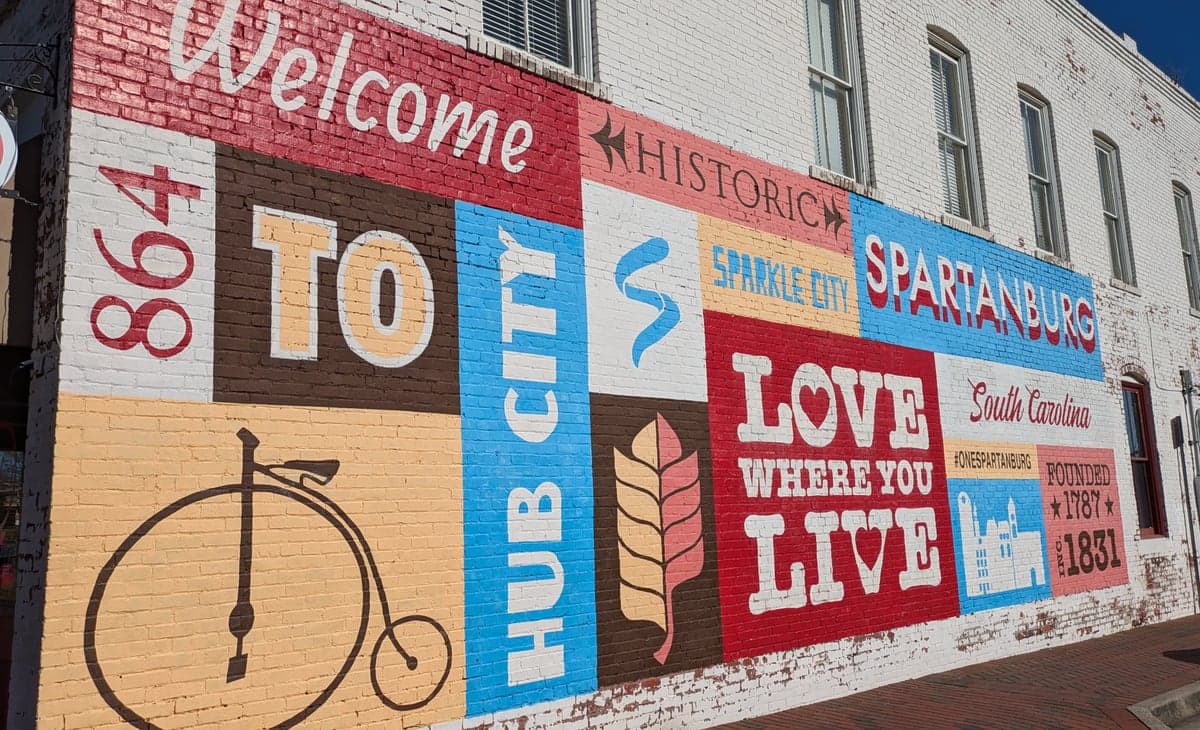
Photo: Wikipedia
Personal Sovereignty in Spartanburg, SC
Viable for self-reliance. Generally workable, though some barriers may limit total independence.
What does Personal Sovereignty tell us?
Personal Sovereignty measures your capacity for self-reliance and independence with minimal government friction. Higher scores mean fewer barriers between you and the way you want to live... but it assumes you have the space you need and good neighbors.
What does this tell us?
Personal Sovereignty measures your capacity for self-reliance and independence with minimal government friction. Higher scores mean fewer barriers between you and the way you want to live... but it assumes you have the space you need and good neighbors.
State Policy
Energy independence: Importer (25% of energy produced in-state)
Personal Liberty
Homesteading

Personal Liberty Analysis
Spartanburg, South Carolina, offers a notably high degree of personal sovereignty compared to much of the Northeast and West Coast, largely due to a state-level legal framework that prioritizes individual liberty over government mandates. For the strategic relocator—whether a single prepper or a family building a resilient life—the city sits in a state that consistently ranks among the most free in the nation, with low taxes, strong gun rights, and minimal zoning interference. However, the specific environment within Spartanburg County itself requires a nuanced look, as municipal ordinances and rapid growth from out-of-state transplants are beginning to introduce friction points that a sovereignty-minded individual must weigh carefully.
Tax burden and regulatory posture: How South Carolina’s low-tax framework affects your autonomy
South Carolina’s tax structure is a clear win for personal sovereignty. There is no state tax on Social Security benefits, and the state income tax is a flat 3% as of 2026, down from a progressive rate a decade ago. Property taxes in Spartanburg County are among the lowest in the region, with an effective rate around 0.55% of assessed value—roughly half of what you’d pay in neighboring North Carolina. For a prepper or homesteader, this means less of your labor is seized to fund state programs you may not support. The regulatory posture at the county level is generally permissive: there are no county-wide building codes for agricultural structures, and the health department’s well and septic permitting process is straightforward for rural parcels. The main friction point is the city of Spartanburg itself, which has adopted stricter stormwater and tree-removal ordinances than the unincorporated county. If you value maximum autonomy, buying land in the unincorporated areas of the county—especially north of I-85 toward the Tyger River—is the smarter play, as you avoid city-level overreach entirely.
Self-defense and gun law specifics: What the Second Sanctuary status means for your rights
South Carolina is a “Second Amendment Sanctuary” state in spirit and law, and Spartanburg County’s sheriff has publicly affirmed he will not enforce federal overreach on firearms. The state operates under a constitutional carry law (permitless carry) for anyone 18 or older who can legally possess a firearm, enacted in 2021 and fully in effect. There is no state-level red flag law, no magazine capacity limit, and no firearm registration. The Stand Your Ground statute is robust—you have no duty to retreat in any place you are lawfully present. For the survivalist, this means you can keep a rifle in your truck, carry concealed without a permit, and defend your home or property without fear of prosecution for using deadly force against a threat. The only notable restriction is that open carry is legal but requires a permit for handguns in vehicles—a minor bureaucratic hurdle. Spartanburg County’s gun culture is strong, with multiple private ranges and the Spartanburg Gun Club offering long-range facilities. If you’re coming from a state like New York, California, or Illinois, this is a night-and-day difference in personal sovereignty—you are trusted as a responsible adult, not treated as a potential criminal.
Self-reliance and homesteading viability: Lot sizes, zoning, and off-grid feasibility in Spartanburg County
For the prepper or homesteader, Spartanburg County offers a mixed but generally favorable landscape. In unincorporated areas, the minimum lot size for a single-family home with a septic system is typically one acre, though many rural parcels are sold in 2-to-5-acre tracts. Zoning is minimal: there are no county-wide restrictions on keeping chickens, goats, or even a few head of cattle on residential acreage, provided you meet basic setback requirements. Off-grid feasibility is high: South Carolina has no state law prohibiting rainwater collection, and solar panel installation is not subject to HOA-style restrictions in unincorporated areas. The main challenge is that Spartanburg County does require a building permit for any permanent structure, and the county inspects electrical and plumbing work. However, owner-builder permits are available, meaning you can act as your own general contractor and do the work yourself—a significant win for self-reliance. The biggest threat to homesteading autonomy is the rapid suburbanization along the I-85 corridor. New subdivisions are popping up with HOAs that ban livestock, limit solar panels, and require manicured lawns. If you want true self-reliance, avoid any property with an HOA and aim for parcels at least 5 acres in size—this gives you buffer from neighbors who might complain about a chicken coop or a wood-fired boiler.
Personal liberties: Parental rights, medical autonomy, speech, and property protections
South Carolina has a strong track record on parental rights. The state’s “Parents’ Bill of Rights” (enacted in 2023) gives parents explicit authority over their children’s education, medical decisions, and religious upbringing. School districts in Spartanburg County, including Spartanburg District 1 (the most rural and conservative), have resisted federal overreach on curriculum and health mandates. Medical autonomy is more nuanced: the state did not impose broad vaccine mandates during the pandemic, and there is no state-level requirement for children to be vaccinated to attend public school (though individual districts may have policies). The biggest win for medical sovereignty is that South Carolina has no certificate-of-need laws for most medical equipment, meaning you can buy your own defibrillator, oxygen concentrator, or even certain prescription devices without government permission. Free speech is robust—there are no hate speech laws, and the state has preempted local governments from enacting their own speech restrictions. Property rights are protected by a strong eminent domain statute that requires “public use” (not just “public benefit”), and the state has a right-to-farm law that shields agricultural operations from nuisance lawsuits—critical if you plan to raise animals or run a small farm. The only real concern is that Spartanburg County has seen a rise in code enforcement complaints from new residents who don’t appreciate the “rural aesthetic” of a property with stored equipment or unmanicured land. If you value maximum property autonomy, consider buying in a county like Union or Cherokee just to the east, where enforcement is even more lax.
Overall, Spartanburg offers a solid B+ for personal sovereignty when compared to the national landscape. It is far freer than any major metro area on the coasts, but it is not the libertarian paradise that rural Idaho or Montana might offer. The state-level framework is excellent—low taxes, strong gun rights, parental control, and minimal zoning—but the county’s rapid growth is introducing suburban pressures that erode autonomy over time. For the single prepper or family looking to build a resilient, self-reliant life without constant government interference, Spartanburg County’s unincorporated areas are a strong choice. Just be prepared to buy land with acreage, avoid HOAs like the plague, and keep an eye on local elections to ensure the county commission remains committed to limited government. If you do that, you’ll find a place where you can live largely on your own terms, with the law on your side.

* Values derived from national, state, county, city and local statistics and may differ in a specific area. Last updated: 2026-04-30T02:03:59.000Z
Narrative content on this page is AI-generated and may contain mistakes. Verify any details that matter before acting on them.
ReloMaps may earn a commission from affiliate links at no extra cost to you.

