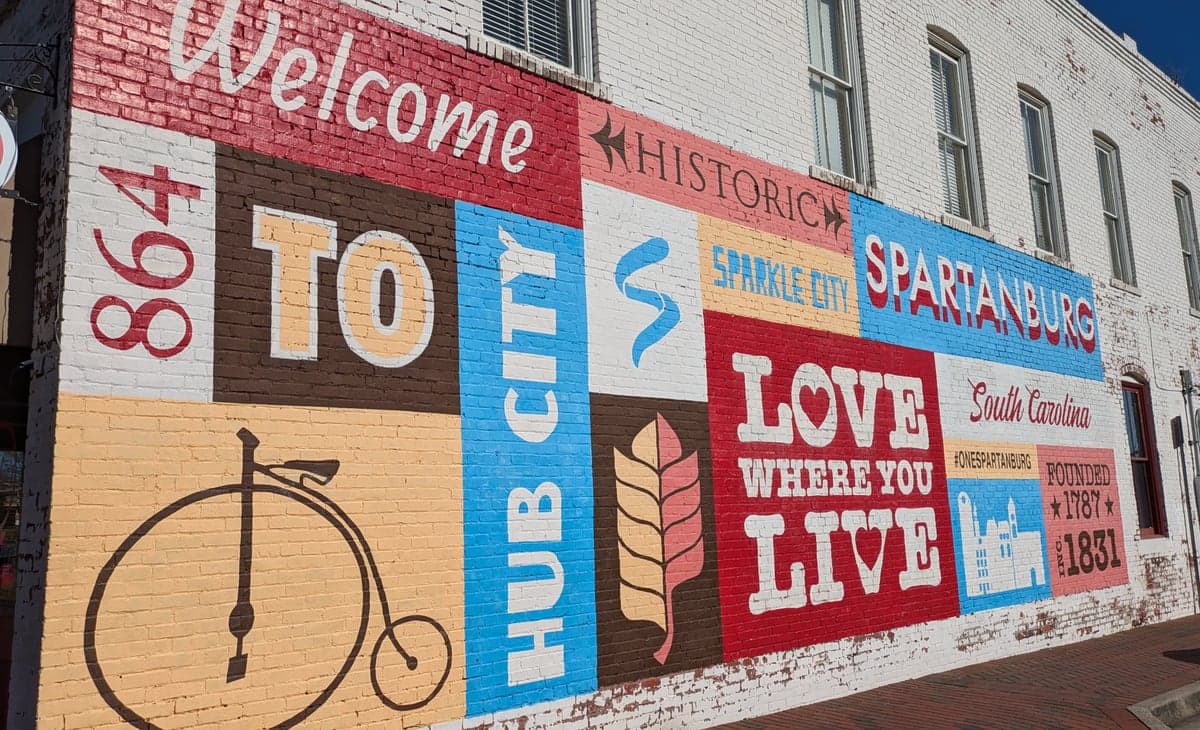
Photo: Wikipedia
Political ClimatePolitical Climate in Spartanburg, SC
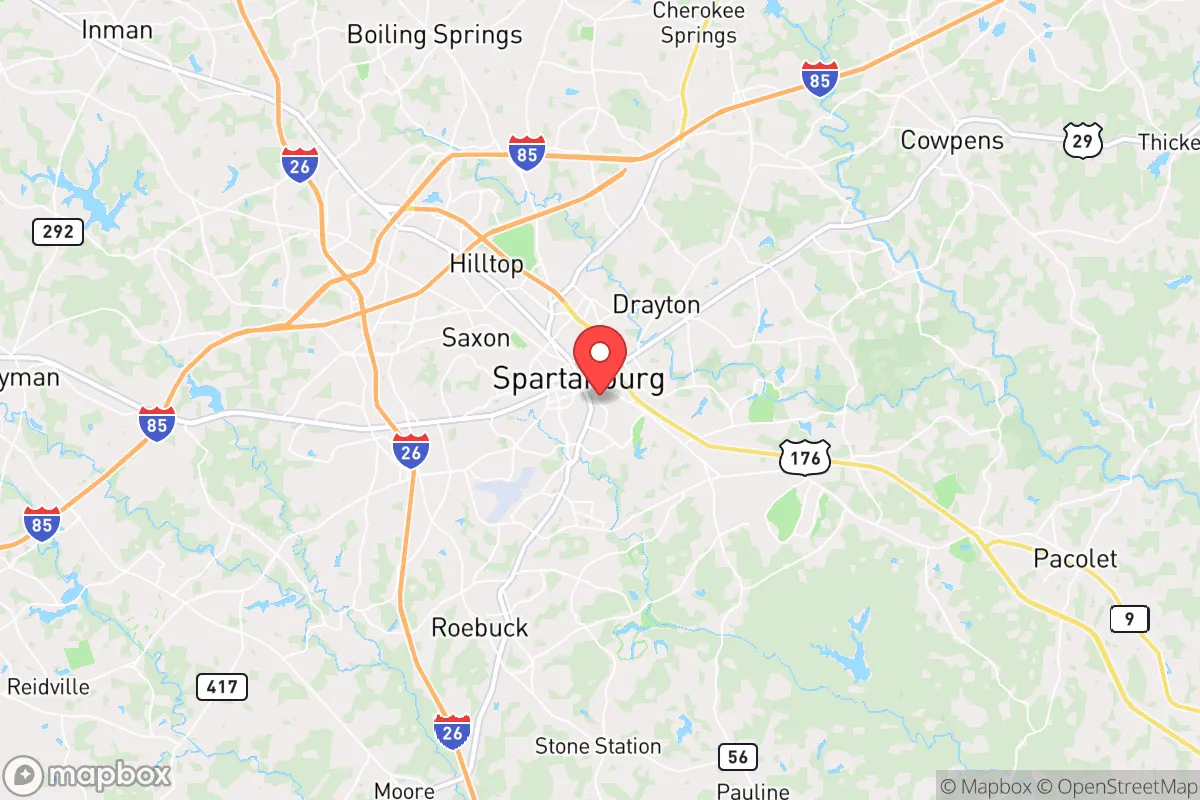
District shown is the primary district for this city’s centroid. Cities may span multiple districts.
Local Political AnalysisPolitical Analysis of Spartanburg, SC
Spartanburg has long been a reliably conservative area, and that hasn't changed much overall. The Cook PVI rating of R+11 tells you the math: Republicans hold a solid 11-point advantage over the national average in partisan voting. But if you've lived here as long as I have, you know the story is a little more complicated than just a number. The city itself has seen some demographic and cultural shifts in the last decade, with younger professionals and some transplants from bluer states moving in, which has nudged the local political conversation. Still, the county and the surrounding Upstate region remain deeply red, and the core values of limited government and personal responsibility are still the bedrock of most folks' thinking around here.
How it compares
If you drive just 30 minutes east to Greenville, you'll find a similar conservative lean, but with a much more polished, corporate-friendly vibe. Greenville's politics feel a bit more "chamber of commerce" — still conservative, but with a heavy emphasis on economic development and downtown revitalization that sometimes rubs old-school locals the wrong way. Head south to Union or west to Laurens, and you're in deep, unapologetic red territory where the idea of government overreach into things like land use, school curriculum, or business operations is met with serious skepticism. Spartanburg sits in a sweet spot: it's conservative enough that you don't feel like an outsider for flying a Gadsden flag, but it's also got enough industry and growth that you're not stuck in a cultural time warp. The contrast is sharpest if you go north to Asheville, North Carolina — that's a whole different world, and most folks here see it as a cautionary tale of what happens when progressive ideology takes over a once-practical mountain town.
What this means for residents
For the average person living here, the political climate means you can generally go about your business without a lot of government interference. Taxes are relatively low, zoning is loose, and the local school board isn't pushing radical social experiments on your kids — at least not yet. There's a strong sense that your property rights matter, and that you should be free to run your small business, keep your firearms, and raise your family without some bureaucrat in Columbia or Washington telling you how to do it. That said, there are warning signs. The city council has flirted with some progressive pet projects — bike lanes that nobody uses, diversity initiatives that sound good on paper but create division, and a few zoning changes that could invite more state control down the road. The long-term concern is that as Spartanburg grows, it might attract the same kind of activist energy that has turned other Southern cities into high-tax, low-freedom zones. For now, though, the culture here still rewards hard work and common sense over virtue signaling.
One thing that sets Spartanburg apart from some of its neighbors is the strong presence of the military and manufacturing sectors. The local economy is anchored by BMW, Michelin, and the South Carolina National Guard, which means there's a built-in respect for discipline, hierarchy, and national sovereignty. You don't see a lot of "defund the police" bumper stickers around here. The policy distinctions are subtle but real: the county commission has consistently pushed back against state-level mandates on everything from mask requirements to property tax hikes, and there's a general wariness of any proposal that sounds like it came from a think tank in D.C. or a coastal university. If you're looking for a place where you can still have a say in your own life without fighting a daily political battle, Spartanburg is a solid bet — just keep an eye on the city council meetings and vote in every local election, because the fight to keep this place free is never really over.

State Political ClimatePolitical Climate in South Carolina
State Political AnalysisPolitical Environment in the State
South Carolina has long been a reliably Republican state, but the political climate here is more layered than a simple red-state label suggests. The overall partisan lean is solidly GOP, with Republicans holding every statewide office, supermajorities in both legislative chambers, and a 9-1 advantage in the US House delegation. However, the trajectory over the past 10-20 years shows a state that is slowly shifting—not toward blue, but toward a more complex, suburban-driven conservatism that is increasingly split between traditional, low-tax, pro-business Republicans and a newer, more populist, culturally-focused wing. The dominant coalition remains conservative, but the internal tensions are real, and any newcomer needs to understand the fault lines.
Urban vs. rural divide
The political map of South Carolina is a classic story of three distinct regions. The rural Lowcountry and Pee Dee regions are deep red, with counties like Bamberg, Allendale, and Marlboro voting Republican by margins of 30-40 points in 2024. These areas are driven by agriculture, manufacturing, and a strong sense of traditional values. The major metros tell a different story. Charleston is the state's most politically competitive city; Charleston County itself voted for Joe Biden in 2020 and has trended leftward as the tech and tourism sectors have drawn in younger, more secular transplants. Greenville and the Upstate, by contrast, remain a conservative stronghold, with Greenville County voting +18 for Trump in 2024, though the city proper is becoming more moderate as it attracts corporate relocations. Columbia, the state capital, is a mixed bag—Richland County is reliably Democratic (Biden won it by 20 points), while Lexington County, just across the river, is one of the most Republican suburban counties in the nation. The real story is the suburban ring around these metros: places like Mount Pleasant (east of Charleston), Fort Mill (north of Charlotte), and Simpsonville (south of Greenville) are where the political future is being fought. These areas are growing fast, and they tend to vote Republican, but with a more educated, fiscally-conservative, socially-moderate tilt that sometimes clashes with the rural base.
Policy environment
South Carolina's policy environment is generally friendly to conservative priorities, but with some notable wrinkles. The state has a flat income tax rate of 6.2% (down from 7% in 2022, with a scheduled phase-down to 5.99% by 2026), and no state property tax on vehicles or business inventory. Sales tax is 6% statewide, but local add-ons can push it to 9% in places like Charleston. The regulatory posture is light—South Carolina is a right-to-work state with no state-level OSHA plan, and the permitting process for new businesses is among the fastest in the Southeast. On education, the state has a robust school choice program, including the Education Scholarship Trust Fund (vouchers for low-income families) and a growing charter school sector, though teacher pay remains below the national average. Healthcare is a mixed bag: the state did not expand Medicaid under the ACA, and the uninsured rate hovers around 10%, but there is a strong network of rural hospitals and a growing telehealth infrastructure. Election laws are strict—voter ID is required, early voting was expanded to two weeks in 2022, but absentee voting requires an excuse. The state also passed a 6-week abortion ban in 2023, with no exceptions for rape or incest, which has become a major flashpoint.
Trajectory & freedom
On the freedom front, South Carolina has been moving in a decidedly more conservative direction over the past five years, but not without controversy. The biggest expansion of personal liberty came in 2021 with the Constitutional Carry Act, which allows any law-abiding adult to carry a concealed firearm without a permit. This was a major win for gun rights advocates. On parental rights, the state passed the Parents' Bill of Rights in 2023, which requires schools to notify parents of any changes to a child's mental, emotional, or physical health, and prohibits instruction on sexual orientation or gender identity in K-5 classrooms. This has been challenged in court but remains in effect. On the other hand, the state has tightened medical autonomy: the 2023 abortion ban is one of the strictest in the country, and there is no legal protection for medical marijuana (though a limited CBD oil program exists). Property rights are generally strong, with no statewide rent control and a relatively low property tax burden (average effective rate of 0.55%), but there have been fights over eminent domain for industrial projects, like the Volvo plant in Berkeley County. The state also passed a religious freedom restoration act in 2021, which has been used to defend faith-based adoption agencies that refuse to place children with same-sex couples. Overall, the trajectory is toward more cultural conservatism, but the tension is between those who want to expand economic freedom (lower taxes, less regulation) and those who prioritize social and cultural restrictions.
Civil unrest & political movements
South Carolina has a history of political activism that is both deep and visible. The Confederate flag removal from the Statehouse grounds in 2015, following the Charleston church shooting, was a watershed moment that still reverberates. Since then, the state has seen a rise in organized conservative activism, particularly around school boards and library content. The Moms for Liberty chapter in Lexington has been one of the most active in the nation, successfully pushing for book removals and curriculum transparency. On the left, the Indivisible movement has a strong presence in Charleston and Columbia, organizing around abortion access and voting rights. Immigration politics are less heated than in border states, but there have been flashpoints: in 2023, the state legislature passed a bill requiring local law enforcement to cooperate with ICE, and there have been protests over the detention of undocumented immigrants in Dorchester County. Election integrity remains a hot topic—the 2020 election saw no major scandals, but the state's Republican Party has pushed for stricter voter roll maintenance and signature verification. The most visible flashpoint for a new resident would be the abortion debate: clinics in Greenville and Charleston have been the sites of regular protests and counter-protests, and the issue is likely to dominate the 2026 gubernatorial race.
Projection
Looking ahead 5-10 years, South Carolina is likely to become more, not less, conservative on cultural issues, but the economic and demographic shifts could create a more divided political landscape. The state is growing fast—over 1.5 million new residents since 2010, mostly from the Northeast and Midwest—and these newcomers tend to be more moderate on social issues but still fiscally conservative. The I-85 corridor from Greenville to Spartanburg is the fastest-growing region, and it is pulling the state's center of gravity northward. This will likely lead to a more suburban, less rural Republican Party, which could create tensions over issues like school choice (rural districts fear losing funding) and property taxes (suburban homeowners want caps). The Democratic Party is unlikely to win statewide office anytime soon, but they could become more competitive in the Charleston and Columbia metro areas, especially if the national party moderates on cultural issues. The biggest wildcard is the abortion ban: if it remains in place, it could drive away some young professionals and women, but it also solidifies the GOP base. For someone moving in now, expect a state that is culturally conservative, economically dynamic, and politically stable, but with growing internal debates over how far to push cultural restrictions and how to manage rapid growth.
For a new resident, the bottom line is this: South Carolina offers a low-tax, business-friendly environment with strong gun rights and parental control over education, but you need to be comfortable with a state that is actively restricting abortion access and is deeply engaged in culture war battles. If you're a conservative looking for a place where your values are reflected in law and where the economy is booming, this is a strong choice. If you're more moderate, you'll find welcoming communities in the suburbs of Greenville or Mount Pleasant, but you'll need to accept that the state's political direction is firmly to the right. The key is to pick your county carefully—the difference between living in Lexington (deep red, family-focused) and Richland (blue-leaning, urban) is night and day. Do your homework on local school boards and city councils, because that's where the real action is.
* Values derived from national, state, county, city and local statistics and may differ in a specific area. Last updated: 2026-04-30T02:03:59.000Z
Narrative content on this page is AI-generated and may contain mistakes. Verify any details that matter before acting on them.
ReloMaps may earn a commission from affiliate links at no extra cost to you.

